


Switzerland is considered one of the richest countries in the world, yet the distribution of that wealth is increasingly unequal.
According to the World Inequality Database (WID), the richest 1 percent of the population in Switzerland owns over 31 percent of total private wealth, while the poorest half owns just 3.7 percent.
The gap appears enormous even in absolute terms: half the population has an average of 25,000 francs per capita, while the richest 1 percent possess over 21 million francs per capita.
In case you are wondering, to be counted among the richest 1 percent of people currently living in Switzerland, you’d need just under 6 million francs in assets.
More specifically, 5,915,493 francs is the magic number you would need to reach in net worth to be considered a member of the country’s top 1 percent.
Who belongs to that 1-percent group?
The same research indicates that foreigners are overrepresented at the top of Switzerland’s wealth ladder.
Billionaires in two highest spots in Switzerland are both foreigners.
As The Local reported, German national, 88-year-old Klaus-Michael Kühne, is the majority shareholder of the Schwyz-based transport logistics giant Kuehne + Nagel. His wealth is estimated at 41 billion francs.
Next is Italian national Gianluigi Aponte, 85, the founder, owner and chairman of Mediterranean Shipping Company. He and his wife, Rafaela Aponte-Diamant, 81, are worth 30 billion francs.
And then there are the ultra-rich Norwegian citizens who moved to Switzerland to avoid paying increased taxes on the wealth in their native country.
READ ALSO: Why do rich Norwegians flee to Switzerland?
Advertisement
But back to the uneven wealth distribution in Switzerland
The Federal Statistical Office (FSO) provide further figures on income and wealth disparity.
It found that “10 percent of people living in Switzerland have an equivalised disposable income (the total income of a household, after tax and other deductions) that is less than 26,086 francs per year. At the other end of the scale, 10 percent of people living in Switzerland have an equivalised disposable income that is greater than 95,510 francs per year. The median shows that half of people living in Switzerland have an equivalised disposable income that is less than 51,973 francs per year.”
In fact, according to FSO, 8.7 percent of the population live in poverty, which is defined in Switzerland at 2,279 francs per month on average for a single person, and 3,976 francs per month for two adults and two children.
“The risk of poverty is largely determined by family circumstances and the level of education”, FSO said.
This group is primarily made up of single-parent households, people with no education or training beyond the compulsory schooling, single people under 65 without children who live alone, as well as immigrants.
READ ALSO: How many people in wealthy Switzerland are actually at risk of poverty?
Advertisement
How does Switzerland’s inequality compare to the rest of Europe?
This answer is provided by the GINI Coefficient.
Used to measure income disparity within a given country, it varies, according to the FSO, between 0 and 100. It equals 0 in a situation of perfect equality (which doesn’t exist anywhere in Europe). At the other extreme, it equals 100 in the most unequal situations possible (this is also not seen in Europe). The higher the Gini index, the greater the inequality.
Switzerland’s number 31.5 – higher than in Austria (28.1), Germany (29.4), and France (29.7), and equal to Italy’s (31.5).
The European average is 29.6.
Advertisement
And then there’s yet another metric
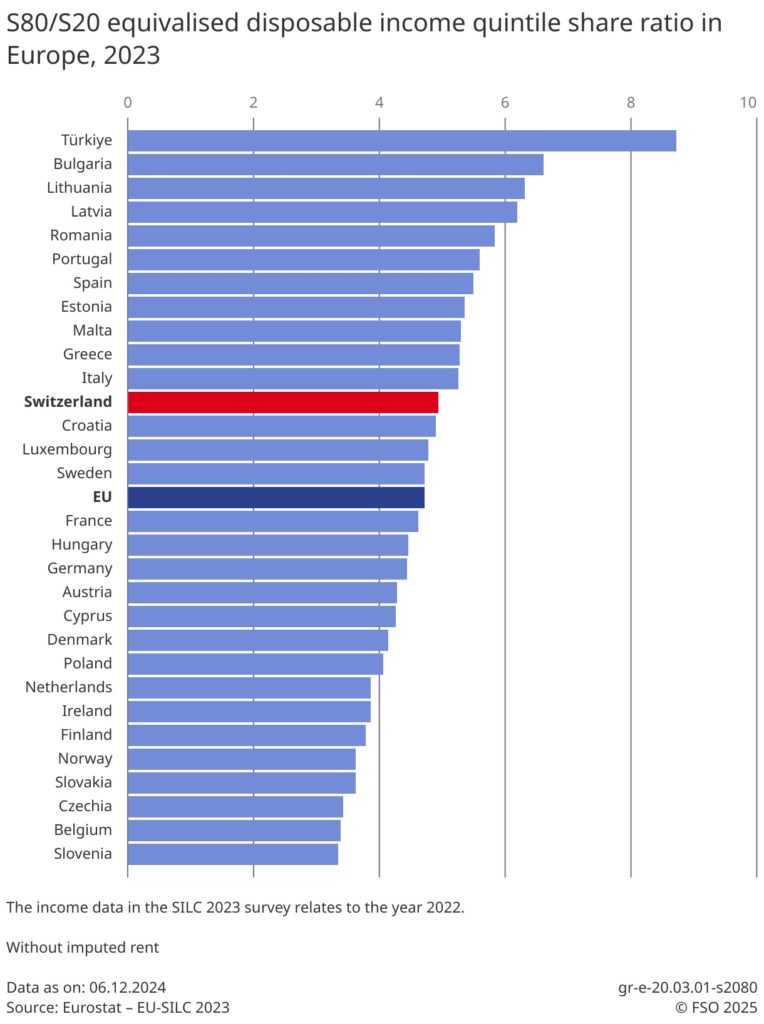
The S80/S20 ratio measures the relative inequality of the distribution of a given value, such as wages, income, and standard of living.
“For a distribution of income, S80/S20 therefore measures the ratio between the total equivalised disposable income of the richest 20 percent and that of the poorest 20 percent, “the FSO said. “The higher it is, the greater the inequality of income distribution.”
The S80/S20 for 2023 (the last year for which statistics are available) shows that in Switzerland, the total income of the richest 20 percent is 4.9 times higher than the total income of the poorest 20 percent – the reason being that the poorest countries may not have a great number of very wealthy individuals).
In Europe this average is 4.7; however, it varies greatly between countries.
And Switzerland’s S80/S20 ratio is not the highest in Europe, as this FSO chart indicates:
FSO
READ ALSO: Are people in Switzerland really the world’s richest?


