

Though it is not one of Switzerland’s national languages, English is, nevertheless, one of the main ones used in business and education. And it’s use is on the rise.
In fact, English is the most commonly used non-national language in Switzerland, becoming even more prevalent in both professional and academic life, according to the latest study carried out by the Federal Statistical Office (FSO).
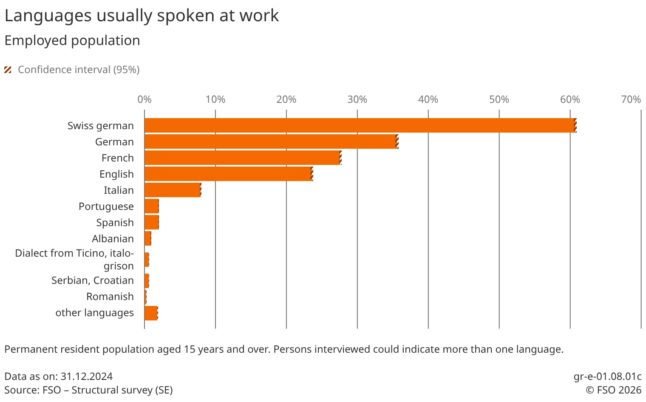
As this FSO chart shows, nearly a quarter of Switzerland’s population (23.6 percent) speak English at work.
 .
.
This translates to – 1.08 million out of the total of 4.58 million
This trend is most prevalent among executives: 49,000 out of 127,000 use English daily.
In the city of Zurich for instance, the proportion of English speakers has gone up from 9 to 14 percent in the past 10 years — an increase of 40 percent.
As The Local previously reported, “70 percent of academics and managers working in Zurich use English, as do over 50 percent of technicians and office workers.”
Overall, however, Zug has the largest proportion of English speakers – 14.1 percent of the population.
READ MORE: Where in Switzerland is English most widely used?
Advertisement
What about universities?
In many higher-education institutions in Switzerland, the use of English is as common as the use of a national language.
This is the case in both federal polytechnic institutes – the ETH in Zurich and the EPFL in Lausanne.
At the ETH, though Bachelor curriculum is taught in German, “Master’s programs are almost exclusively taught in English,” the university writes on its website.
(It added, however, that “while English is widely used for research and communication, proficiency in German is recommended for integration).
The same rule applies at the EPFL as well.
Advertisement
As the FSO data reveals, English is also becoming more prevalent in other Swiss universities.
This trend is particularly clear in the German-speaking cantons: In Zug, for instance, two out of five students (40.8 percent) study at least part of their curriculum in English.
For Zurich and Basel-City, these figures are 36.5 and 35.8 percent, respectively.
In French-speaking cantons, English is the standard language for 27 percent of students in Geneva and 24.6 in Vaud (except or the EPFL, as mentioned above).
However, this doesn’t necessarily mean that a foreigner can – or should – live in Switzerland relying only on English, to the detriment of the national language of their place of residence:


