


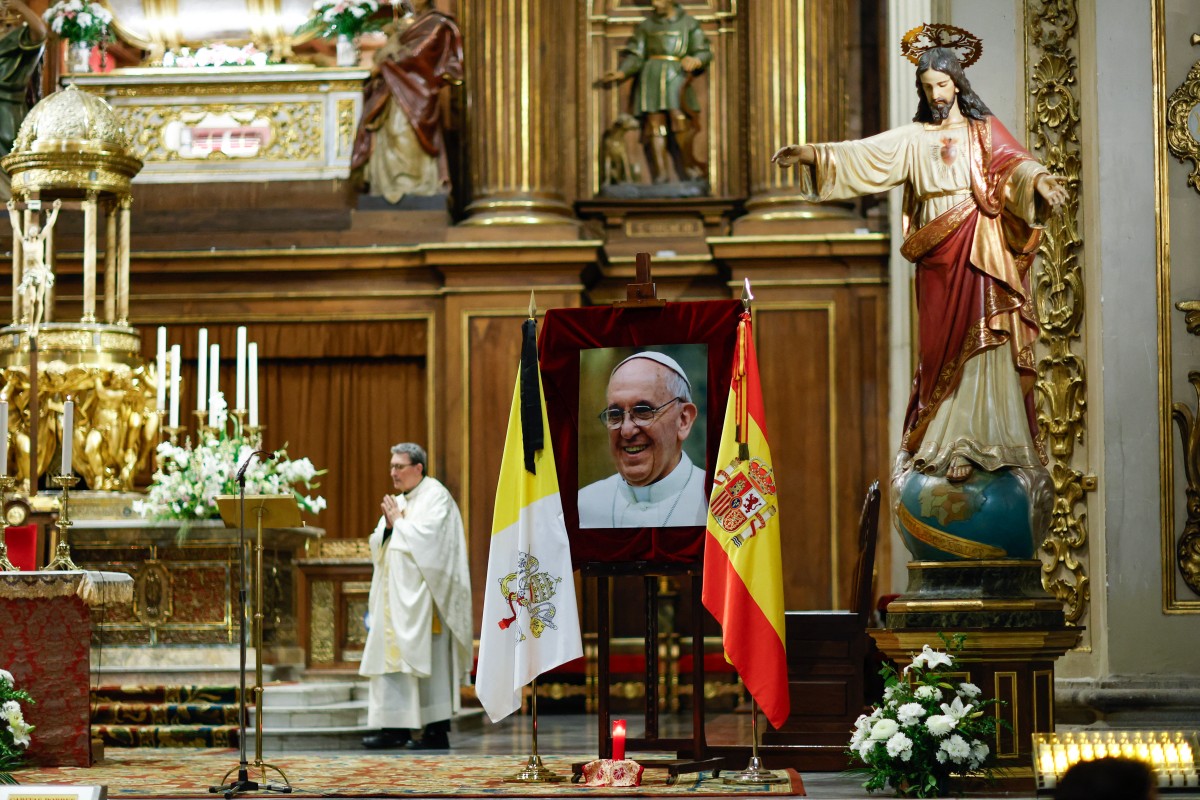
Recent Holy Week celebrations and widespread mourning for Pope Francis’ death would lead most foreigners in Spain to believe that Spaniards are deeply religious, but has the once devout country now become an example of ‘cultural Catholicism’?
Whether it be Seville’s world renowned Semana Santa celebrations, the abundance of street names named after famous Bishops and Priests, or even the occasional nun you still see walking down the street, Spain is considered one of the world’s ‘Catholic’ countries.
Or perhaps, it used to be. Over the years, Spain’s Catholicism has declined more and more. And yet, following Pope Francis’ recent death, the media frenzy in Spain, along with three days of national mourning declared by the government, has brought Catholicism front of mind again.
READ ALSO: What you need to know about Semana Santa in Seville
In very broad terms, Spain, like many countries around the world, has seen declining religiosity over time. In May 1978, 90.5 percent of Spaniards described themselves as Catholic. But by October 2021, however, that figure had fallen to 55.4 percent, according to the CIS, Spain’s sociological research centre.
Advertisement
And that’s not even mentioning that Spain is, technically speaking, a secular state. Despite being known as a Catholic country, Spain’s 1978 Constitution gave Spaniards the right to religious freedom and began unpicking Catholicism as the state religion.
However, like many other secular or non-confessional countries, the state can and does have agreements with the church, whether legally or financially. This is certainly the case in Spain, where the Catholic church still retains some privileges.
But it’s safe to say that Spain’s Catholicism has changed, and has been steadily declining for many years.
Can Spain really still be considered a Catholic country? Are Spaniards still practicing Catholics going to Mass (La Misa) or are they now more ‘cultural Catholics’?
The numbers
As stated above, in all the years that the CIS has been tracking Spaniard’s religious beliefs, the percentage of people who define themselves as Catholics has plummeted from 90.5 percent in the late-1970s to just 55.4 percent in 2021 – a fall of around 35 percent and one of the lowest figures in history, according CIS data.
The most recent data from CIS shows that 58.4 percent of people polled in 2024 declared themselves Catholic, a not insignificant increase on 2021 figures, while non-believers account for 36.1 percent.
Those who follow other religions accounted for 3.5 percent.
Breaking down the Catholicism number, 19.3 percent of those who identified as Catholic reported being practising Catholics, while 39.1 percent said they were non-practising.
Increasingly in Spain in recent decades, attendance at Mass has become something saved for special occasions.
2021 surveys asked how often Spaniards attended Mass for ‘non-social occasions’, in other words excluding baptisms, first communions, weddings, and funerals, 33.8 percent said they ‘never’ went to Mass, 19.7 percent said ‘almost never’, 21.2 percent said a ‘few times a year’, 13.1 percent said ‘every Sunday and public holiday,’ and 4.6 percent of respondents said they go ‘several times a week,’ something now that is now almost certainly a custom of the older generations in the 75+ years old category.
Looking at the 2023-24 figures for practicing Catholics, among those who self-identified as practising or ‘believers’, only 47.6 percent attended Mass at least every Sunday and on public holidays. Meanwhile, 40.2 percent said they attend between two and three times a month and several times a year.
Even 12.2 percent of practising respondents said they ‘never’ or ‘almost never’ attend religious services.
READ ALSO: GALLERY: This is how Easter was celebrated across Spain
Advertisement
Demographic breakdown
Interestingly, according to the figures it seems that the decline in Catholicism is not evenly distributed across different demographic groups. Generally speaking, Spanish women have always been more likely to identify as Catholic than men. In February 1990, the first time the CIS began logging the data by gender, 92.1 percent of women said they were Catholic, 9.7 percentage points more than men.
Overall, though, the number of Catholics is falling among both men and women. In the October 2021 survey, 50.4 percent of men said they were Catholic compared with 61 percent of women, a very similar gap to back in 1990.
However, the over decline is almost identical: the number of Spanish women who are Catholic is 31.1 percent lower than 1990, and for men the drop was 32 percent.
By age group, it has always been the case that the younger generations are less likely to be Catholic. The 18-24 age range, however, is also the demographic group with the biggest decline: from 78.1 percent in February 1990 to just 28.2 percent in October 2021, a 49.9 percent drop in 31 years.
Equally, in 1990 all age groups surveyed had over 70 percent of respondents identifying as Catholic. By 2021, the only group that remained above the 70 percent threshold was the 65+ group.
Interestingly but perhaps unsurprisingly, we can also track Catholicism by political ideology. 53.5 percent of PSOE voters, generally considered centre-left, identify as Catholic.
Just 19.2 percent of far-left Podemos voters identify as Catholic, however, whereas on the right Catholic identity has remained much stronger: 84.9 percent of PP voters and 77.0 percent of far-right Vox voters.
Advertisement
Cultural Catholicism?
So, it seems clear that over time Spain has become less and less traditionally Catholic. Less people (of all ages) describe themselves as Catholic and regularly go to Mass, while atheism and agnosticism are on the rise.
Despite the decline of formal, practicing Catholicism in Spain, many Spaniards still describe themselves as Catholic and some of Spain’s most famous festivals and tourist attractions are based on its Catholic heritage. Despite this decline in devoutness, Seville’s Semana Santa is still an enormous event, as are Holy Week festivos across the country, and Spain is generally considered a Catholic country.
How can this be?
To this writer, at least, it seems that modern Spain is a country that still maintains a strong sense of ‘cultural Catholicism’; that is to say, less and less people are believers or go to Mass but would likely still describe themselves as Catholic and adhere to the cultural traditions of being baptised, doing their first communion, confession, confirmation, and so on, and then maintain a more ‘social’ relationship with the church by attending Catholic weddings, funerals, and baptisms but little else.
If you live in Spain, you’ll likely have seen what a huge deal first communion is for a Spanish family, for example, despite it being statistically likely that nobody in the family is a practicing Catholic or perhaps even a believer – beyond the grandparents, of course.
Contradictory though this may sound, for anyone who grew up with an Irish granny or Italian nonna, the concept of a ‘Catholic atheist’ won’t sound so strange at all.


