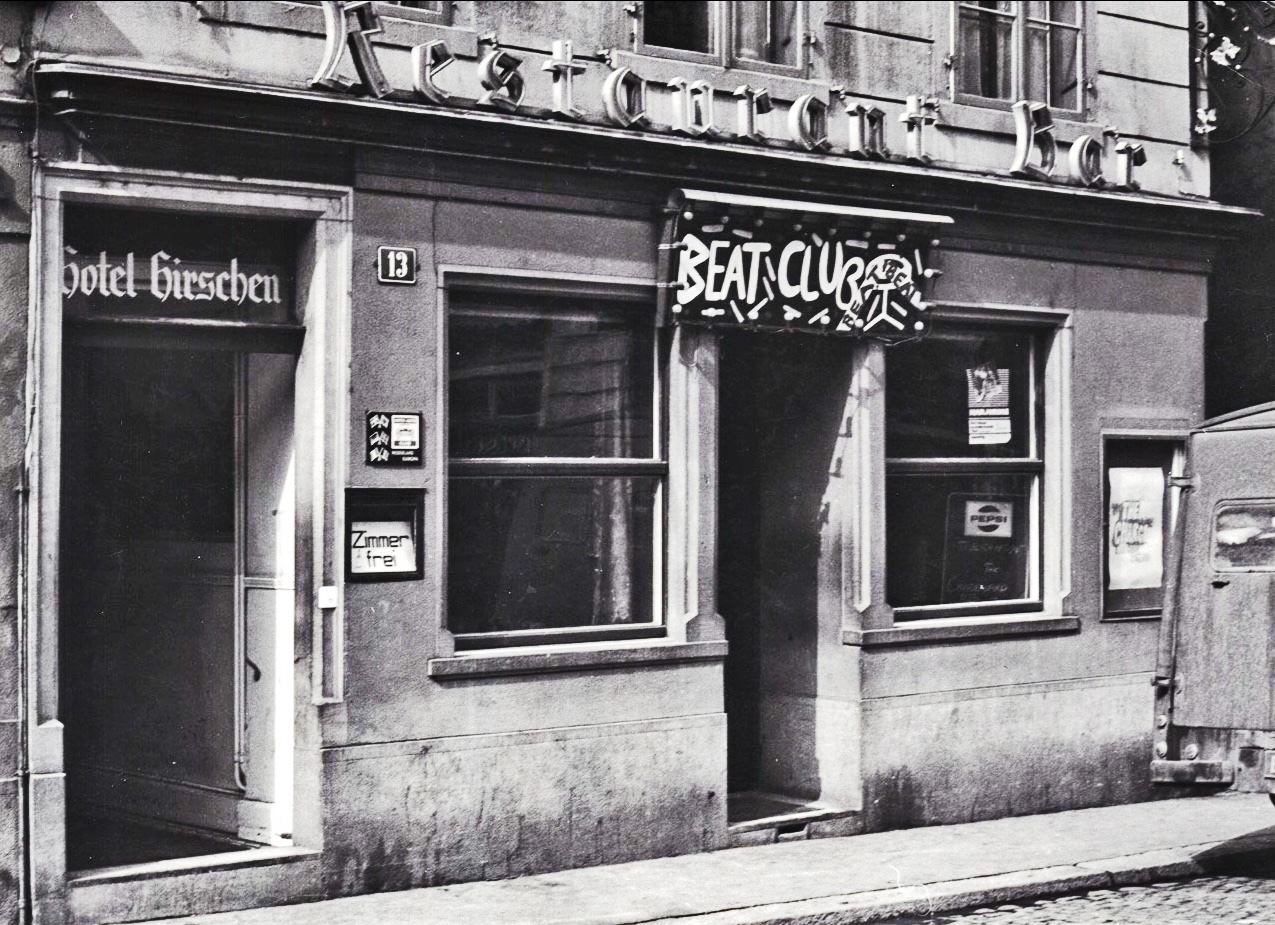
The Hirschen “Beat-Club”, circa 1970: the concert bar is on the ground floor, the hotel rooms up above.
Courtesy
In 1969, Black Sabbath spent six weeks in Zurich – a formative time for the young band, who fine-tuned their groundbreaking style in marathon sessions.
On November 11, 1969, Black Sabbath nailed down their first album in a mere 12 hours. Called Black Sabbath, the album was recorded practically live. A day later, the four young musicians were crossing the English Channel on a journey that would take them to Switzerland, where they were booked to play in Zurich.
It was November and the autumn wind was blowing leaves through the streets. In Zurich’s old town, coat-collars were up, hats were pulled down over dour faces and the smell of roasted chestnuts was announcing the approach of winter.
An island of sin in a bourgeois city
At the time, the Hotel Hirschen in Niederdorf, central Zurich, was a colourful melting pot, filled with a spirit of optimism and drunk on desire for change. It was also an outlier: an island of debauchery in a staid and bourgeois city, populated by hungover sex workers and their clients, moody pimps – and the rebellious Zurich youth of ‘69. This was where nightlife pulsated.
The seemingly clean and pure world of the Swiss bourgeoisie still prevailed in Zurich, but student unrest was bubbling. The desire for an outlet for such rebellious energy proved an ideal ground for the young British rock band’s six-week stay.
The Hirschen Club, located on the ground floor of the hotel, was also known as the “Beat Club”. It was a favourite meeting place for bands from Birmingham making their first trip abroad. Some of these bands would even arrive unannounced and queue up in the hope of landing a spot on the bill.
Rock-hard working conditions
Swiss bands stayed away from the Hirschen; the gigging conditions weren’t tolerable for them. Bands’ passports were taken from them. There was board and lodging to be paid. Musicians lived above the venue, crammed into a room. The working conditions were extremely tough.
The residence contract lasted six weeks and involved seven blocks of 45 minutes each day, starting at 3pm. This worked out at some 200 hours of stage presence per engagement – in other words, the equivalent of a week-long concert without interruption.
For years afterwards, Black Sabbath never had such a large amount of time to constantly work on new ideas and develop song structures. There was also no pressure from a record label expecting a new album.
In this tough setting, the band’s musical approach, which had taken shape in Birmingham, developed into something more – a historical event and a masterpiece. The loose ideas they had brought to Zurich were gathered together in the Hirschen into a fixed form.
Ozzy: ‘it was bloody hard’
In an interview with Swiss public broadcaster, SRF, in 2011, Ozzy Osbourne remembered the time in Zurich. “Isn’t the Hirschen-Club there anymore?! We used it to rehearse!” he said. Ozzy later told the SonntagsZeitung newspaper that the time was “bloody hard”. “We were a young band and didn’t have much material. So we only played one song per set, 45 minutes long.”

Black Sabbath and Zurich didn’t have the cosiest relationship, as this postcard sent home by the young Ozzy shows.
Boris Schlatter
The diverse audience in the Hirschen proved a perfect sounding board. The breaks between the blocks were ideal for getting immediate feedback. The band drew conclusions from this and fed the criticism directly into their next performance.
Due to its scant repertoire, Black Sabbath also tried to cheat its way through the seven daily blocks with solo interludes by the individual musicians. But according to various sources, this was strictly forbidden by the severe owner of the Hirschen. It was enforced by his daughter, the barmaid at the club. “No drum solos!” she would shout towards the stage.
And so, the band hid the drum solos in jam sessions. They managed to get through by playing on and on. Such jam sessions offered a fantastic opportunity to fine-tune songs: indeed, without any undue fuss, this is exactly how one of rock’s most legendary tracks, the groundbreaking War Pigs, gradually came into existence.
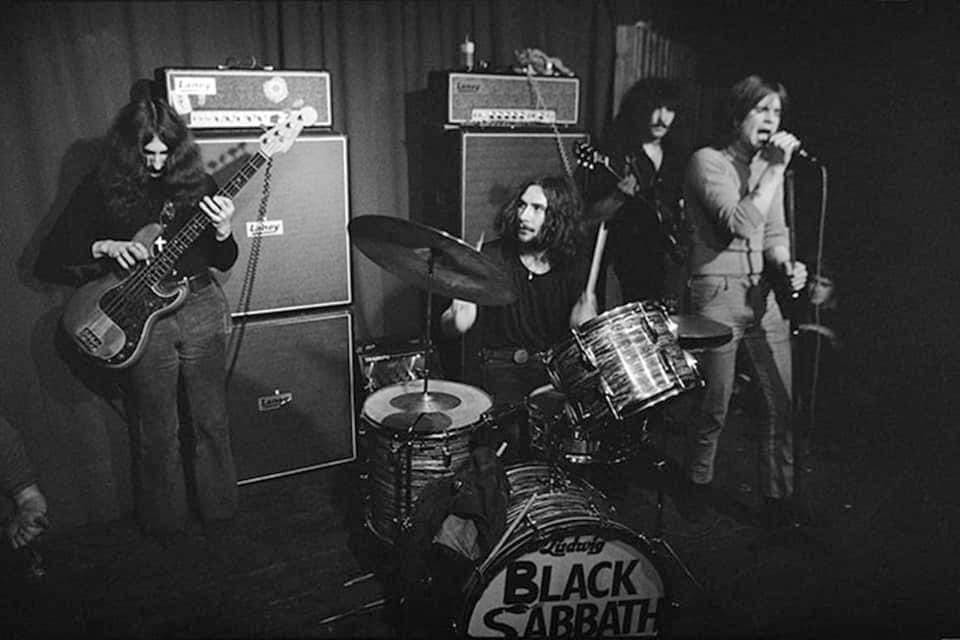
Black Sabbath on stage in Germany, 1969.
X / @blacksabbath
The history of a classic
Until shortly before the recording of their second album Paranoid, the song was still called Walpurgis, and centred around witch cults. Outraged by the Vietnam War, bassist Geezer Butler, who was responsible for lyrics, rewrote the song and made it into one of the most musically explicit anti-war songs in rock history.
The second line of the first verse – “Just like witches at black masses” – is reminiscent of the originally planned song about Walpurgis Night. But the song is a battlefield. In the intro, ominous wafts of mist drift over a quagmire. The drums click like a time bomb. Short detonations are heard before the voice of Ozzy enters.
External Content
The song came about at a time when the final breaths of the ‘flower power’ movement were fading out.
Would such a track have been created without those 200 hours of backbreaking labour in Zurich? By a band in exile, imprisoned in a rehearsal room with an audience and forced daily to squeeze out every last drop of potential available to them?
There is hardly another album like Black Sabbath’s Paranoid which has caused such a furore in rock history – it was a big bang moment.
Originally, the album was even supposed to be named after the song War Pigs, written in Zurich. The cover shows a samurai warrior in a garish costume charging out of a forest – which is entirely in keeping with that name. However, due to the highly controversial Vietnam War, the record company decided shortly before the release to call the album Paranoid.
Zurich uninterested
Is it due to Swiss modesty and reserve that this story has never been properly told? Zurich tourist authorities don’t feature it anywhere on their homepage. Does the city still feel somewhat ashamed about the episode?
As long as it remains ignored that four 20-year-old boys from Birmingham – Tony Iommi, Ozzy Osbourne, Bill Ward and Geezer Butler – set off the most important big bang in rock history on Hirschenplatz in 1969, Zurich’s cultural history can only ever remain half-written.
After the band’s return from Switzerland, it was just a few days before its debut album Black Sabbath was released on Friday, February 13, 1970 – marking the start of a countdown to a new era of rock music.
‘Most songs originated in Zurich’
Six months later, after a hectic tour, Black Sabbath recorded their second album Paranoid – peppered with song structures which had taken shape in the Hirschen Club and which were now immortalised in groundbreaking tracks, including one of the most characteristic and fundamental rock songs in history: War Pigs.
And as Ozzy later told the SonntagsZeitung, “most of the songs on Paranoid were written in this bar in Zurich”.
The result was a genre that offered millions of young people a balm for the soul – and in a form that worked faster than intravenous painkillers. It was a liberating outlet with an effect that was disconcertingly relieving. It’s not for nothing that the love of heavy metal is one that usually lasts longer than just a summer.
The end of the Hirschen
As Black Sabbath’s musical star rose, the Hotel Hirschen increasingly degenerated into a hotbed of thieves in the 1970s. Raids were common, and it was even said in police circles that the hotel was always a good bet for an inspection when nothing else was going on. Officers could bust a dealer or stumble directly on some crooked deal in the making.
In the mid-1980s, the owners of the Hirschen filed for bankruptcy, and all documents, memorabilia and legacy from earlier years were destroyed.
Only the name remained. The Hotel Hirschen is still there, on the Hirschenplatz. After several changes of ownership, it seems to have found a sense of stability. But while the walls stand, no more music is played in this birthplace of heavy metal.
Edited by Balz Rigendinger
Boris Schlatter has gathered the results of his research into Black Sabbath’s time in Zurich in a blogExternal link, which he kindly allowed Swissinfo to republish.
More