


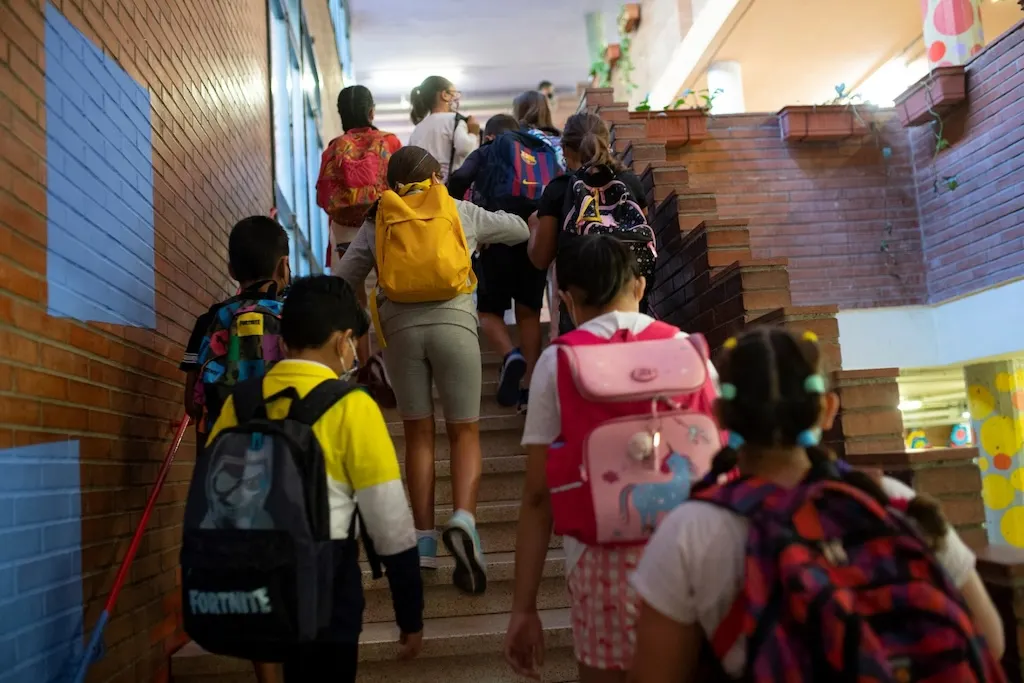
Spain’s Ministry of Education has approved draft legislation to reduce the student-teacher ratios in schools, a measure to boost learning that teaching unions have been requesting for some time.
The Spanish cabinet on Tuesday approved a draft bill to reduce class sizes, improve student-teacher ratios and cap the maximum number of students per classroom.
The text still requires final approval before being sent to the Spanish Congress, but according to a statement on the Education Ministry website: “The aim is to correct the inequalities detected between autonomous regions and improve teachers’ working conditions, as well as to achieve more individualised attention.”
The proposal includes a reduction in class sizes at primary school, secondary school and bachillerato studies, the equivalent of A-levels or IB.
Ministry information states that the bill establishes a maximum of 22 pupils per classroom in primary education (compared to the current 25) and 25 in secondary education (compared to the current 30). In publicly funded schools, students with special educational needs will be counted as two places in student-teacher ratio calculations.
READ ALSO: 11 things to consider when choosing a school for your child in Spain
It also provides for the creation of a socio-economic vulnerability index that will be used to identify schools that have particularly complex situations.
There have also been previsions made for the maximum number of students with educational needs in each classroom, and number of students in vulnerable situations attending a particular school.
The government proposes including students with special educational needs in mainstream classrooms as a way to reduce the maximum number of students.
This will ensure that all students receive the best and most appropriate educational support and reduce the workload required by teachers to make the necessary changes to lessons.
They also want to reduce the maximum enrolment ratios in certain primary and secondary schools, as well as vocational training centres where there are a high number of students with learning difficulties or are from disadvantaged backgrounds. High school vocational training courses are included “as this curriculum is demanding and is often taught in classrooms with a large number of students”.
READ ALSO: Does Spain have a catchment area system for public schools?
Advertisement
The primary goal is to achieve more personalised attention for students, which will help reduce dropout rates and promote academic success.
The draft bill also sets, as a general rule, the weekly teaching schedule for teachers at “23 hours in pre-school, Primary and Special Education, and at 18 hours in the rest of education.”
For organisational reasons a maximum of 20 hours may be reached, compensated by two additional hours for each additional teaching period.
Nonetheless, the main thrust of the reform is to reduce class sizes. Classes in Spain are larger than in neighbouring countries such as Italy, with 19 students per classroom, or Portugal, with 17.5.
In 2024, it was noted that there were 10.6 students per teacher compared to 14.3 in 2023.
Advertisement
The regions with the fewest students per teacher are Cantabria with 9.1 students per teacher, Asturias with 9.7, and Castilla y León with 9.9.
If approved in the Spanish Congress, the changes will come into force in the academic year 2026/2027.
The new student-teacher ratios will be implemented progressively: in the academic year 2027/2028 in Pre-school and Primary Education; in 2028/2029 in Secondary Education; and in 2029/2030 in Baccalaureate, reaching full implementation in the academic year 2031/2032.


