


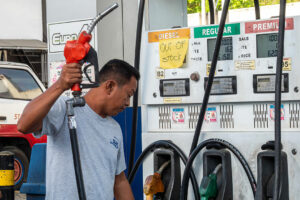
The chairman of the House of Representatives’ ways and means committee wants the chamber to adopt the Senate version of a bill allowing President Ferdinand R. Marcos, Jr. to suspend the fuel excise tax amid surging oil prices linked to the Iran war.
Marikina Rep. Romero “Miro” S. Quimbo, who heads the committee, said he had asked Majority Leader Ferdinand Alexander “Sandro” A. Marcos III to accept Senate Bill No. 1982, which lets the President reduce or freeze the levy on petroleum products.
“This alignment between the two chambers reflects a shared recognition of the urgency of providing the Executive with a mechanism to address volatility in fuel prices,” Mr. Quimbo said in a statement.
The appeal could fast-track the bill’s enactment by bypassing a bicameral conference committee tasked with reconciling differences between House and Senate versions. President Marcos certified the measure as urgent last week.
The Senate and House proposals differ mainly in duration and automatic triggers. The Senate bill limits the President’s power to three months, while House Bill No. 8418 allows a six-month suspension.
The Senate bill also includes a safeguard: excise tax reductions would automatically revert if the average Dubai crude price falls below $80 per barrel, a condition absent from the House version.
Under the 2017 Tax Reform for Acceleration and Inclusion (TRAIN) law, the Philippines charges P10 per liter on gasoline, P6 on diesel and P5 on kerosene. The law had allowed excise tax suspension when global oil prices exceeded $80 per barrel for three straight months, but that provision expired six years ago.
Lawmakers are racing to give the government temporary powers to ease fuel costs, which risk stoking inflation and weighing on economic growth, as global crude prices remain elevated due to war in the Middle East. — Kenneth Christiane L. Basilio

