


Official Development Assistance (ODA) for education is projected to fall by $3.2 billion – a 24 per cent drop from 2023 – with just three donor governments accounting for nearly 80 per cent of the cuts.
Such a decline would push the number of out-of-school children worldwide from 272 million to 278 million, UNICEF said – the equivalent of shutting every primary school in Germany and Italy combined.
“Every dollar cut from education is not just a budgetary decision, it’s a child’s future hanging in the balance,” said UNICEF Executive Director Catherine Russell.
Children in crisis hit hardest
The heaviest impact is expected in regions that are already vulnerable. West and Central Africa could see 1.9 million children lose access to school, while 1.4 million more could be pushed out across the Middle East and North Africa.
In total, 28 countries stand to lose at least a quarter of the education aid they rely on. Côte d’Ivoire and Mali face some of the steepest risks, with enrolment projected to fall by 340,000 and 180,000 students respectively.
Primary education will be hit hardest, with funding expected to drop by one-third. UNICEF warns this could deepen the global learning crisis and cost those children affected an estimated $164 billion in lost lifetime earnings.
In humanitarian contexts, the cuts could be devastating. In the Rohingya refugee response, 350,000 children risk losing access to basic schooling permanently.
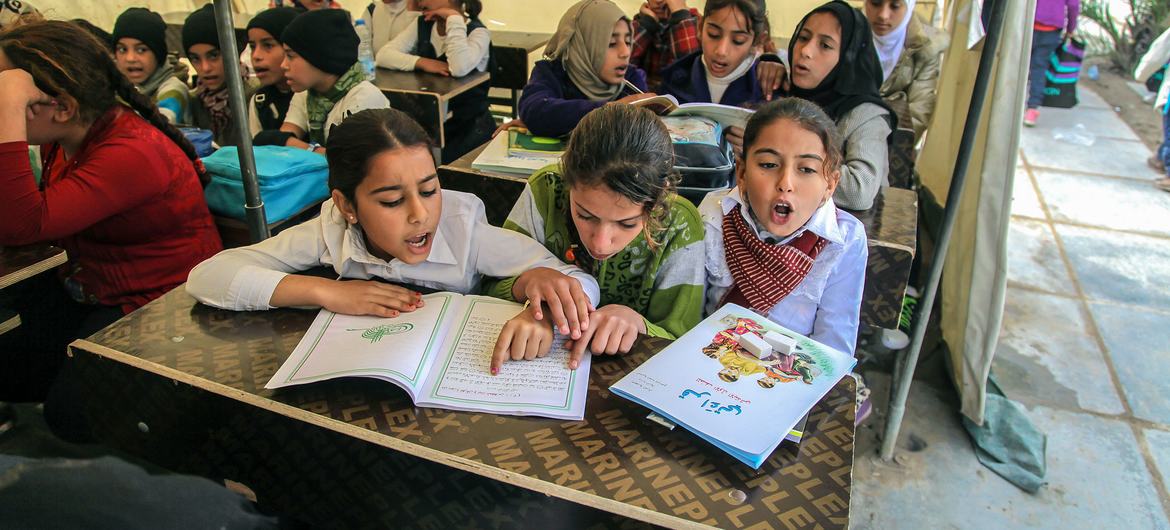
Displaced children in a classroom in Baghdad, Iraq.
Call to protect education
The crisis will also threaten vital services. School feeding programmes – sometimes a child’s only reliable meal – could see funding halved, while support for girls’ education is likely to shrink. At least 290 million children who remain in classrooms could also face a decline in learning quality.
UNICEF is calling on donors to direct at least half of all education aid to least developed countries, safeguard humanitarian funding, and prioritise early years and primary schooling. It also urges reforms to make financing more efficient and sustainable.
“Education, especially in emergency settings, often serves as a lifeline,” Ms Russell said. “Investing in children’s education is one of the best investments in the future – for everyone.”


