Achille Capelli studies the effects of climate change on Alaska’s ice and snow. Pictured is at Barrow Point, the northernmost point in the United States.
Andy Mahoney
Swiss researcher Achille Capelli has found an open-air laboratory in Alaska. He is studying the polar ice shelf and is worried to see the impact of climate change. Unlike other Swiss scientists, Capelli is so far unaffected by funding cuts by the Trump administration, as his research is also of interest to the United States.
Thick blankets of snow are falling over Fairbanks, Alaska. It is mid-April, and winter is in its last throes. Achille Capelli, from canton Graubünden in eastern Switzerland, is sitting in his office at the Geophysical Institute of the University of Alaska. The Swiss researcher has been living in the 49th US state for the past four years.
“When spring comes, the snow melts and the temperatures shoot up,” he says during a video call. It’s 8am in Alaska and 6pm in Switzerland. “Summer here is hotter than in Davos because the sun never sets, not even at night.”

Achille Capelli on the ice floe in Utqiagvik, Alaska.
Achille Capelli
Warm welcome despite Arctic chill
Between December and January, meanwhile, the polar night holds sway, and there are but few hours of daylight. Temperatures can plummet to -45°C. Capelli, 37, has nonetheless remained true to his habits.
“Back in Switzerland I went to work by bike, and I have continued to do so here, also because I don’t live far from the university,” he says. “I just have to wrap up properly if I don’t want to get frostbitten hands or an iced-up beard.”
“Climate change is having a huge effect on Alaska”
Swiss researcher Achille Capelli
The postdoctoral student lives on the outskirts of Fairbanks. This is Alaska’s second-largest city, with nearly 100,000 inhabitants in the metropolitan area. “I live in a dry cabin – a small house with no running water or plumbing – because in winter the water would freeze in the pipes,” he explains. Every two weeks or so, he takes his car and fills a few plastic containers with water to have a supply for use at home.
The harsh Alaskan climate seems also to have forged the character of the residents. “The hostile environment has made the people very welcoming and helpful,” Capelli says. “Even though Fairbanks is quite a big town, it feels like a small community: people are open and supporting, and curious about outsiders.”
This is unlike his experience back home. “In German-speaking Switzerland, people are rather reluctant to establish contact with those from another linguistic region. Whereas here it’s surprisingly easy to make new friends.”
Research to help local communities
And so the researcher from Graubünden soon felt at home in Fairbanks – not least because snow and ice are at the heart of his scientific work. In Switzerland he studied the different mechanisms regulating the snowpack and the formation of avalanches at the WSL Institute for Snow and Avalanche Research in Davos.
He also tried to understand the warning signs for avalanches, using acoustic emissions. After obtaining his doctorate from the federal technology institute ETH Zurich, he sought a new professional challenge and, in 2020, applied for a postdoctoral project at the University of Alaska.
“The research focused on sea ice, which was not really my field, but I said to myself, ‘why not?’” says Capelli, who grew up in Valposchiavo, an Italian-speaking valley in Graubünden. “I also liked the fact that it was not just basic research but also had a practical application.”
The aim of the research project is to develop an electromagnetic system that can be fitted on drones to measure the thickness of the Arctic snow and sea ice. “There are instruments that work well on the ground and others that can be mounted on helicopters or large planes, but an intermediate solution was lacking – something that could be carried by a drone,” he explains.
The initial plan was to use long-range drones, but given the limitations of the technology available, the research team had to modify its approach and used smaller multi-rotor drones instead.
The Arctic is one of the regions of the planet where temperatures are rising fastest. Between 1979 and 2021, the area covered by sea ice at the end of summer shrank by 13%External link.
The melting of the ice pack is caused by global warming and a phenomenon known as “Arctic amplification”: with less snow and ice present, the dark surface of ocean water absorbs more heat, leading to a vicious circle.
The melting of Arctic ice contributes to rising sea levels and exacerbates climate change. Thawing permafrost releases carbon dioxide and methane, two powerful greenhouse gases, into the atmosphere.
This reportExternal link by Swiss public television, RSI, explains why the world should be worried about the warming of the Arctic.
Sea ice: an unstable but vital platform
“The first phase of the project is complete. We’re now carrying out new studies, continuing to fine-tune the system,” he says. Capelli and his research team are currently focusing on practical application. They are measuring the thickness of the ice shelf, the floating sea ice that forms in winter near the coast and remains attached to the land until spring.
“It’s a kind of natural platform that local people have used for centuries to move, hunt and transport goods,” he says. “But it’s a constantly evolving surface: it can become too thin, and therefore dangerous if you don’t know how thick it is.”
The research also has logistical significance: in much of the Arctic, ships cannot dock directly on the coast as the sea is too shallow. “In winter and spring the ice shelf is used to unload and transport people, vehicles and goods. So knowing its thickness is vital.”
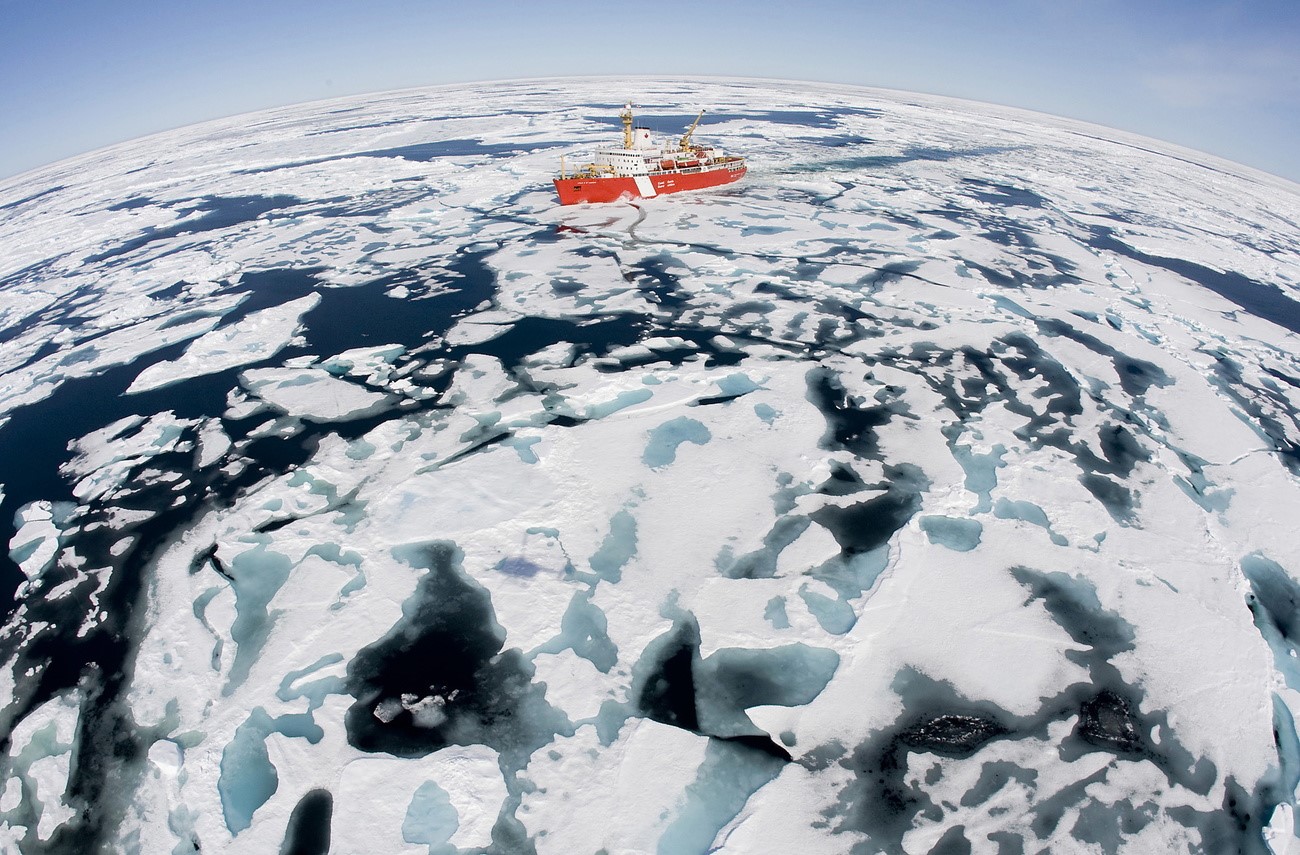
>> Arctic regions are attracting increasing international interest. A race to the far north of the planet, however, also entails risks, as this article explains:
More
More
Switzerland has a role to play in the Arctic
This information is also crucial for the US Department of Defense. Alaska is becoming increasingly important from a geostrategic point of view and hosts several US military bases. This field of research is therefore likely to be spared from cuts by the Trump administration.
In February Capelli took part in a mission with the US Navy. “Our task was to evaluate the thickness of the ice in order to identify the most suitable areas for a temporary camp.”

Achille Capelli installing a sensor on the ice floe in Alaska.
Andy Mahoney
Ten metres of erosion annually
“Climate change is having a huge effect on Alaska,” Capelli says. For example, in Utqiagvik, the northernmost town in the United States, the subsoil is composed of fine sediments held together by permafrost. As it melts, it leaves the coastline exposed to sea waves that erode it at a rate of up to tens of metres a year.
“Some communities already know they will have to abandon their villages and move hundreds of kilometres inland. Their very existence is at risk,” Capelli says. “The melting of the permafrost is having an enormous impact on the lives of the Arctic’s indigenous communities. For millennia, they used the ice shelf to hunt seals, whales and other marine animals, but its growing instability makes it more and more difficult for them to access vital resources.”
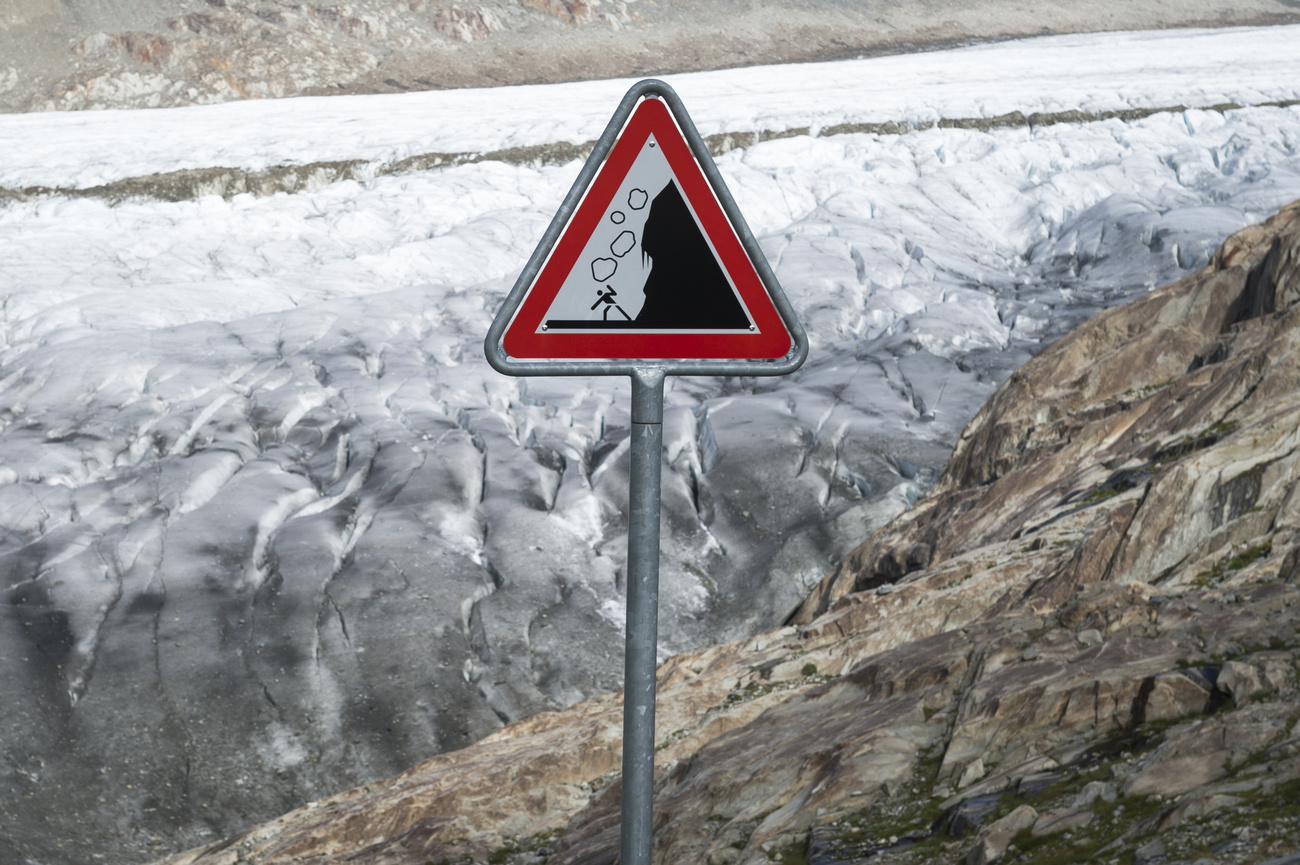
>> Thawing permafrost could accelerate global climate change. Here’s what you need to know about permafrost research in Switzerland and around the world:
More
More
How climate change is threatening permafrost’s delicate balance
The city of Fairbanks is also built on permafrost. “From the street you can see houses that are sinking,” says Capelli, who also followed with concern the natural disasters that struck various parts of Switzerland in 2024.
From thousands of kilometres away, he has also learnt to look at his home country with new eyes. “Seen from here, I appreciate our democratic system and its stability even more.” In addition to political debate and the search for compromise, he also misses the flavours of home: cheese, home-made sausage and the traditional cooking of Valposchiavo.
In Alaska, however, he can continue to follow his passions, taking long walks in the wilderness, kayaking on wild rivers and hunting caribou.
Edited by Samuel Jaberg. Adapted from Italian by Julia Bassam/ts