


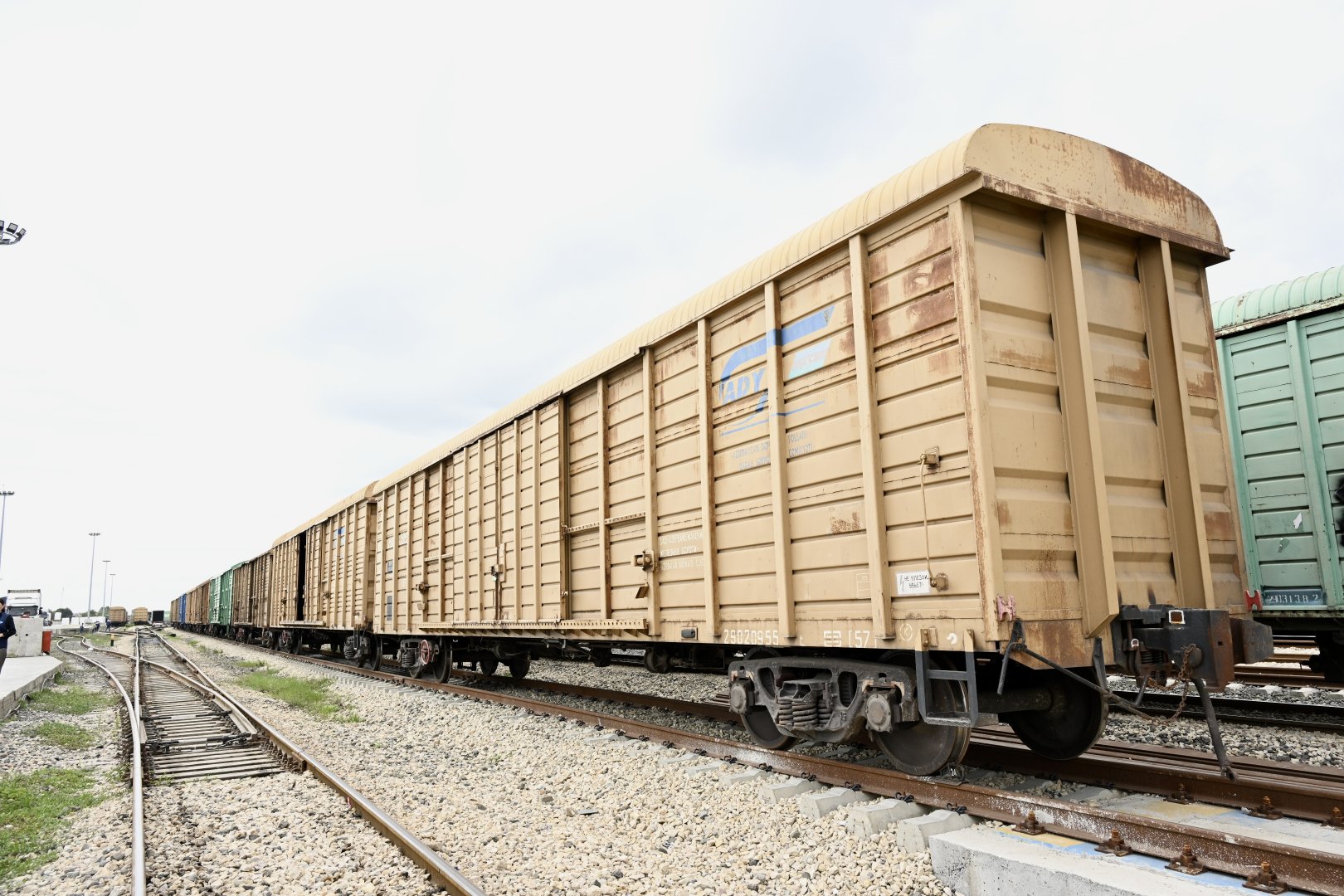
BAKU, Azerbaijan, October 27. Iran is moving
quickly to complete the Rasht-Astara railway, the missing link in
the International North–South Transport Corridor (INSTC), aiming to
strengthen its role as a key transit hub connecting South Asia, the
Persian Gulf, the Caucasus, and Europe. The project has gained
momentum under Iran’s current government, reflecting Tehran’s
ambition to expand trade routes, attract investment, and increase
regional influence.
Since taking office in August 2024, the government has focused
on the Rasht-Astara section – the only part of the INSTC in Iran
without a railway. While the 165-kilometer line has been discussed
for years, progress has been slow until now. Recognizing its
strategic value, Iran is actively addressing the remaining
obstacles to construction.
Land acquisition along the route is the first step. So far,
ownership rights for 80 kilometers have been secured, with the
remaining 80 kilometers expected to be acquired by March 20, 2026.
Construction will begin once the entire route is cleared.
In an exclusive interview with Trend, Iran’s Ambassador to Azerbaijan Mojtaba
Demirchilou emphasized the corridor’s significance, noting
that once operational, it will benefit Iran, Azerbaijan, and the
broader region.
“Work is underway on the Rasht-Astara railway with Russia’s
support. Beyond the railway itself, Iran is addressing bottlenecks
at border checkpoints and simplifying customs procedures. Fully
leveraging the corridor’s potential requires strong infrastructure
and the development of supporting capabilities,” the ambassador
said.
Iran’s Minister of Roads and Urban Development Farzaneh Sadegh
told Trend that the
railway remains a top priority.
“In recent months, we’ve closely monitored progress and focused
on accelerating physical work. The Rasht-Astara railway fills the
missing link in the INSTC. Iran plans to complete land acquisition
by year-end, while Russia has already begun preparatory studies for
construction,” she said.
The western branch of the INSTC, which runs through Azerbaijan
and beyond, is particularly valuable for trade. With Azerbaijan’s
advanced railway infrastructure and the operational terminal at
Astara, Tehran sees this route as strategically effective.
At an October 26 event in central Iran on expanding the
Saveh-Salafchegan highway, Minister Sadegh noted that an agreement
between Iran and Russia on the Rasht-Astara railway is expected
next month, which will accelerate construction. Iran aims to
transport up to 15 million tons of cargo annually along this route
in the first phase.
The agreement builds on a May 17, 2023, deal between Iran and
Russia in Gilan Province, northern Iran. The 163-kilometer railway
will feature nine stations. Once completed, the INSTC will connect
Iran’s rail network with the Caucasus, Russia, and Northern Europe.
Russia is expected to invest 1.6 billion euros, with construction
planned to finish within 48 months.
The Rasht-Astara railway is more than an infrastructure project.
It positions Iran as a pivotal transit hub in the region,
strengthens trade ties with regional partners, and offers an
alternative to existing routes through the Suez Canal or Russia’s
traditional transport network. Azerbaijan, of course, plays a key
role in this corridor, providing advanced railway infrastructure
and an operational terminal at Astara that ensures seamless
connectivity between Iran and the South Caucasus. For Central Asian
exporters, it opens a new pathway to global markets, while for
Iran, it reinforces both economic and strategic influence in the
region.


