


The fragile cease-fire between the United States and Iran could hang in the balance over what Washington has labeled a “misunderstanding” over whether the truce includes Israel’s offensive against Tehran-backed Hezbollah assets in Lebanon.
US Vice President JD Vance, during a visit to Hungary, on April 8 said he believes there was a “legitimate misunderstanding” about the terms of the truce announced the night before by President Donald Trump.
“I think the Iranians thought that the cease-fire included Lebanon, and it just didn’t,” he said, adding that “neither us nor the Israelis said that that was going to be part of the cease-fire.”
“If Iran wants to let this negotiation fall apart…over Lebanon…that’s ultimately their choice,” he told reporters, adding that Israel was ready to show restraint in its attacks in Lebanon.
White House press secretary Karoline Leavitt told reporters Lebanon was not included in the cease-fire terms. She added: “This will continue to be discussed, I am sure, between the president and Prime Minister [Benjamin] Netanyahu, the United States and Israel, and all of the parties involved.”
A statement released by Netanyahu’s office also said the cease-fire did not include Lebanon, which contradicted an earlier statement from Pakistani Prime Minister Shehbaz Sharif, who is acting as a mediator between the two sides.
‘Rising Death Toll’
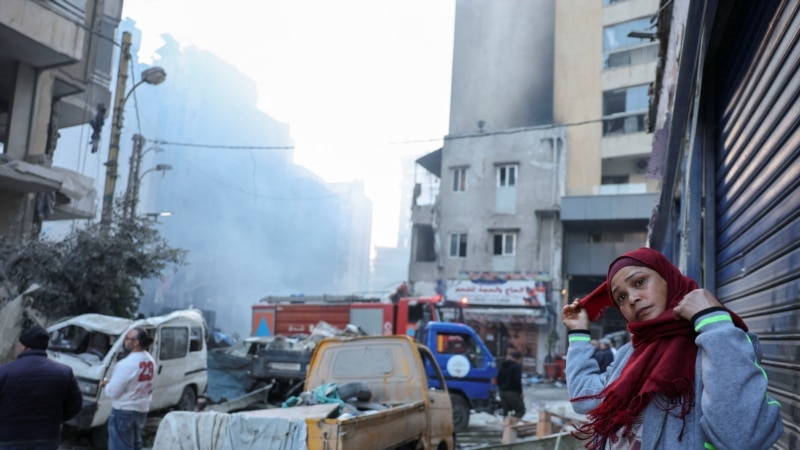
Lebanon’s Health Ministry on April 8 reported on the one-day death toll of least 182 people — saying the toll was likely to rise – during Israeli strikes in the hours following the announcement of the cease-fire.
UN Human Rights Chief Volker Türk said the “scale of the killing and destruction in Lebanon today is nothing short of horrific.” The Red Cross said it was “outraged by the devastating death and destruction” across Lebanon.
Lebanon’s Health Ministry said 1,739 people have been killed and 5,873 wounded in Lebanon since the start of the Israel-Hezbollah war on March 2. Hezbollah has been deemed a terrorist organization by Israel and the United States.
Iran’s powerful parliament speaker, Mohammad Baqer Qalibaf, claimed that three parts of Iran’s 10-point proposal for a resolution had been violated and that, in such a situation, a “bilateral cease-fire or negotiations” were “unreasonable.”
In a post on X, Qalibaf asserted that the violations were attacks on Lebanon, the entry of a drone into Iranian airspace, and what he said was a “denial of Iran’s right to [uranium] enrichment.”
Qalibaf is reportedly expected to lead Tehran’s delegation, along with Foreign Minister Abbas Araqchi, in Pakistani-mediated talks in Islamabad starting on April 10.
Washington and Tehran agreed late on April 7 to a two-week cease-fire, pulling back from the brink to allow the two sides time to negotiate a peace deal.
Trump on social media said he had received a 10-point proposal from Tehran and that talks would be held behind closed doors. He said that “only one group of meaningful ‘POINTS'” was acceptable to the United States, although he gave no other details.
“These are the POINTS that are the basis on which we agreed to a CEASEFIRE. It is something that is reasonable, and can easily be dispensed with,” he said.
Along with the dispute over the situation in Lebanon, uncertainty over shipping freedom in the Strait of Hormuz also clouds the prospects for a lasting cease-fire.
While giving no details of the Iranian proposal, Trump insisted that Tehran must allow the free passage of ships in the strait, a key shipping lane through which some 20 percent of the world’s oil and gas passes.
Minimal Hormuz Traffic
According to data from maritime monitor Marine Traffic, four ships passed through the waterway on April 8.
“Early signs of vessel activity are emerging in the Strait of Hormuz following a cease-fire announcement, which includes a temporary reopening of the strategic waterway to allow for negotiations,” the monitor said in a post on X.
It added that “hundreds of vessels remain in the region, including 426 tankers, 34 LPG carriers, and 19 LNG vessels, many of which had been effectively stranded during the disruption.”
A senior Iranian official said ships navigating the strait, however, still require the permission of Iran’s hard-line Islamic Revolutionary Guards Corps (IRGC) to pass.
Reuters and others reported that shippers were awaiting more clarity before resuming transit.
The waterway is crucial to global oil and natural gas transport and has been largely closed since the beginning of US-Israeli air strikes on Iran on February 28. Tehran has retaliated by launching missiles and drones against Israel and US Arab allies in the region.
The Wall Street Journal reported that Iran told mediators it would limit the number of ships crossing the strait to around a dozen a day and that it would collect toll charges for its permission.
Prior to the US-Israeli war, ships moved freely through the strait without the need for coordination with Iran.
The Journal reported that Iran is charging some fees in Chinese yuan, a move that regional officials said threatens reduced Western and allied influence over oil markets.


