


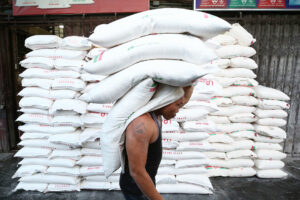
THE Economy and Development (ED) Council has approved the recommendation to allow a more flexible rice tariff scheme starting in 2026, the Department of Economy, Planning, and Development (DEPDev) said.
“Starting Jan. 1, 2026, a more gradual and flexible tariff adjustment shall be adopted, with adjustments by 5 percentage points per 5% change in international prices, subject to a minimum rate of 15% and a maximum rate of 35%,” DEPDev said in a statement on Tuesday.
This was the recommendation presented by the Tariff and Related Matters Committee (TRMC).
However, this fell short of farmer groups’ demand to restore the 35% rice tariff, slamming the lower rate for flooding the market with cheap imports and gutting farmgate prices.
The ED Council also approved the TRMC recommendation to maintain the current Most Favored Nation tariff rate on rice imports at 15% until Dec. 31, for both in-quota and out-quota imports.
President Ferdinand R. Marcos, Jr. had issued Executive Order (EO) No. 102 extending the rice import freeze until Dec. 31, in line with the Department of Agriculture recommendation.
However, DEPDev Secretary and ED Council Vice Chairperson Arsenio M. Balisacan said Mr. Marcos’ order makes tariffs “redundant,” and will not affect local prices.
“The TRMC’s recommendation is part of a broader government strategy to ensure stable rice prices and protect both farmers and consumers, while safeguarding macroeconomic stability,” DEPDev said.
Meanwhile, the Council also tweaked scope and implementation arrangements of the Jalaur River Multipurpose Project-Stage II to facilitate the completion of the remaining project works and ensure delivery of irrigation water to farmer beneficiaries.
It also approved new rules for formulation, prioritization and monitoring of Infrastructure Flagship Projects (IFP) amid a corruption crackdown on flood control projects.
This seeks to streamline the IFP list, tighten agency accountability, and lock projects into the government’s planning and budgeting pipeline.
ODA LOANS
At the same meeting, the ED Council greenlit two official development assistance (ODA) loans from the World Bank amounting to P53.25 billion.
This includes the Department of Education’s P38.27-billion Program for Learning Upgrading and School Development (PLUS-D) that aims to bolster learning outcomes, education management and delivery systems in the country.
PLUS-D is set for implementation from 2026 to 2032 and will introduce system-level interventions, provide targeted support to schools, and establish monitoring and evaluation mechanisms, DEPDev said.
The program, with public schools as the primary beneficiaries, focuses on raising literacy and numeracy among Kindergarten to Grade 6 learners.
It also approved the P14.98-billion Accelerating Water Supply and Sanitation for the Poor and Lagging Areas project. This is targeted to improve access to safe water supply and sanitation services in underserved communities.
The project will be implemented in the Loboc Cluster (Bohol), Siargao Island (Surigao del Norte), and Jolo (Sulu).
The ED Council also endorsed an EO that facilitates voluntary Social Security System, Philippine Health Insurance Corp., Pag-IBIG Fund contributions for contract of service and job order personnel in National Government agencies.
“The proposed EO seeks to close gaps in social protection coverage by making it easier for non-regular government workers to maintain contributions through a voluntary, payroll-based mechanism,” it said. — Aubrey Rose A. Inosante


