


 Getty
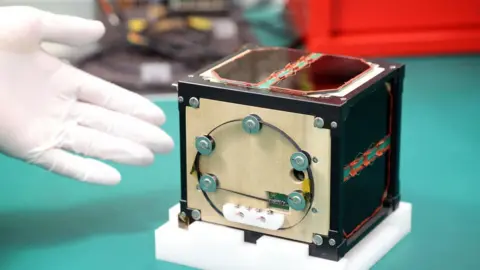
GettyThe world’s first wood-panelled satellite has been launched into space to test the suitability of timber as a renewable building material in future exploration of destinations like the Moon and Mars.
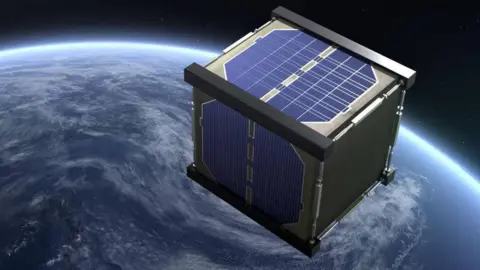
Made by researchers in Japan, the tiny satellite weighing just 900g is heading for the International Space Station on a SpaceX mission. It will then be released into orbit above the Earth.
Named LignoSat, after the Latin word for wood, its panels have been built from a type of magnolia tree, using a traditional technique without screws or glue.
Researchers at Kyoto University who developed it hope it may be possible in the future to replace some metals used in space exploration with wood.
“Wood is more durable in space than on Earth because there’s no water or oxygen that would rot or inflame it,” Kyoto University forest science professor Koji Murata told Reuters news agency.
“Early 1900s airplanes were made of wood,” Prof Murata said. “A wooden satellite should be feasible, too.”
If trees could one day be planted on the Moon or Mars, wood might also provide material for colonies in space in the future, the researchers hope.
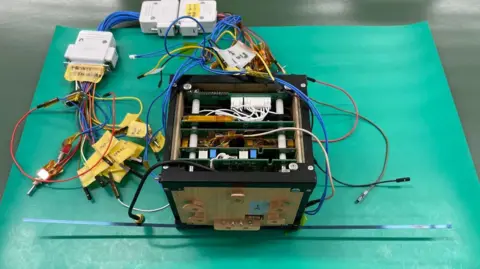
Along with its wood panels, LignoSat also incorporates traditional aluminium structures and electronic components. It has sensors on board to monitor how its wood reacts to the extreme environment of space during the six months it will orbit the Earth.
 Kyoto University
Dr Simeon Barber, a space research scientist at the Open University in the UK, said: “We have to be clear that this is not a satellite completely made of wood… but the basic premise behind the idea is really interesting.
“From a sustainability point of view, wood is a material that can be grown and is therefore renewable,” he told the BBC.
“The idea that you might be able to grow wood on another planet to help you explore space or make shelters – explorers have always used wood to make shelters when they’ve gone to a new land.”
Dr Barber said it wasn’t the first time that wood had been used on spacecraft.
“We use wood – cork – on the re-entry, outer shell of vessels of spacecraft to help them survive re-entry into Earth’s atmosphere.”
Russian and Soviet lunar landers used cork to help the rover have grip as it was descending to the surface, he added.
“There’s nothing wrong with using wood in space – it’s using the right material for the right task.”
He pointed out that wood has properties that are hard to control.
“So from an engineering point of view it’s quite a difficult material to work with… I think wood’s always going to have a problem to make critical structures like parts of spacecraft where you need to predict how strong it’s going to be.”
The researchers at Kyoto University hope using wood in making spacecraft could also be much less polluting than metal ones when they burn-up on re-entry at the end of their life.
 Kyoto University
Experts have warned of the increasing threat of space junk falling to Earth, as more spacecraft and satellites are launched.
Dr Barber acknowledged the space industry was under growing pressure over the amount of pollution it puts into the atmosphere but he was sceptical using wooden spacecraft could provide the answer.
“In principle having materials such as wood which can burn up more easily would reduce certainly those metallic contaminants… But you may end up taking more material with you in the first place just to burn it up on the way down.”


