


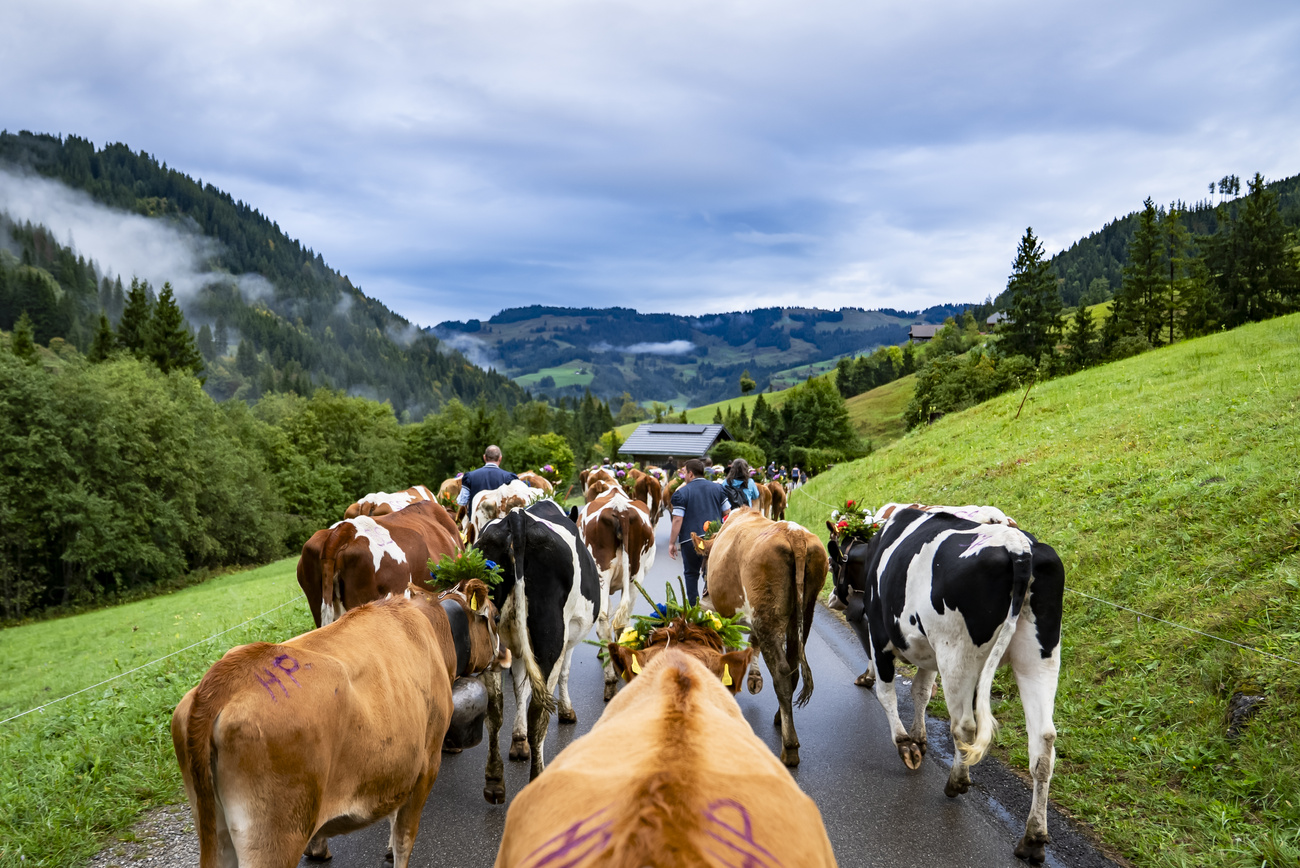
After feeding in the Alps all summer, cows are escorted back to their farms to produce high-quality milk that is used to make cheeses like Gruyère, Emmentaler, Tilsiter and Appenzeller.
Keystone / Julien Grindat
The country’s dairy farmers produced a bumper harvest of milk, but higher U.S. duties have forced them to consider ways to cut back, including slaughtering cows.
As a dairy farmer, Boris Beuret tends to more than 60 cows in the gently rolling meadows of his farm in Switzerland’s Jura region. Their milk, herbaceous and nutty from the tender grasses they graze on, makes fine Swiss cheeses and chocolates, much of it destined for American consumers.
But recently, Beuret sent some of his herd to the slaughterhouse prematurely. Nearly every other Swiss dairy farmer is thinking of whether to follow suit.
Since President Donald Trump announced a punishing 39% tariff on Switzerland in August, the blow has landed hard on the Swiss dairy industry, where cheese makers have cut production to deal with an expected falloff in U.S. demand.
More

More
Explainer: How the new US tariffs are already impacting the Swiss economy
The tariffs compounded an existing problem: Switzerland has too much milk — and too many cows.
“We need to find a solution with the United States to lower the tariffs,” Beuret said. “But if things continue, we need to consider whether we need to start slaughtering more cows.”
Few things are as symbolic of Switzerland as its dairy cows, with their giant copper bells, brown and white coats and high-quality milk. No one dreamed that an abrupt shift in U.S. trade policy could play a role in a Swiss way of life that dates back centuries.
But as Trump traveled through Asia last week announcing new trade deals, the fallout of tariffs imposed this year on U.S. trading partners has become clearer. Clothing factories have been shuttered in Africa. Auto plants in Europe have been cutting jobs.
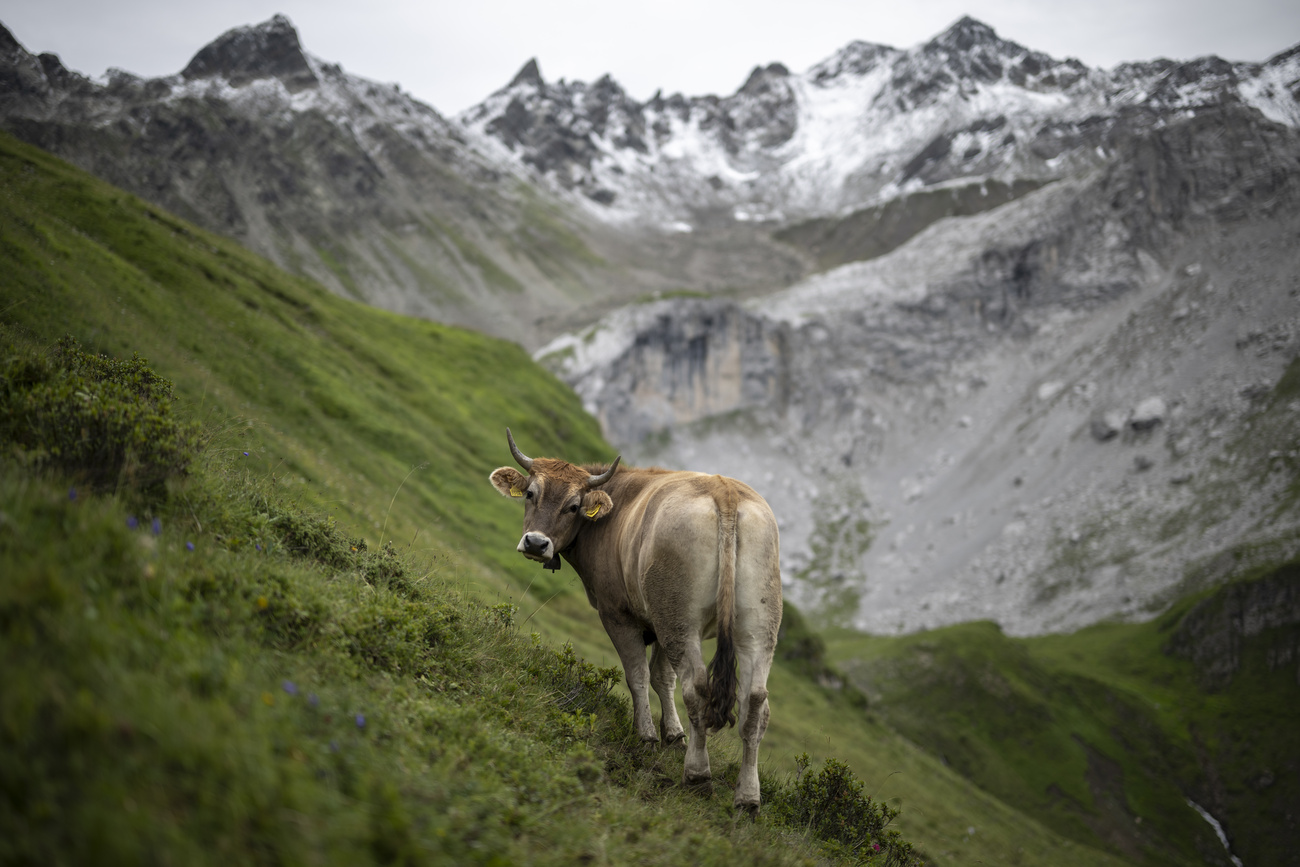
After feeding on Alpine grass, the cows produce an herbaceous, nutty milk.
Keystone / Gian Ehrenzeller
The stakes have been high for Switzerland, too. Since the announcement, the pastures behind Beuret’s farm have become an example of the consequences of a trade war.
An abundant season
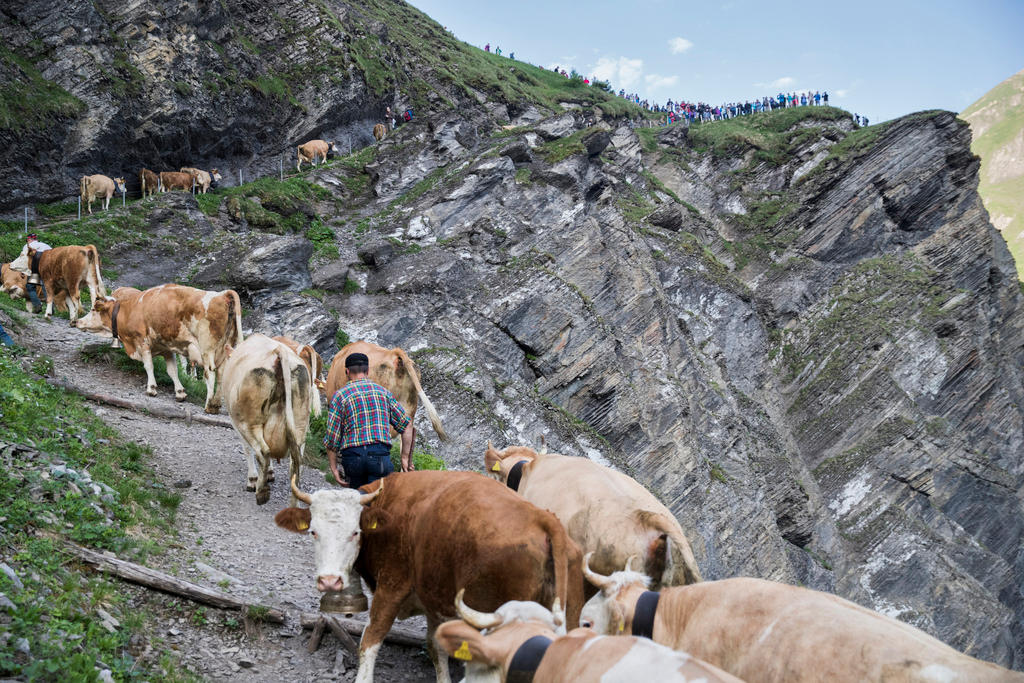
Beuret’s small dairy farm is one of 20,000 in Switzerland, producing 90% of the nation’s milk. Swiss farmers could make more money on an industrial scale, but they prefer to keep tradition alive. Farmers escort cows — around 550,000 all told — up verdant Alpine mountains in the summer to feed, producing some of the world’s best milk. The cows descend a few months later, often paraded with flower crowns to the sound of yodeling.
More
More
Why Swiss cows climb mountains
To ensure the farms’ survival, the Swiss dairy industry sets strict quotas for milk production and prices.
But an unusually rainy spring spawned an abundance of grass. Although farmers lately have been battling higher temperatures that have dried up feed, the cows on Beuret’s farm, and at others across Switzerland, ate so well this year that they produced a bumper milk harvest.
That would not have been a big problem, because the dairy industry could turn the excess supply into milk powder or frozen butter, said Stefan Kohler, the director of IP Lait, which represents the Swiss dairy sector. But when Trump announced high tariffs, those calculations were thrown off track.
Cutting cheese production
The United States is Switzerland’s biggest market after Europe, importing 13% of Swiss cheese production. Half is premium Gruyère, made with Alpine milk, but there is also Emmentaler (the cheese with holes), Tilsiter and Appenzeller. Milk also goes into Swiss chocolate.
Anthony Margot, a co-owner of Margot Fromages, a 139-year-old company and one of Switzerland’s biggest cheese dealers, was shocked when he heard the new tariff rate. The Swiss had been expecting a duty closer to the 15% secured by the Europe Union. When combined with other levies and a plunge in the U.S. dollar, the effective tariff on Switzerland tops 50%.
More
More
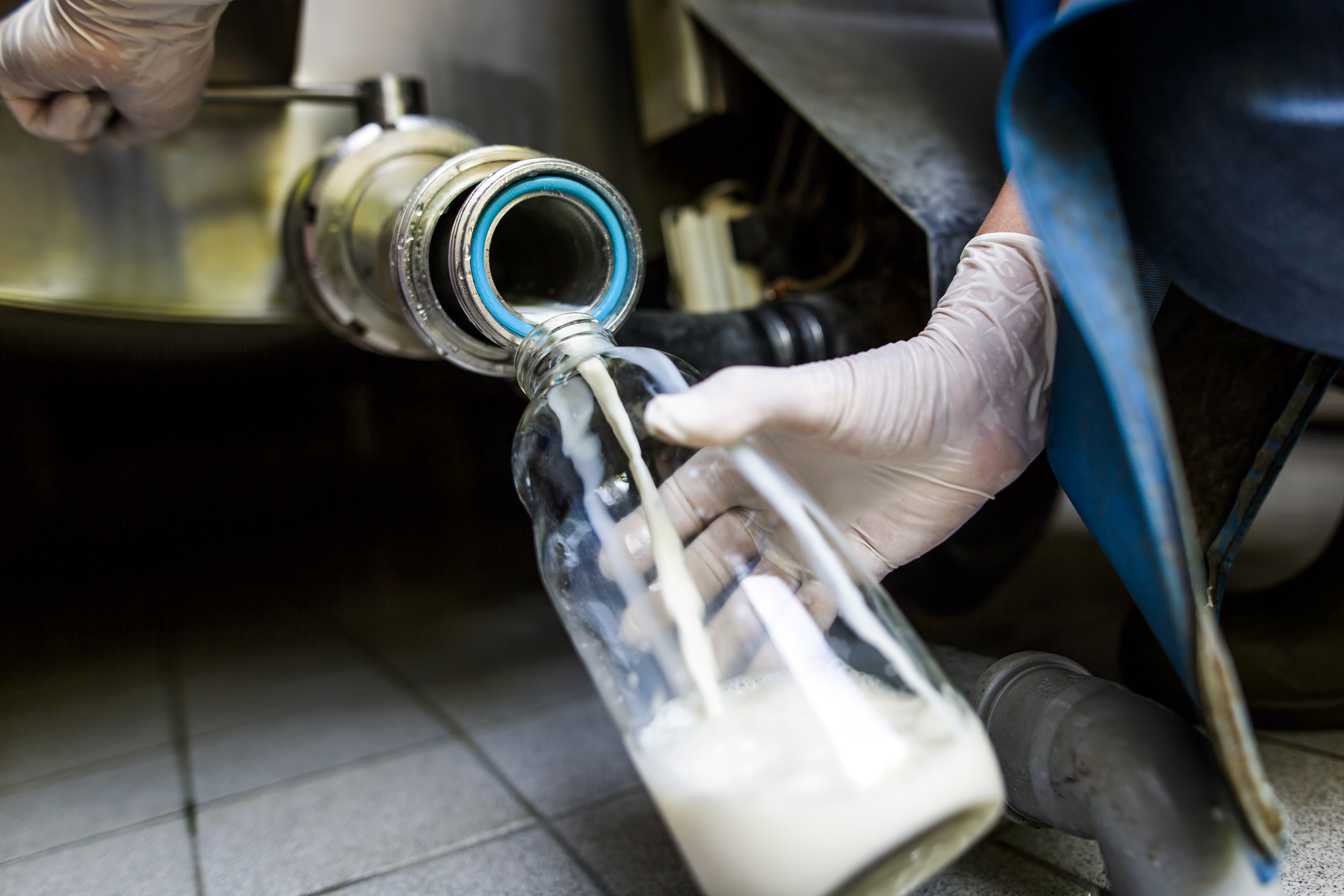
Raw milk: regulatory loophole gives Swiss the freedom to skip pasteurisation
Switzerland has zero tariffs on most imported goods, but its levies on agricultural imports can top 100%, to protect its dairy industry. “Maybe from the U.S. point of view, that’s not fair,” he said. But neither, he said, were Trump’s tariffs.
When the new levy inflated Switzerland’s tax rate on exports to the United States, prices soared, and the Gruyère industry urged cheese makers to cut output by 5%.
“The impact was direct,” said Margot, whose company matures 10% of Switzerland’s Gruyère production. Around 36,000 wheels rest in cavernous cellars before being shipped to 40 countries, including the United States, where he exports 4,500 tons of Gruyère. Buyers include Sam’s Club, Costco and Murray’s Cheese in New York.
Cheese that was previously priced at $15 to $50 per pound now costs $20 to $70, he said.
Thinning the herd
With less cheese to make, the IP Lait industry group urged action to limit price declines that could hurt farmers. “We already had excess production due to good weather, but Donald Trump’s decision made the glass overflow,” Kohler said.
The organization recommended cutting annual milk production by 50,000 tons, the amount produced by 25,000 cows, Kohler said. The fastest route, he said, would be for cows to be slaughtered sooner than usual.
Beuret, who is also president of Swissmilk, a producers association, has already done so. He sent three dairy cows to the slaughterhouse prematurely to reduce milk supplies, and is deciding whether to cull more.
He said farmers were reluctant to reduce herd sizes quickly in case a lower tariff was negotiated. “In Switzerland, the cow is almost a sacred animal,” he said. “If you say you have to kill more cows, that sends shock waves.”
That includes Swiss cattle farms that raise a breed of cows for steaks. They worry that a sudden supply of excess meat could harm their prices.
Around 85,000 Swiss dairy cows are culled annually as they age and produce less milk. They are replaced with younger cows, and their meat is used for hamburger and pet food. Kohler said any further slaughter, should it happen, would be carried out slowly.
“It’s not like thousands of cows would be killed suddenly,” he said. Farmers could choose to thin herds “more quickly than normal in the next couple of months,” he added.
Looking for alternatives
By far, though, the preference is to find other ways to deal with excess milk. Ideas include making mozzarella rather than importing it from Italy, making more yogurt or running “solidarity” ad campaigns urging the Swiss to eat more dairy. Some farmers have suggested feeding cows a little less so they do not produce as much milk, Kohler said.
Trump’s tariffs have pushed the Swiss government to accelerate international trade deals elsewhere, including Latin America, India and China, which is becoming more open to Swiss dairy products.
“Americans should know that the whole world is starting to organize trade without the United States,” Kohler said.
Gruyère makers are trying to make the most of a glum situation. With the price of gold near record highs, and Switzerland a global hub for gold bars, the industry has started a U.S. marketing campaign to play off the higher prices.
More
More
Selling Swiss cheese: ‘The main problem with the US today is uncertainty’
“We’re saying Gruyère is the new gold of Switzerland,” said Pierre-Ivan Guyot, president of the Gruyère Interprofessional Association.
The hope is that American consumers will be willing to shell out for the luxury of real Gruyère rather than copies made elsewhere. After slashing exports in August, producers sent more Gruyère to the United States in September ahead of the Christmas season.
As for Swiss cows, Beuret said farmers would keep working toward a solution.
“We will try to do the least amount of slaughter possible,” he said. “Then when we have passed the difficult period, Switzerland can bounce back.”
This article originally appeared in The New York TimesExternal link.


