


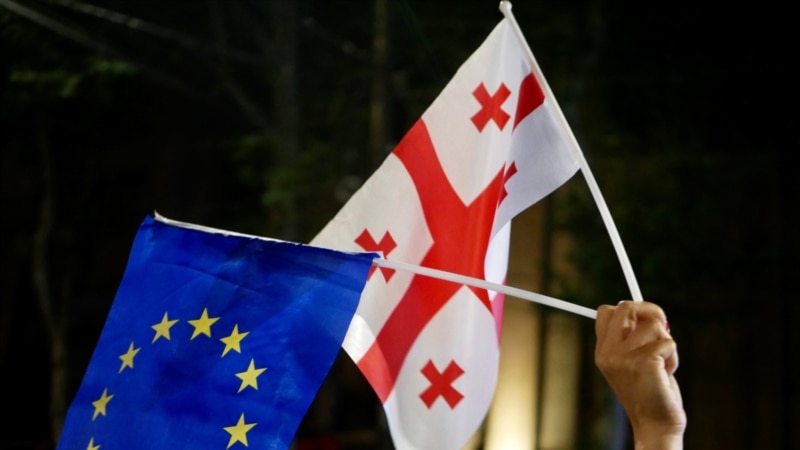
The European Commission has said it will suspend visa liberalization for Georgian diplomatic passport holders as new European Union rules enter into force at the end of the month, while not ruling out targeting the entire population of the South Caucasus country if measures aren’t implemented to strengthen democratic rights and freedoms.
The announcement came as the commission on December 19 presented its annual report on non-EU countries whose citizens enjoy visa-free travel for up to 90 days in every 180-day period. The rules apply to entry to most bloc members as well as EU-associated countries such as Iceland, Liechtenstein, Norway, and Switzerland.
Georgian citizens have enjoyed this benefit since 2017.
Rights Abuses In Georgia
The commission said Tbilisi has “violated numerous commitments undertaken during the visa liberalization dialogue” and was accused of having failed to implement the recommendations in last year’s report such as the protection of fundamental rights, including the freedoms of association, assembly, and expression.
In that report, Brussels also slammed the Georgian government’s controversial legislation on “transparency of foreign influence” and “family values and protection of minors.”
The report states that “given the systemic and deliberate nature of this backsliding, the commission will consider appropriate measures under the revised Visa Suspension Mechanism, which will enter into force on 30 December 2025.”
Last month, EU foreign policy chief Kaja Kallas said Georgia has “no viable path to the EU at this stage unless conditions change dramatically.”
Specifically, the report blames the situation on Georgian government policies — namely a crackdown on political opponents and a policy shift that appears slanted toward Moscow — that have undermined relations with the 27-member bloc.
New Visa Rules
The new rules, which were approved earlier this fall, allow the European Commission to partially or fully suspend visa liberalization for a country not only for home affairs violations such as overstays, a lack of returns or unfounded asylum claims, but also human rights abuses.
It also allows the EU executive to take this decision on its own even though it is likely to consult with EU member states before taking a final decision.
In response, Georgian parliamentary speaker Shalva Papuashvili accused the bloc of “blackmail.”
Diplomatic sources have told RFE/RL that a majority of EU member states would like to at least suspend visa liberalization for Georgian decision-makers, while sparing regular citizens.
The commission is, however, allowing that a second stage suspension “could be extended to the entire population if issues are not addressed by the Georgian authorities.”
It also adds that in the final stage “Georgia could lose its visa free status entirely and be transferred to the EU list of visa-required third countries.”
So far, this has only happened to the South Pacific nation Vanuatu in late 2024.
In that case, the country was offering a so-called “golden passport” scheme that encouraged people to invest in the country and get expedited citizenship — something that is against EU rules.
Georgia’s relationship with the EU in particular has deteriorated since Tbilisi adopted anti-LGBT legislation and a so-called “foreign agents” law last year, when the EU halted accession talks.
Tensions deepened further after parliamentary elections in October 2024, in which the Georgian Dream party held on to power, froze talks on Georgia’s accession to the European Union, and accused the bloc of trying to plot a coup in Tbilisi.


