


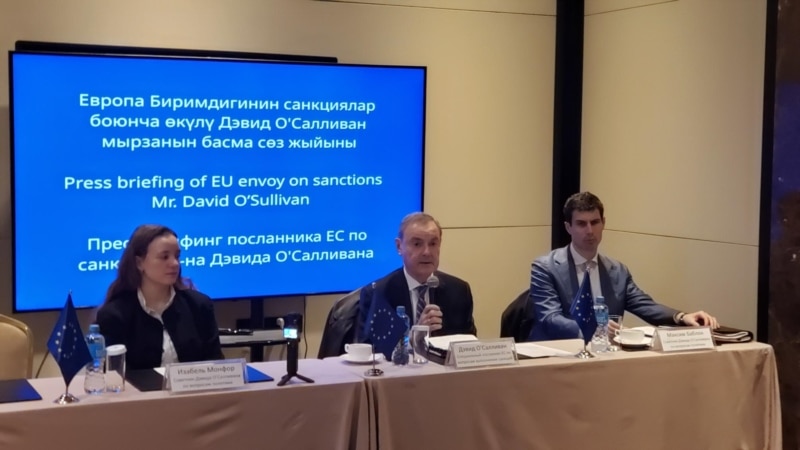
European Union sanctions envoy David O’Sullivan arrived in Bishkek for high-level meetings with Kyrgyz officials amid concerns that some financial channels and trade flows in Kyrgyzstan are being used to circumvent sanctions against Russia.
In a visit on February 26 as the European Union moves toward adopting its 20th sanctions package targeting Russia, O’Sullivan met with officials from the central bank and other economic ministries, briefing them on his mission to identify and address possible sanctions circumvention before Brussels finalizes the new measures.
In a press conference, he said that about 80 goods, mainly dual-use items, are under scrutiny for possible reexport to Russia via Kyrgyz territory.
Roughly 50 of these items are used in Russian military equipment, while the rest are critical for industrial production. He emphasized that these are just a narrow category that “does not represent economic interest for Kyrgyzstan.”
Focus On Dual-Use Goods And Financial Risks
O’Sullivan said the EU’s primary concern is not asking Kyrgyzstan to adopt EU sanctions but rather ensuring the country isn’t used as a platform for circumvention.
“We are not asking Kyrgyzstan to adopt our sanctions … we understand that there are countries that, for various reasons, choose a different path,” he told RFE/RL’s Kyrgyz Service in an interview.
He added that some goods are currently being imported into Kyrgyzstan from the EU and then reexported to Russia, which he described as “unacceptable.”
The envoy also highlighted risks in the financial sector, citing the infiltration of Kyrgyz banks and cryptocurrency platforms by actors seeking to circumvent sanctions. He said this was the reason for including several banks and crypto-related institutions in the previous sanctions package.
“Where we have evidence that companies in any country, including in Kyrgyzstan, are facilitating the circumvention of our sanctions, then we reserve our right to act against these companies,” he said, clarifying that such measures target companies, not the country.
O’Sullivan stressed that the EU respects Kyrgyz sovereignty and legitimate trade with Russia, noting the importance of migrant worker remittances for local families:
“We have no intention to interfere with your perfectly legitimate trade and economic relations with Russia, none whatsoever. We respect the closeness of your relations with Russia; we know that you have many migrant workers in Russia whose remittances back to Kyrgyzstan are important for the livelihood of many families.”
Proposed Measures In 20th Sanctions Package
Draft proposals for the 20th package now being debated by the EU would prohibit exports of certain high-risk items such as computer numerical control (CNC) machines and radio equipment to Kyrgyzstan, amid concerns that goods exported there from the EU have already been reexported to Russia, helping to circumvent existing sanctions.
EU draft data shows that exports of these items to Kyrgyzstan rose nearly 800 percent in the first 10 months of 2025 compared with levels prior to Russia’s February 2022 invasion, while Kyrgyz exports of the same goods to Russia increased by about 1,200 percent.
The EU describes this pattern as a “continuing and particularly high risk of circumvention,” noting that these goods can be used in military production and advanced industrial applications.
The draft, seen by RFE/RL, also includes adding a Kyrgyz crypto-related company to the EU blacklist for facilitating Russian financial interests, reflecting a shift toward targeted company-level restrictions rather than broad country-level sanctions.
Kyrgyz Government Response
Following meetings with O’Sullivan, Kyrgyz officials expressed a desire for constructive dialogue while voicing concern over the economic impact of unilateral measures if they are adopted by the bloc.
Kyrgyz officials were quick to point out measures being implemented to cut down on any perceived circumventions.
Daniyar Amangeldiev, first deputy chairman of the cabinet, noted that lawmakers have already introduced restrictions on dual-use goods and stressed the importance of predictability and stability in financial ties with the EU.
Deputy Prime Minister Edil Baisalov, meanwhile, warned that EU measures could threaten regional economic stability.
The Foreign Ministry has proposed a joint working group to prevent sanctions circumvention, while the National Bank of Kyrgyzstan said it is assessing the potential impact of the upcoming package to ensure the stability of the banking sector.
“We would dearly like to work with the Kyrgyz authorities in identifying and resolving these issues before we need to take action ourselves. This is why I’m here in the spirit of friendship and cooperation…we value our relationship with Kyrgyzstan,” he said.
EU sanctions require unanimous approval from all 27 member states. Measures affecting Kyrgyzstan, including export controls on CNC machines and radio equipment, might face resistance. Germany, Italy, and Poland are the biggest exporters of these goods to Kyrgyzstan.
EU diplomats told RFE/RL that some of these exporters may seek to block proposed Kyrgyz-related restrictions.


