


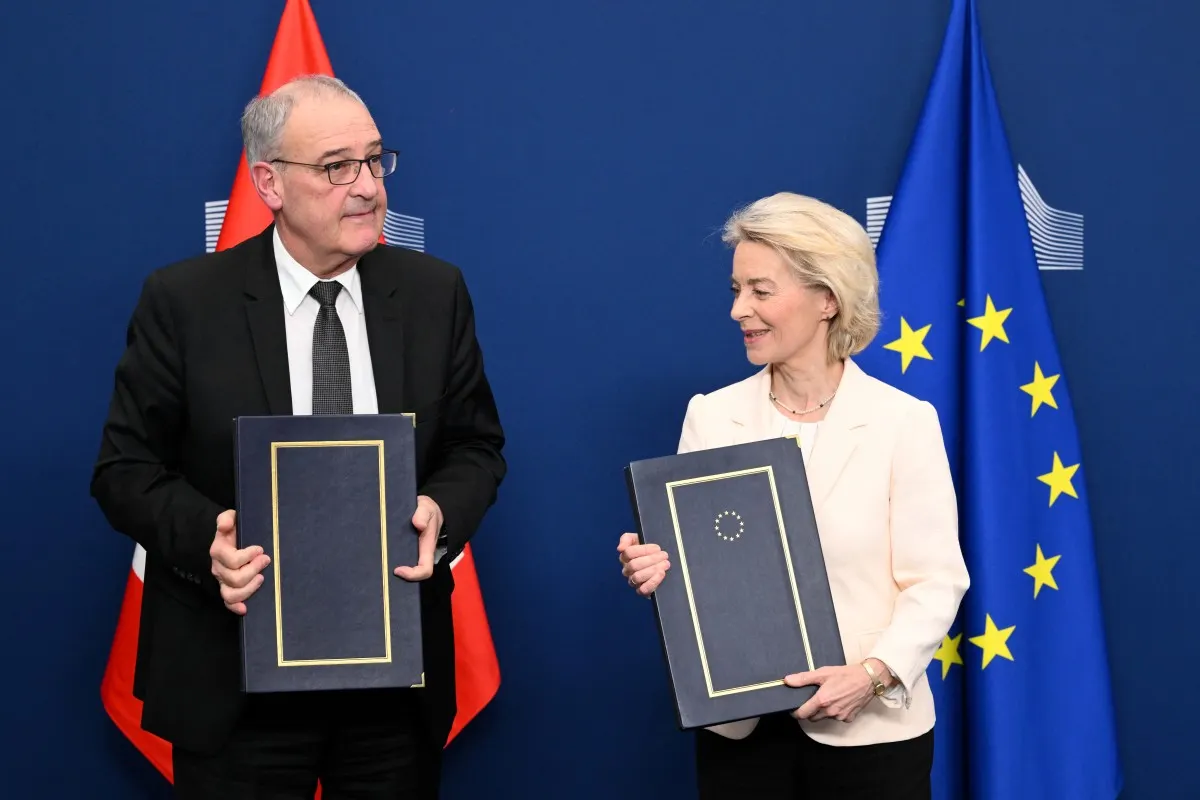
Switzerland and the European Union signed on March 2nd a package of agreements to deepen and harmonise ties in the face of what the EU chief described as “a volatile global context”.
European Commission President Ursula von der Leyen and Swiss President Guy Parmelin inked more than a dozen deals that build on existing accords during a signing ceremony in Brussels.
“The EU and Switzerland may be neighbours by geography but we are partners by choice,” von der Leyen told a press conference.
“The European Union is and will remain a reliable and predictable partner. In a volatile global context, this matters more than ever,” she added.
Monday’s signing is not the end of the road, as the package, which needs approval from the Swiss parliament, is expected to be put to voters in a referendum.
Landlocked Switzerland is not in the EU but is almost entirely surrounded by bloc members Germany, France, Italy and Austria.
EU-Swiss ties are currently governed by a patchwork of bilateral agreements, and the two have for years been striving to nail down a broader cooperation agreement.
‘Mutually beneficial’
Among the pacts signed on Monday, Switzerland committed to have EU students pay the same tuition fees as locals at most public universities.
Bern will also contribute 375 million euros a year towards a EU fund to reduce social disparities across the 27-nation bloc
The accords also set up a “common food safety area” aligning related rules, and allow for Switzerland to participate in the EU internal electricity market.”These agreements constitute a balanced, pragmatic and mutually beneficial package, driving prosperity, employment and stability,” said Parmelin.
“They benefit our citizens, our economies and our societies as a whole.”
Advertisement
The deal comes almost after Switzerland suddenly walked away from more than a decade of negotiations in May 2021.
The two sides picked up talks again three years later, in a bid to streamline the more than 120 agreements that currently govern their relations.
Negotiations were substantially concluded in December 2024.
Since then, the two sides have incrementally signed portions of the deal, including on the EU Programmes Agreement (EUPA) allowing the protocols on their cooperation within education, research, innovation and health to take effect last year.


