

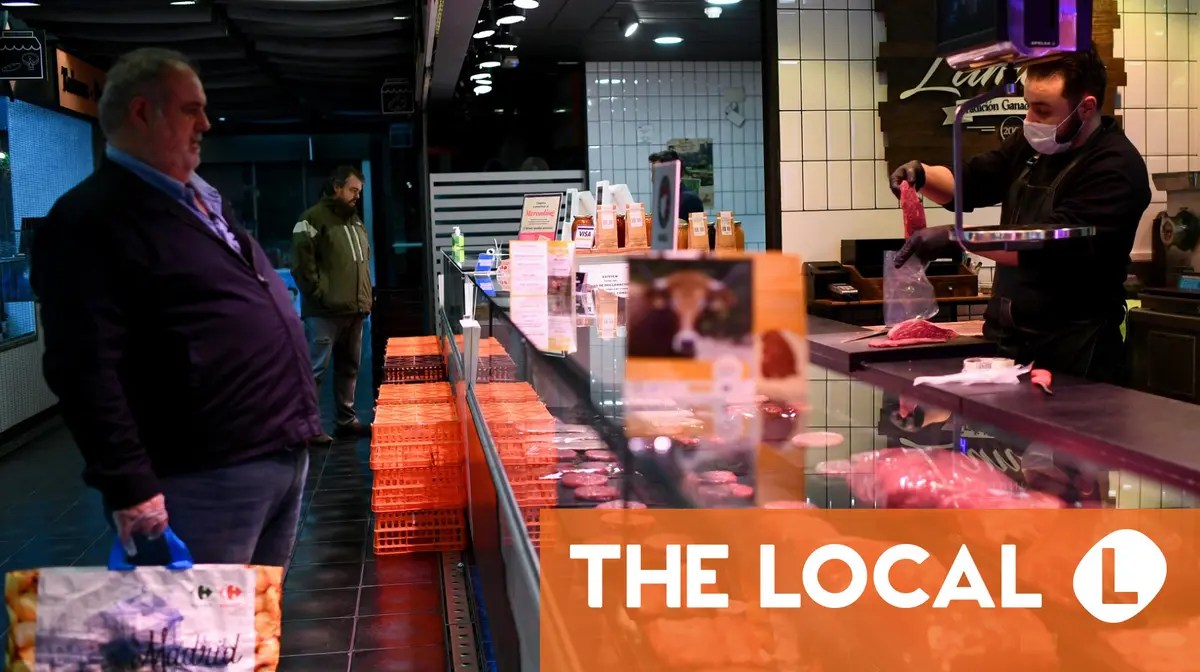

In this week’s edition of Inside Spain we look at how Mercadona is trialling a new system which spells changes in the ways Spaniards shop, and how an Alicante’ public housing complex meant for low-income families has been bought up by the city’s elite.
Next time you’re in a Spanish supermarket, notice who takes a number and waits in line at the fishmonger’s, greengrocer or butcher’s section.
They’re more likely to be middle-aged or elderly Spaniards than young folk, who know their pescadero, frutero or carnicero by name, and spark up a conversation with them while they’re being served.
Advertisement
It’s an example of how daily life in Spain is shared with others, not alone at home but walking the streets of your barrio (neighbourhood) and talking to the people you see regularly.
However, we’ve previously reported how thousands of young and not-so young Spaniards get ‘stage fright’ when it comes to ordering over the counter.
They prefer to do their grocery shopping at supermarkets rather than traditional family-run shops, with their headphones in their ears and without having to interact with anyone.
READ ALSO: Family-run businesses close at alarming rate in Spain’s capital
This is something that Mercadona – by far Spain’s most popular supermarket – has picked up on.
They’re currently trialling a new setup which sees more food at the cheese, meat, fruit and fish counters pre-cut, pre-labelled and pre-packaged.
More reading and less talking, is the essence of it.
The T9 system, as it’s been dubbed, is meant to save time at these counters as customers don’t have to wait to be served.
Instead it will be a more ‘mechanical’ approach where you pick up what you need without speaking or asking for advice from your trusted supermarket worker.
Mercadona has assured its staff that they won’t be slashing any jobs if they fully implement this system, but rather that their job responsibilities will be slightly different.
It’s a sign of the times, another move towards ‘automation’ which improves efficiency while reducing human interaction.
And for a society like Spain’s, where communication and friendliness are intrinsic to the national psyche, such advancements are unlikely to be appreciated by everyone. I can already picture the disgruntled abuelas.
In unrelated news, a scandal has broken in Alicante after it emerged that a new social housing complex meant for low-income families has been bought up by many of the Costa Blanca city’s well-to-do families.
Located in the sought-after La Condomina area, close to Alicante’s San Juan beach, Les Naus housing complex is made up of 140 three and four-bedroom homes.
It also includes parking lots, a swimming pool, a gym, padel courts, a basketball court and a children’s playground. Not bad, right?
Unfortunately, what was meant to be the first public housing complex developed by Alicante City in 20 years has ended up in the hands of local politicians and their family members, wealthy businessmen, in-the-know civil servants and notaries, police officers and others who don’t exactly qualify as ‘vulnerable’ people.
Not only that, because of Les Naus’ status as ‘protected’ housing, they ended up paying between €200,000 and €230,000 for these seafront properties, whereas on the free market similar homes are going for between €350,000 and €450,000.
Mucha cara, as they say in Spanish (a lot of cheek).
To be clear, Alicante City Hall did buy the land for €6.6 million but officials say they “have no authority” in allocating the apartments.
Developers Fraorgi claim Les Naus is a private social housing scheme which falls under a cooperative model, so anyone who signed up to the co-op was supposedly in with a chance to get one of these exclusive apartments.
In truth, reports in the Spanish press suggest that under-the-table payments in the hundreds of thousands tipped the balance in favour of some prospective buyers.
Advertisement
Alicante’s Urban Planning Councillor Rocío Gómez wasn’t going to miss out on the chance to buy one. She, along with another official have stepped down their roles, and investigations are currently underway on a local and regional level to clarify what happened.
Whatever conclusions they reach about the legal loopholes Alicante’s elite jumped through to get their bargain beachside homes, it doesn’t really matter. This is Spanish picaresca (guile) 101.
Spain isn’t building anywhere near enough homes – social housing in particular – which is one of the key reasons why the property crisis will just keep getting worse.
This didn’t used to be the case.
What most people don’t know is that subsequent Spanish governments from 1982 until 2023 allowed 2.7 million public housing units to be bought up by private firms, or allowed private construction companies to first build public housing only for it to then fall into their hands, filling their pockets even further.
Sound familiar? Some things just never change.


