


BBC News at Bergen Belsen

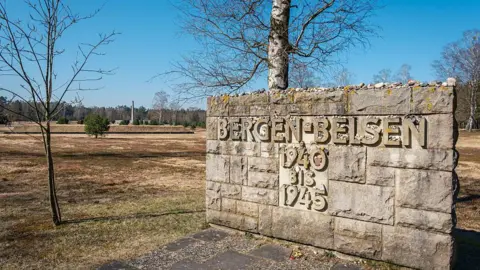 AFP
AFPThere had been rumours. There had been aerial photographs. There had been the written testimony of a few escapees. But it took liberation for the revelation of the shocking reality of the Nazi’s concentration camps.
Nowhere was this more true than when British and Canadian troops advanced on the camp at Bergen-Belsen, near Hanover, in April 1945.
A truce with local German commanders enabled them to enter without a fight. They were met with a stomach-churning vista of death, a torrid panorama of human suffering.
The troops calculated there were 13,000 unburied corpses. A further 60,000 emaciated, diseased, spectral-like survivors stood and lay amongst them.
On Sunday, to mark the 80th anniversary of the liberation of Belsen, more than a thousand survivors and families will attending commemoration events at the camp.
“To me, Belsen was the ultimate blasphemy,” wrote one British soldier, Michael Bentine, who, after World War Two, went on to become a famous entertainer.
Other chroniclers, film-makers and diarists struggled to convey in words and pictures the scenes that made unwanted incursions into their minds.
The BBC’s Richard Dimbleby was the first broadcaster to enter the camp shortly after liberation. In his landmark broadcast he included the words: “This day at Belsen was the most horrible of my life.”
Belsen’s notoriety soon stood out, not just because of the chillingly vivid accounts of journalists, soldiers and photographers, whose testimonies were sent around the world, but because it was found with all its grotesqueness intact.
Other camps further east, like the death camps of Treblinka, Sobibor and Auschwitz, had either been destroyed by the Germans to hide their crimes in the face of Soviet advances or emptied of their inmates.
At Belsen, the huts, the barracks, the evidence, remained.
At Belsen, there were witnesses, perpetrators, victims.
It was where many of those eastern concentration camp prisoners ended up. Overcrowding led to dysentery, malnutrition and typhus.
There were no gas chambers at Belsen. It was Nazi cruelty and incompetence that accounted for the 500 deaths a day that the camp endured.
And most of it came in the final weeks of the war, well into April 1945.
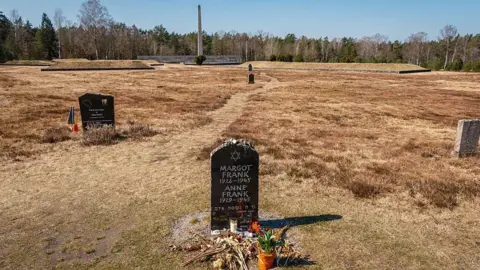 FOCKE STRANGMANN/AFP
As the Third Reich collapsed and freedom came to those in other occupied territories, the dying continued at Belsen: between 50,000 and 70,000 people in total, more than 30,000 of those between January and April 1945.
Around 14,000 of the prisoners died after liberation, their digestive systems unable to cope with the high calorific, rich, sustenance offered by well-meaning cooks and medics.
The vast majority were Jews, with Soviet prisoners of war, Sinti and homosexuals among other groups to be engulfed by the horrors of the camp.
WATCH on iPlayer: Belsen: What They Found – Directed by Sam Mendes
Among the survivors and relatives attending the event on Sunday are 180 British Jews. Their journey is being organised by AJEX, the Jewish Military Association.
Wreaths will be laid by AJEX veterans, as well as dignitaries, including Deputy Prime Minister Angela Rayner.
A psalm will be read by UK Chief Rabbi Sir Ephraim Mirvis.
They will do so amid the verdant surroundings of Lower Saxony where the watch towers, fences and buildings have gone.
That’s because, in the end, to contain disease, the British soldiers decided they had to burn the huts at Belsen.
And so, today, little remains. A visitor centre is a focal point, near to where a handful of memorial stones and crosses have been erected.
The inscription on one reads Hier ruhen 5,000 toten – here rest 5,000 dead.
It is just one of the graves, one of the memories, that haunt the grassed landscape.


