


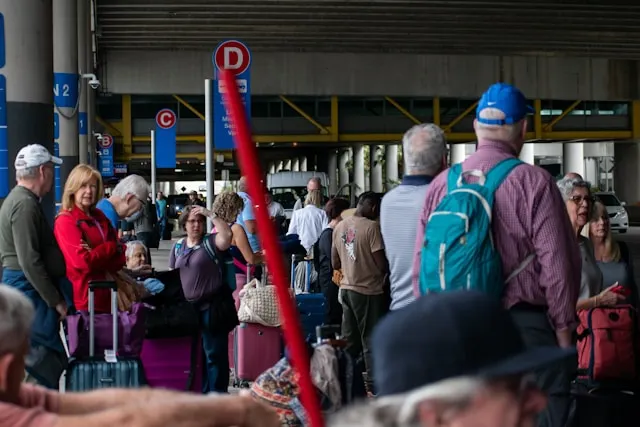
More than 4,000 Swiss nationals are stranded in the Middle East after US and Israeli airstrikes on Iran kickstarted a war in the region on February 28th. Does the government plan to bring them back home?
The closure of airports in Dubai, Abu Dhabi, and Doha – the main transit hubs to Asia – has left these travellers without a clear prospect of returning to Switzerland, with Iranian retaliatory actions, particularly with drones, severely restricting takeoffs and landings throughout the region.
The national airline, SWISS, has suspended its flights to and from these aiports until March 6th at the earliest.
What is the Swiss government doing to bring its citizens home?
While neighbours France and Germany are preparing repatriation flights, Switzerland is more passive on that front: the Federal Department of Foreign Affairs (FDFA) is simply advising against travel to the region.
Das EDA rät von touristischen und nicht dringenden Reisen nach Bahrain, Jordanien, Katar, Kuwait, Saudi Arabien und in die Vereinigten Arabischen Emirate ab. https://t.co/r9JXgoqz3e
— travel_EDA-DFAE (@travel_edadfae) March 1, 2026
But It has said that it “has no solution” for actually repatriating Swiss tourists.
In fact, according to Marianne Jenni, director of the FDFA’s Consular Affairs section, repatriation of tourists stranded in foreign lands is not up to the government, but is instead a matter of “individual responsibility.”
She added, however, that federal authorities are “monitoring the situation continuously” and are in contact with SWISS airline “to explore possible solutions.”
As for on-site assistance, “it is up to the airlines to cover the costs of accommodation, meals, and replacement flights for stranded passengers.”
The airlines are not, however, obligated to provide any additional compensation in such cases, which fall under the category of ‘force majeure’.
Advertisement
‘Personal responsibility’
Though not coming to the aid of its citizens stuck abroad may seem heartless, the government is, in fact, complying with the law.
It explains on its site that “the FDFA can provide assistance to individuals abroad if they cannot reasonably be expected or are not in a position to safeguard their interests on their own initiative or with the help of third parties,” – in this case, ‘the third parties’ being the airlines.
The FDFA’s position is that – unlike diplomats, who are sent to work abroad by the government and therefore are entitled to its protection – tourists choose willingly to travel to various destinations, and must therefore assume the consequences themselves.
Advertisement
And there is more bad news…
As though being stuck in a war zone with no way out is not bad enough, many of these people could also lose part of their salaries if they fail to return to their jobs in Switzerland on time.
That’s because under the Swiss law, employers are not required to pay for absences from work due to flight cancellations.
READ MORE: When can a Swiss employer refuse to pay your salary?


