


 Getty Images
All primary schools in Delhi will close due to worsening air pollution, officials have announced.
In a post on X, the Indian capital’s chief minister, Atishi Marlena Singh, said classes will move online until further notice due to a thick smog that has enveloped the city.
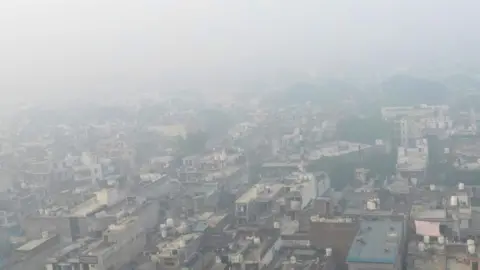
Delhi and nearby cities are experiencing pollution levels that are deemed hazardous to people’s health. On Thursday, fine particulate matter in the air was more than 50 times what is considered safe by the World Health Organization (WHO).
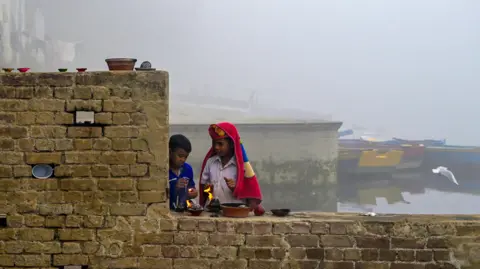
Delhi and northern states annually face smog during the winter due to a confluence of dropping temperatures, smoke, dust, low wind speeds, vehicle emissions and crop stubble burning.
According to IQAir, a Swiss-based Air Quality Index (AQI) monitoring group, Delhi had on average 254 pieces of fine particulate matter – or PM 2.5 – per cubic metre of air on Thursday. The WHO considers no more than 15 in a 24-hour period safe.
This is because fine particles can penetrate through lungs and affect organs. It can cause cardiovascular and respiratory diseases, while research shows it can also delay development in young children.
Levels of larger particulate matter – PM 10 – reached an average of 495, more than 10 times the daily amount considered safe by the WHO.
At the same time, monitoring by IQAir suggests the neighbouring cities of Gurugram and Noida had hazardous air pollution, as did the northern Indian city of Chandigarh.
Residents in Delhi have reported eye irritations and breathing issues, according to local media.
 Getty Images
A study published in The Lancet in July found that 7.2% of daily deaths in the city could be attributed to fine particulate pollution.
Air pollution is expected to decrease in the coming days, but will remain at unhealthy levels.
Authorities in Delhi – which has an estimated population of more than 33 million – have already enacted measures aimed at tackling the pollution, including spraying roads with water containing dust suppressants.
Non-essential construction has also been banned, and citizens told to avoid burning coal.
But critics argue these measures have proven ineffective.
The smog is extensive enough to be visible from space. Recently, Nasa shared satellite imagery showing it stretching across northern India and into Pakistan.
Earlier in the month, air pollution in the Pakistani city of Lahore forced officials to temporarily close its primary schools.


