


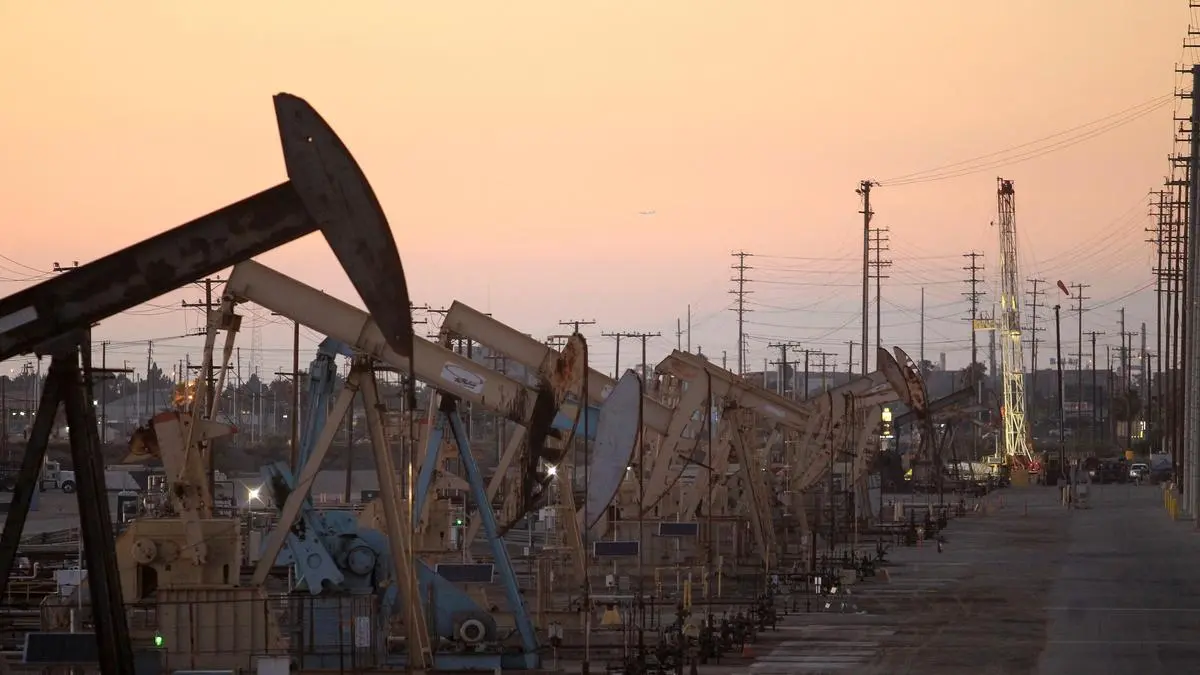
FILE PHOTO: According to industry players, the biggest fear for the oil market is the shutdown of the Strait of Hormuz. This could impact oil flows from the Persian Gulf. Almost a third of global seaborne oil trade moves through this chokepoint.
| Photo Credit:
DAVID MCNEW
Crude oil futures traded lower on Thursday morning as markets awaited further details on possible US involvement in Israel-Iran conflict.
At 9.54 am on Thursday, August Brent oil futures were at $76.45, down by 0.33 per cent, and August crude oil futures on WTI (West Texas Intermediate) were at $73.38, down by 0.16 per cent. July crude oil futures were trading at ₹6364 on the Multi Commodity Exchange (MCX) during the initial hour of trading on Thursday, against the previous close of ₹6334, up by 0.47 per cent, and August futures were trading at ₹6,235, against the previous close of ₹6203, up by 0.52 per cent.
Though US President Donald Trump conducted a meeting with his advisors on the Israel-Iran situation during the week, the US administration did not give any indication on whether the US would join Israel in the ongoing conflict. A Reuters report, which quoted Trump, said he may or may not decide for the US to join Israel in its missile attacks on Iran. The Israel-Iran conflict entered its seventh day on Thursday.
Market reports noted that a direct US involvement in this conflict could impact the energy infrastructure in West Asia region.
In their Commodities Feed for Wednesday, Warren Patterson, Head of Commodities Strategy of ING Think, and Ewa Manthey, Commodities Strategist, said the biggest fear for the oil market is the shutdown of the Strait of Hormuz. This could impact oil flows from the Persian Gulf. Almost a third of global seaborne oil trade moves through this chokepoint. A significant disruption to these flows would be enough to push prices to $120 a barrel, they said in the report.
“OPEC’s spare capacity would not help the market in this case, as most of it is located in the Persian Gulf. Under this scenario, we would need to see governments tap into their strategic petroleum reserves, although this would only be a temporary fix,” they said.
Weekly petroleum status report released by the US EIA (Energy Information Administration) showed a decline in crude oil inventories in the US for the week ending June 13. According to US EIA, commercial crude oil inventories in the US decreased by 11.5 million barrels for the week ending June 13. At 420.9 million barrels, US crude oil inventories were about 10 per cent below the five-year average for this time of year.
Total motor gasoline inventories increased by 0.2 million barrels from last week and were about 2 per cent below the five-year average for this time of year. Distillate fuel inventories increased by 0.5 million barrels last week and were about 17 per cent below the five-year average for this time of year.
Total products supplied in the US over the last four-week period averaged 20 million barrels a day, down by 0.3 per cent from the same period last year. Over the past four weeks, motor gasoline product supplied averaged 9 million barrels a day, down by 0.9 per cent from the same period last year. Distillate fuel product supplied averaged 3.5 million barrels a day over the past four weeks, down by 4.2 per cent from the same period last year. Jet fuel product supplied was up 2.9 per cent compared with the same four-week period last year.
June zinc futures were trading at ₹251.90 on the MCX during the initial hour of trading on Thursday, against the previous close of ₹253, down by 0.43 per cent.
On the National Commodities and Derivatives Exchange (NCDEX), July guargum contracts were trading at ₹9,589 in the initial hour of trading on Thursday, against the previous close of ₹9,572, up by 0.18 per cent.
July cottonseed oilcake futures were trading at ₹3,195 on NCDEX in the initial hour of trading on Thursday, against the previous close of ₹3,202, down by 0.25 per cent.
Published on June 19, 2025


