


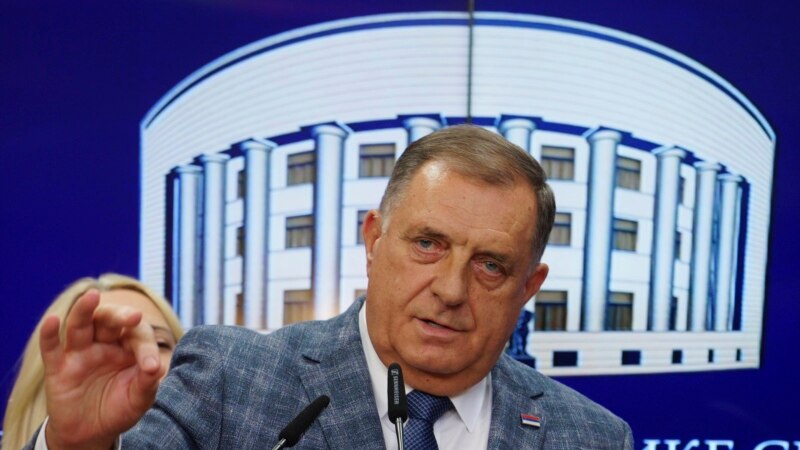
An appeals court in Bosnia-Herzegovina has confirmed a prison sentence for Bosnian Serb President Milorad Dodik for disregarding the decisions of an international peace envoy, a charge the pro-Russia nationalist politician has dismissed as politically motivated.
Dodik was appealing a sentence handed to him in February for defying the Constitutional Court as well as the peace envoy. It included a one-year prison term that under Bosnia’s legal system may be exchanged for a fine, as well as a six-year ban on political activities.
“I do not accept the verdict,” Dodik told reporters. “I will seek help from Russia and I will write a letter to the US administration.”
Goran Bubic, Dodik’s lawyer, said they would appeal the ruling to the Constitutional Court and seek a delay of the implementation of the verdict pending the appeal.
The European Union, which Serbia seeks to join, said the ruling “must be respected.”
“The EU calls on all parties to acknowledge the independence and impartiality of the court, and to respect and uphold its verdict,” the European Union’s diplomatic service said of the prison sentence.
The furor around Dodik has ignited a major political crisis in the EU membership hopeful, which is often referred to as the world’s most complex democracy.
Since the Dayton peace agreement, which was signed in 1995 and ended the war in Bosnia, the country has consisted of the Bosniak-Croat Federation and the ethnic Serb-dominated Republika Srpska under a weak central government.
While Republika Srpska can pass laws on internal matters, state-level laws and institutions remain supreme according to the constitution.
The Office of the High Representative (OHR) oversees the implementation of civilian aspects of Dayton. Dodik, who is currently under US and U.K. sanctions for actions that Western governments say are aimed at the secession of Republika Srpska from Bosnia, has refused to implement several orders from the OHR.


