


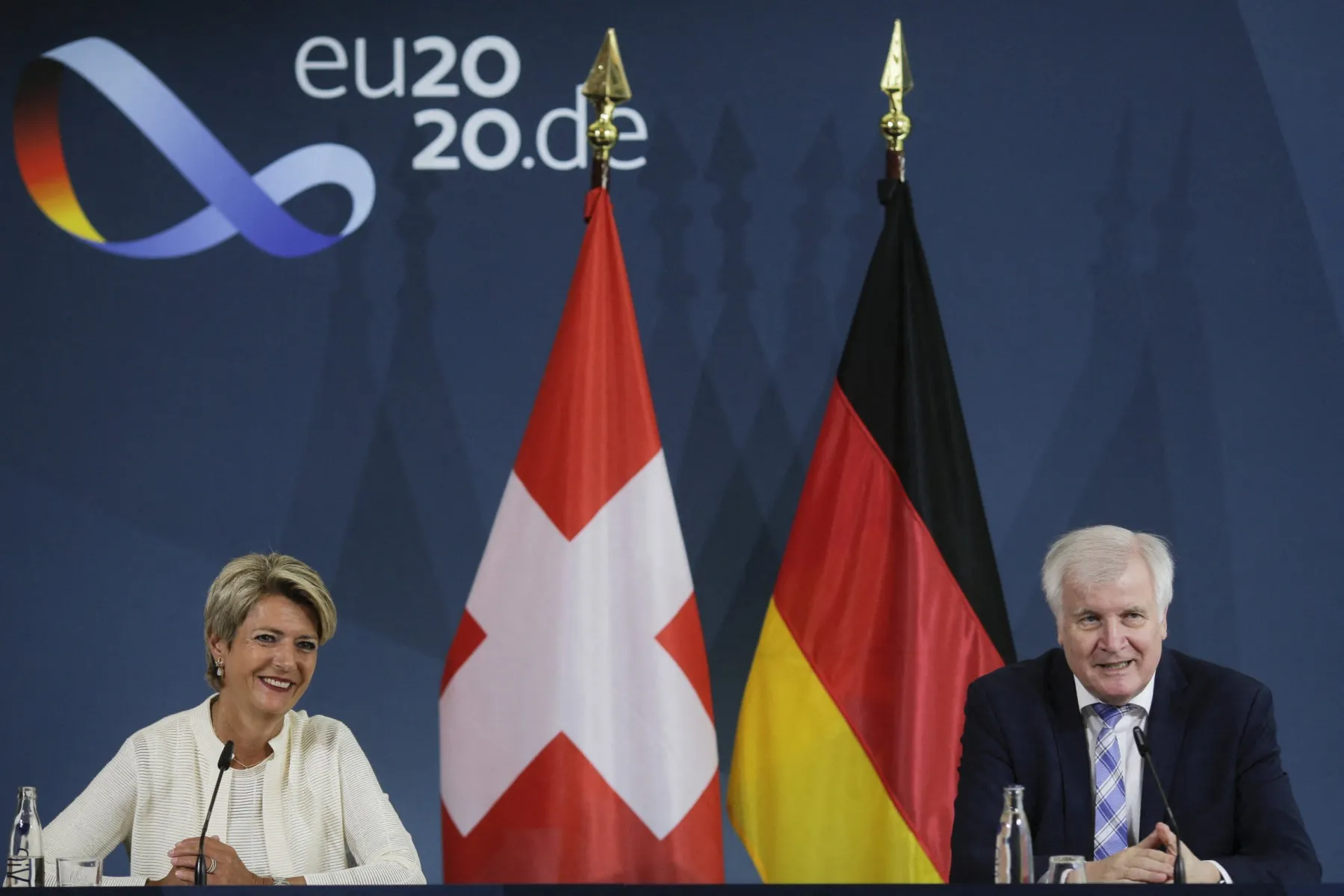
Swiss MPs have passed a parliamentary motion curbing the ability of Switzerland’s top politicians to speak English in international settings.
The motion was instigated by deputy Carlo Sommaruga from the Social Democratic Party, based on the fact that many official Swiss documents that have an international context — such as financial reports, for instance — are written in English.
Sommaruga wants — and the majority of MPs agree — members of the Federal Council to speak one of Switzerland’s official languages — that is, German, French, or Italian — with foreign politicians or organisations which also use these languages, and not automatically revert to English.
According to Sommaruga, “there is no justification” for Swiss ministers to use English.
“Our country boasts a linguistic richness uncommon in Europe, with four national languages,” he wrote in his motion.
Therefore, “the Federal Council is invited to maintain the official Swiss languages with international institutions and organisations when they are also official languages within these institutions or organisations.”
‘Absurd’
But even though the majority of deputies voted in favour of this proposal, Swiss President Karin Keller-Sutter called it “absurd.”
With such a motion, “I will no longer have the right to speak in English with leaders of other countries and organisations,” she said. “Certainly, German, French, and Italian are also official languages in the EU. But if we follow the motion to the letter, English would no longer be permitted.”
As an example, she mentioned a meeting she recently had with former European Commissioner Paolo Gentiloni.
“He and I are fluent in Swiss official languages, but since other colleagues were present, we spoke in English. That would no longer be possible.”
Advertisement
‘Not serious’
Other deputies (presumably those who voted against the motion) also expressed their criticism of the proposal.
“Even the president of Switzerland’s central bank would no longer be able to speak English at the annual meeting of the International Monetary Fund or the World Bank. It would require the use of an interpreter, at great expense,” said Centre Party MP Nicolò Paganini.
This proposal, therefore, “can’t be taken seriously,” he added.
Even Jean-Luc Addor from the right-wing Swiss People’s Party, which normally is staunchly anti-foreign, recommended a flexible approach.
According to him, the goal should not be to ban, but to provide guidelines by “demonstrating common sense and flexibility.”
And “exceptions should be tolerated,” he said.
READ ALSO: How English has become more prevalent in Switzerland


