


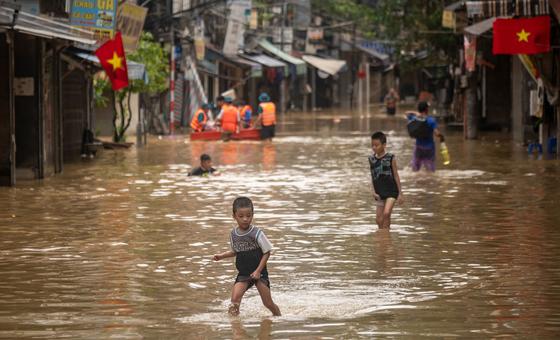
‘The State of the World’s Children 2024: The Future of Childhood in a Changing World’, explores three megatrends young people face including climate disasters, demographic shifts and technological disparities that will dramatically reshape childhood by 2050.
“It is shocking that in the 21st century, any child still goes hungry, uneducated, or without even the most basic healthcare,” UN Secretary António Guterres said in his World Children’s Day message.
“It is a stain on humanity’s conscience when children’s lives are caught in the grinding wheels of poverty or upended by disasters”.
Climate emergency threatens lives
In a stark warning the report reveals children will face eight times more exposure to extreme heatwaves and triple the risk of extreme river floods compared to the 2000s.
Following 2023’s record-breaking temperatures, projected climate hazards will disproportionately affect children based on their socioeconomic settings and access to resources.
“Children are experiencing a myriad of crises from climate shocks to online dangers, and these are set to intensity in the years to come,” warned UNICEF Executive Director Catherine Russell.
“Creating a better future in 2050 requires more than just imagination, it requires action. Decades of progress, particularly for girls, are under threat”.
Shifting demographics
The report also projects significant population changes, with Sub-Saharan Africa and South Asia hosting the largest child populations by the 2050s.
While still high, Africa’s child population will drop below 40 per cent – down from 50 per cent in 2000s. East Asia and Western Europe’s data show a 17 per cent drop compared to 29 perc cent and 20 percent for those regions during the 2000s.
These demographic shifts create challenges, with some countries under pressure to expand services for large child populations, while others balance the needs of a growing elderly population.
Digital divide
While artificial intelligence and frontier technologies offer new opportunities, the report reveals the digital gap remains stark: In 2024 over 95 percent of people in high-income countries have internet access compared to merely 26 percent in low-income countries.
The report notes that youth in developing countries particularly struggle to access digital skills, impacting their educational and workplace prospects.
Signs of hope
Despite these concerns, some positive trends have emerged. Life expectancy at birth continues to rise, and nearly 96 per cent of children globally are expected to receive primary education by the 2050s.
Increased investment in education and public health, and more stringent environmental protection could narrow the gender gap and reduce exposure to environmental hazards, the report reveals.
UNICEF recommends urgent investment in education, services and sustainable and resilient cities for children.
The agency aims to boost climate resilience in infrastructure, technology, essential services and social support systems as well as delivering connectivity and safe technology design for all children.
“The decisions that world leaders make today – or fail to make – define the world children will inherit, Ms. Russell emphasised.


