


Briefing the Security Council on Wednesday, Special Representative Valentine Rugwabiza said the 28 December 2025 polls marked “an important milestone in the consolidation of the peace process and State authority.”
The combined presidential, legislative, regional and municipal elections – including the first municipal polls since 1988 – represented “the most extensive electoral operations ever undertaken in the Central African Republic,” she said.
Voting was conducted “in a peaceful and secure manner across most of the country, despite isolated security incidents.”
Incumbent President Faustin-Archange Touadéra secured an outright majority and won a third term in office.
UN support for the elections
The UN peacekeeping mission, MINUSCA, provided technical, logistical, operational and security support, including transporting more than 232 tonnes of voter information and facilitating the deployment of nearly 500 election-related workers nationwide.
The mission also supported the rotation and reinforcement of 1,237 national defence and security forces and provided assistance packages to more than 800 soldiers in hotspot areas.
The elections also reflected progress on inclusion, with women representing more than 47 per cent of voters and 45 per cent of municipal candidates.
Implementing the peace accord
CAR has faced recurrent cycles of conflict since 2013, when predominantly Muslim Seleka rebels seized power, prompting the rise of largely Christian anti-Balaka militias.
The 2019 Political Agreement for Peace and Reconciliation between the Government and 14 armed groups – brokered with international support – remains the central framework for stabilisation efforts.
Ms. Rugwabiza reported continued progress under that agreement, including the dissolution of two additional armed groups and the signing of a third agreement for the return of the Movement of Central African Patriots to the process, facilitated by Chad.
Since July 2025, more than 1,200 combatants have been disarmed and demobilised.
Security improved, but challenges remain
However, she cautioned that “the continuation of a well-planned and coordinated disarmament and demobilisation process remains essential to sustain security and peace gains.”
Security conditions have improved in western and central regions, but challenges remain acute in the northeast and southeast.
In the southeast, militia attacks targeting civilians and local authorities continue, after 21 voting centres out of 6,700 nationwide were prevented from opening there on election day.
The spillover of conflict from neighbouring Sudan has driven thousands of refugees into northeastern prefectures, straining limited services and exacerbating intercommunal tensions – while further constraining humanitarian access.
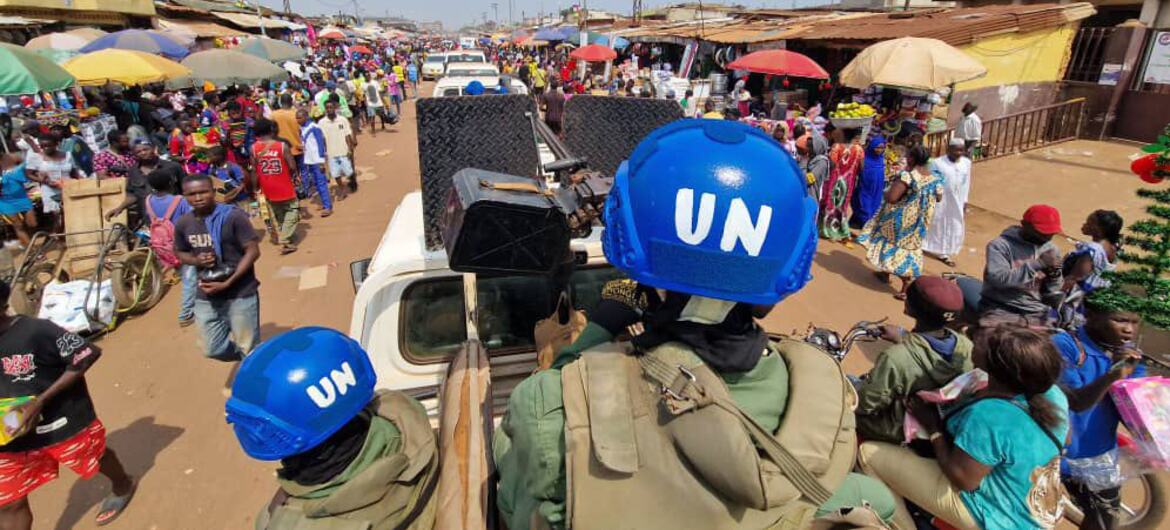
MINUSCA peacekeepers on patrol in a market town in Central African Republic in the lead up to the December 2025 elections.
Cuts to peacekeeping
MINUSCA has consolidated its force presence in affected areas to enhance civilian protection. At the same time, the mission’s operations have been impacted by a lack of money.
As of 2 February, $733 million of the mission’s $1.17 billion annual budget from July 2025-June 2026 remains unpaid (approximately 63 per cent).
Established in 2014, MINUSCA is mandated to protect civilians, support the peace process and help extend State authority.
As the country enters a post-election phase, the mission is seeking to gradually transfer responsibilities to national institutions – a process dependent on continued stability, institutional capacity and reliable financial resources.
Building peace
Omar Hilale, Morocco’s Ambassador to the UN and Chair of the Peacebuilding Commission’s support group working to bolster peace in CAR, said the country was entering “a decisive phase in terms of consolidation, confidence and national cohesion.”
The UN Peacebuilding Commission is an intergovernmental advisory body supporting peace efforts in conflict-impacted nations worldwide.
“We must ensure that political attention to security sector reform remains unwavering,” said Mr. Hilale, while also underscoring the importance of MINUSCA. Any discussions on its future must be anchored in the “realities on the ground,” he said.
“The Central African Republic is entering a new phase, turning resolutely towards the future with renewed determination and commitment. It is, therefore, incumbent upon us to seize this pivotal moment, and consolidate and safeguard the progress made so far,” he said.

