


 AFP via Getty Images
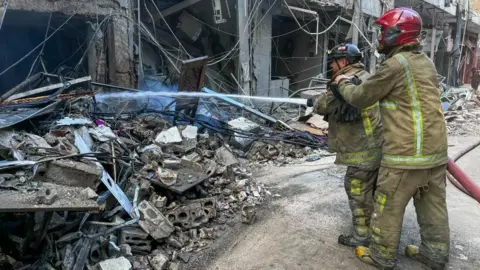
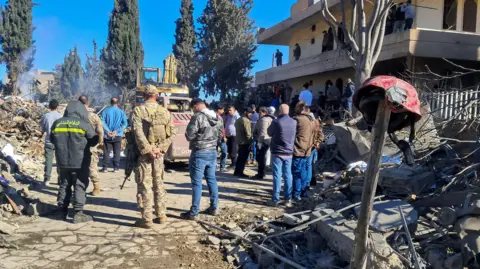
An Israeli air strike on an emergency response centre in north-eastern Lebanon on Thursday killed at least 15 rescue workers, officials say, in one of the deadliest attacks of its kind involving Lebanese emergency responders in the war.
The strike in Douris, near the city of Baalbek, destroyed a building of the civil defence agency, which is linked to the Lebanese government and not affiliated with the Iranian-backed group Hezbollah. The regional governor, Bachir Khodr, said the victims included the city’s civil defence chief, Bilal Raad.
The Israeli military has not commented on the attack, which was described by the Lebanese health ministry as “barbaric”.
The Lebanese civil defence carries out emergency services including search and rescue work and fire-fighting response.
In the southern Nabatieh region, another Israeli air strike on Thursday destroyed the civil defence centre in the town of Arab Salim, killing six people, including five paramedics, the Lebanese state news agency NNA reported.
According to Lebanon’s health ministry, at least 192 emergency and health workers have been killed in Israeli air strikes across the country since the escalation of the conflict with Hezbollah in September.
The attacks come as Israel has intensified its air campaign across Lebanon in recent days, including on Beirut’s southern suburbs, where Hezbollah is based in the capital. The area was hit by air strikes for the fourth consecutive day on Friday following evacuation orders issued by the Israel Defense Forces (IDF), which says it is targeting infrastructure linked to the group.
This comes amid renewed international efforts for a ceasefire, with American officials delivering the first official proposal of a deal to Lebanese authorities.
 Reuters
The Lebanese government says any agreement should be based on the United Nations Resolution 1701, which ended the 2006 war between Hezbollah and Israel. The resolution includes the removal of the group’s fighters and weapons in areas between the Blue Line – the unofficial frontier between Lebanon and Israel – and the Litani River, about 30km (20 miles) from the boundary with Israel.
A potential deal would likely include the deployment of additional troops of the Lebanese army to the area and a mechanism to monitor its implementation, although details remained unclear.
Israel, however, wants the right to act inside Lebanon if there is any violation of a deal. There are no signs that Hezbollah, or the Lebanese government, are willing to accept such a demand.
Hezbollah has been severely weakened after two months of intense air strikes that destroyed large parts of its infrastructure and killed many of its leaders. But after the initial shock, the group seems to have regrouped, according to analysts, and continues to carry out daily attacks on northern Israel, although not with the same intensity.
Speaking in Beirut during a visit of Ali Larijani, senior advisor to the Iranian Supreme Leader, Prime Minister Najib Mikati said the Lebanese government’s priority was to reach a ceasefire and implement Resolution 1701 in “its entirety, without any amendments or interpretations that differ from the content of the resolution and its provisions”. He added that negotiations to try to reach “an understanding” were continuing.


