


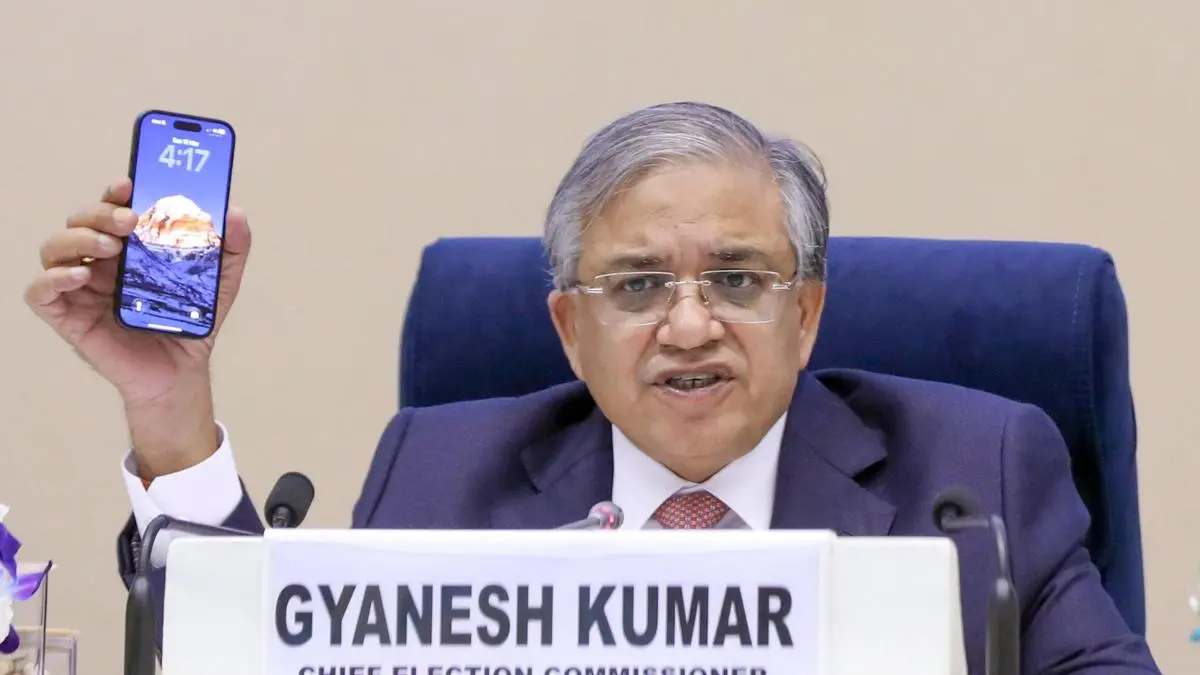
Chief Election Commissioner Gyanesh Kumar addresses a press conference to announce the schedule for assembly elections
| Photo Credit:
ANI
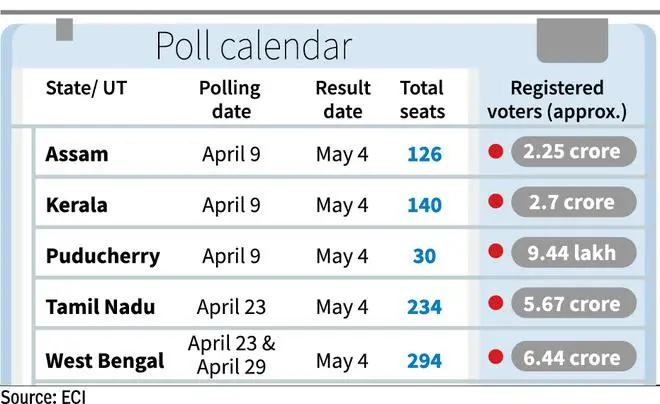
The Election Commission of India on Sunday announced the schedule for assembly elections in West Bengal, Tamil Nadu, Assam and Kerala, along with the Union Territory of Puducherry. Polling will take place in all states between April 9 and April 29, while the results will be declared on May 4.
Assembly elections in West Bengal will be held in two phases — on April 23 and April 29 — while Tamil Nadu will vote in a single phase on April 23.
Meanwhile, polling will be held in Kerala, Puducherry and Assam on April 9 in a single phase.
Alongside these key assembly elections, several States will also see by-elections.
The voting for these by-elections will take place on April 9 in Goa, Karnataka, Nagaland and Tripura, while Gujarat and Maharashtra will hold their by-elections on April 23.
The counting of votes for all these elections will take place on May 4.
Democracy Exercise
Announcing the schedule at a conference in Delhi, Chief Election Commissioner Gyanesh Kumar said the upcoming elections represent a major democratic exercise involving millions of voters across the country.
Kumar highlighted the revision of electoral rolls carried out ahead of the polls, saying the Commission had undertaken the Special Intensive Revision to ensure the integrity of voter lists.
“Pure electoral rolls are the bedrock of any democracy. With this objective, the Special Intensive Revision is being conducted as per Article 326 of the Constitution to ensure that no eligible elector is left out, while no ineligible person is included in the electoral rolls,” he said.
Code Enforced
Replying to a question about the model code of conduct and recent government announcements in West Bengal, he said, “The model code of conduct is applicable from now onwards. So, actions taken before the model code of conduct are the prerogative of the concerned governments. But now onwards, the model code of conduct shall be applicable.”
In responding to a question on why the West Bengal elections were scheduled in two phases this time as opposed to eight phases in the 2021 elections, Kumar said the decision had been taken after careful deliberations.
“In the considered opinion of the Commission, it was found necessary to reduce the number of phases and bring it down to an extent where it is convenient for everybody,” he said.
Answering questions on law and order arrangements, he said the Commission had already sought information from authorities regarding officials linked to earlier election-related violence.
He warned that the Commission would keep a close watch on misinformation, including the misuse of artificial intelligence tools and deepfakes, and said strict action would be taken if such content was used to influence voters
Published on March 15, 2026


