


The US-Israeli war with Iran showed no signs of slowing down on April 2, with reports of air strikes hitting a major Iranian bridge and killing a senior Iranian commander, while US President Donald Trump urged Tehran to “make a deal before it is too late.”
The new strikes came a day after Trump’s TV address to the nation, in which he threatened to bomb Iran “back to the stone ages” and “hit them extremely hard over the next two to three weeks.”
In response, Iranian parliament speaker Mohammad Baqer Qalibaf wrote a defiant message on social media: “Iranians don’t just talk about defending their country, we bleed for it. We’ve done it before, and we’re ready to do it again…. Bring it on.” An Iranian military spokesman warned of “broader and more destructive” attacks to come.
But reports from official Iranian sources highlighted the ongoing cost of the war to Iran. A major new highway bridge, not yet operational, was damaged and Mohammad Ali Fathalizadeh, a brigadier general of Iran’s Islamic Revolutionary Guards Corps (IRGC), was killed in a separate attack, the reports said.
Images on social media showed significant damage to the B1 bridge, which is on a road linking Tehran to Karaj in the Alborz Province and has been described by Iranian media outlets as the highest bridge in the Middle East.
“The biggest bridge in Iran comes tumbling down, never to be used again — Much more to follow!” Trump wrote in a post on his Truth Social platform. “IT IS TIME FOR IRAN TO MAKE A DEAL BEFORE IT IS TOO LATE, AND THERE IS NOTHING LEFT OF WHAT STILL COULD BECOME A GREAT COUNTRY!”
A local official later said eight people were killed and 95 injured in two rounds of attacks on the bridge, Iranian media reported. The account could not be independently verified.
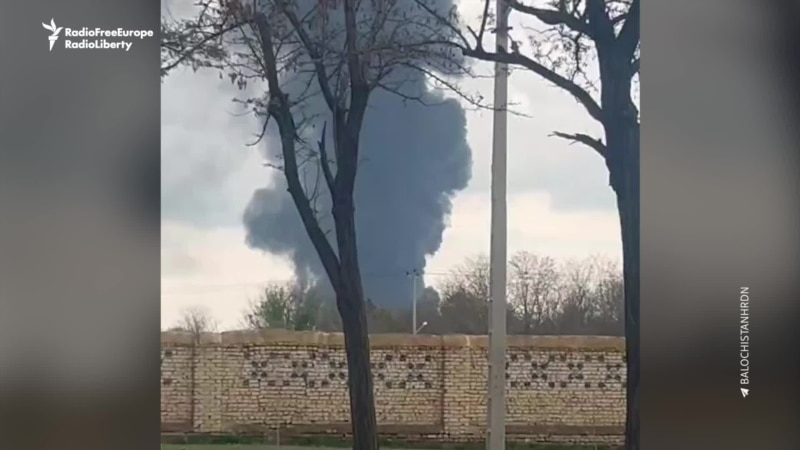
Elsewhere, images on social media showed plumes of smoke at the international airport in Mashhad, a city in northeast Iran, on April 2.
Amid ongoing combat, the Israel Defense Forces (IDF) announced it had struck a “ballistic missile storage site belonging to the missile unit in the Tabriz area.”
Israel was also hit. Emergency services reported rocket fire from Iran’s Lebanon-based Hezbollah proxy group that caused shrapnel injuries to an 85-year-old Israeli man and a 34-year-old foreign worker.
In the Persian Gulf, a spokesman for the Saudi Defense Ministry said four drones and a ballistic missile launched from Iran had been intercepted, while the United Arab Emirates said it had “engaged 19 ballistic missiles and 26 UAVs launched from Iran.”
The US government issued a warning to its citizens in Iraq, saying that “Iraqi terrorist militia groups aligned with Iran may intend to conduct attacks in central Baghdad in the next 24-48 hours.”
The Mood In Iran
Ruslan Suleymanov, a Middle East expert at the London- and Washington-based NEST Center think tank who recently visited Iran amid US and Israeli air strikes, told Current Time he had observed a wide range of attitudes among the Iranian people and that there are currently both supporters and opponents of the regime.
“The opponents are in the majority. But even the opponents of the regime don’t fully understand where this war is heading,” he said on April 2.
The Iranian authorities appeared to be tightening an already brutal crackdown on its opponents, as prominent rights activist Nasrin Sotoudeh was arrested at her home in Tehran last night, her daughter said on Instagram.
This news came after it was reported that Iran had executed an 18-year-old man, Amirhossein Hatami, arrested during mass protests in January.
Meanwhile the health of Iranian Nobel Peace Prize winner Narges Mohammadi has significantly deteriorated in prison, according to her husband, Taghi Rahmani.
Rahmani spoke with RFE/RL’s Radio Farda by telephone on April 1 from Paris, where he is based.
The Strait Of Hormuz
On the diplomatic front, British Foreign Secretary Yvette Cooper condemned Iran’s “recklessness” for stopping nearly all shipping through the Strait of Hormuz — causing global economic chaos as flows of oil, gas, and other vital commodities have come to a halt.
“Alongside today’s discussions, we are also convening military planners to look at how we marshal our collective defensive military capabilities, including looking at issues such as de-mining or reassurance once the conflict eases,” she told an online conference convened by London.
The roughly 40 countries attending the conference did not include the United States, which has called on its allies to secure the strait.
“Today, we looked at diplomatic, economic, and security measures to restore safe passage, alongside working with the shipping industry,” European Union foreign policy chief Kaja Kallas wrote on X after the meeting, which produced no formal agreement.
The strait “is a global public good. Iran cannot be allowed to charge countries a bounty to let ships pass. International law doesn’t recognize pay-to-pass schemes,” she wrote.
Kallas also said the EU naval mission in the Red Sea, Aspides, “must be scaled up,” adding, “We cannot afford to lose another critical trade route.”
Iran, meanwhile, said it was drafting monitoring rules with Oman, which lies across the strait, and current UN Security Council chair Bahrain presented the 15-member group with a new draft of a resolution aimed to protect shipping through the waterway.
“We are developing a protocol for Iran and Oman to monitor passage and navigation through the Strait of Hormuz,” Iran’s official news agency, IRNA, quoted Deputy Foreign Minister Kazem Gharibabadi as saying. There was no immediate comment from Oman.
Bahraini Foreign Minister Abdullatif bin Rashid Al Zayani told the Security Council that country was hoping for a vote on April 3 on the resolution. It would authorize “all necessary means” to protect commercial shipping while specifying that such steps should be “defensive in nature.”
To pass, a Security Council resolution needs at least nine yes votes and no veto from any of the permanent members: The United States, Russia, Britain, France, and China, which has signaled its opposition to any authorization of the use of force.
In comments at a Kremlin meeting with the Egyptian foreign minister, Russian President Vladimir Putin said “we all hope that this conflict will be resolved as quickly as possible. President Trump spoke about this yesterday. I repeat, we, for our part, are ready to do everything possible to bring the situation back to normal.”
Russian Foreign Minister Sergei Lavrov spokes to his Iranian counterpart, Abbas Araqchi, about the war and the situation surrounding the Strait of Hormuz, the Russian ministry said. Putin’s foreign policy aide Yury Ushakov said on state TV that the strait is “open to us.”
In China, which like Russia has close ties to Iran, Foreign Ministry spokeswoman Mao Ning responded to Trump’s speech by calling on all sides to cease military operations, while also criticizing Washington.
“The root cause of obstruction to navigation through the Strait of Hormuz is the illegal military actions by the United States and Israel against Iran. Only through a cease-fire and the achievement of peace and stability in the Gulf region can the security and smooth operation of international shipping lanes be fundamentally safeguarded,” she told a news conference.
China has presented a five-point plan with Pakistan, calling for an immediate cease-fire and talks.
Pakistan has emerged as a potential key mediator for passing messages between the United States and Iran, which have presented wildly different visions for peace.
‘The Key Question’
Tehran is demanding, among other things, reparations and recognition of its control over the Strait of Hormuz. Washington’s plan has not been made public but is believed to include a demand that Iran will agree to not develop nuclear weapons, limits on Iran’s missile capabilities, and an end to Iran’s support for regional proxy forces.
Trump has said Iran is “begging to make a deal” while Iran has denied any talks are taking place.
Kamal Kharrazi, a former Iranian foreign minister believed to be involved in contact with Pakistani mediators was reported to have been seriously injured in an air strike overnight. Kharrazi was taken to a hospital while his wife died in the attack.
“Reports of diplomatic contacts alongside the targeting of figures such as Kamal Kharrazi, believed to have been linked to potential negotiations, have fueled speculation that cease-fire pathways may be actively disrupted by Israel,” Hamidreza Azizi, a visiting fellow at the German Institute for International and Security Affairs, wrote on social media.
“This reinforces Iranian narratives that the Israeli side seeks to prolong the war,” he added.
Meanwhile, the prospect of the war continuing for at least a few more weeks saw oil prices again rising and stock markets showing mixed results.
Speaking to Reuters news agency, Russel Chesler, head of investments and capital markets at VanEck Australia, summed up the mood.
“The key question in all investors’ minds is ‘When is this going to be over?'” he said.


