


One in four jobs worldwide is potentially exposed to what’s known as generative artificial intelligence – or Generative AI – according to a new joint study from the UN labour agency (ILO) and Poland’s National Research Institute. The study finds that transforming job descriptions, not widespread job loss, is the more likely result.
Generative AI (GenAI) refers to systems that can create content such as text, images, code or data summaries in response to user prompts. As such tools become more widely used, they are expected to reshape the tasks employees perform each day.
The new ILO-NASK index draws from nearly 30,000 real-world job descriptions using worker surveys, expert reviews and AI models to identify occupations most susceptible to AI driven change.
“Few jobs consist of tasks that are fully automatable with current AI technology,” the authors write. “Transformation of jobs is the most likely impact of GenAI.”
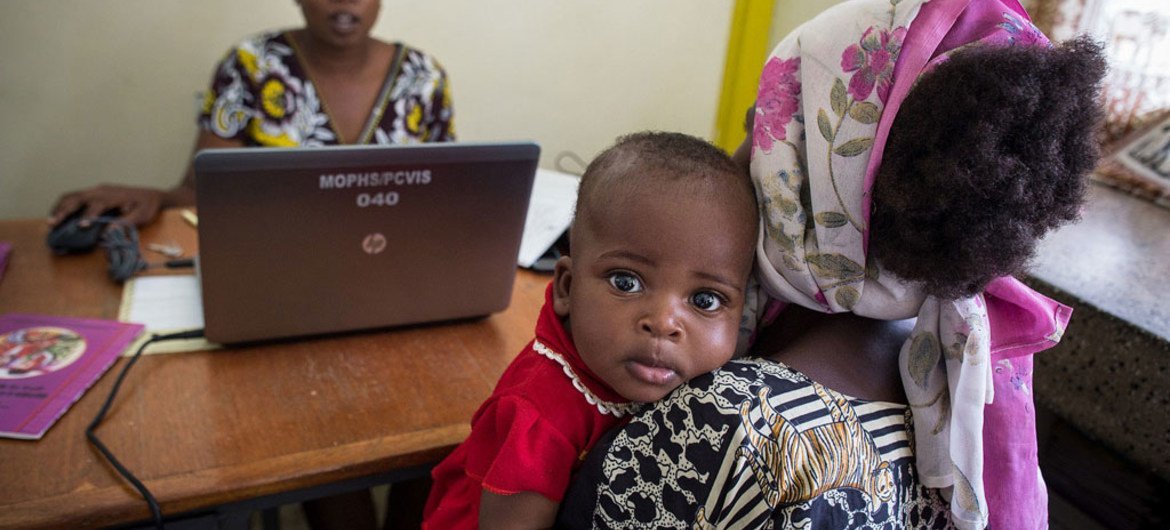
A baby has his general health recorded by a data clerk.
Women face disproportionate exposure
The study finds that in high-income countries, jobs considered at the highest risk of AI-driven task automation account for 9.6 per cent of female employment – nearly three times the share for men.
Worldwide, 4.7 per cent of women’s jobs fall into the highest-risk category, compared with 2.4 per cent for men.
This disparity is due largely to the overrepresentation of women in clerical and administrative roles, which are among the most exposed occupational groups.
These jobs often involve tasks such as data entry and document formatting and scheduling, functions that AI technologies can already perform efficiently.
While these roles are unlikely to disappear entirely, the report warns that partial automation could reduce job quality, leading to fewer responsibilities, stagnating wages and growing insecurity.
Without targeted training or role redesign, some workers – particularly women – may face limited opportunities to adapt.
A global, unequal picture
The report also identifies stark differences across regions. In high-income countries, 34 per cent of jobs are in occupations exposed to GenAI, compared to just 11 per cent in low-income countries.
Middle-income regions such as Latin America and parts of Asia fall somewhere in between.
Europe and Central Asia show the highest gender disparities, driven by high female employment in clerical roles and widespread digital adoption.
Regions such as sub-Saharan Africa, South Asia and the Arab States currently show lower overall exposure but could still experience significant disruption if AI technologies spread without safeguards.
The study cautions that lower exposure does not equal lower risk. In regions where digital access is limited or labour protections are weak, even small-scale automation could destabilise vulnerable sectors.
Turning insight into action
To ensure that the transition to generative AI supports rather than displaces workers, ILO urges governments, employers and workers’ organisations to act decisively.
Central to the recommended response is the need to strengthen access to digital skills and training, particularly for women and those working in clerical or administrative roles.
The agency also highlights the importance of integrating AI planning into broader labour market and education policies.
Preparing workforces for transformation will require not only technical training, but also supportive infrastructure, modernised curricula, and alignment between employers’ needs and national policies.
Inclusivity’s a must
At the heart of this transition, authors stress, must be inclusive social dialogue. Workers should have a say in how GenAI is introduced and used in the workplace, and their experiences must inform decisions about implementation.
Without this engagement, the risks of unequal outcomes, including widening gender gaps and declining job quality, will be much greater.
Finally, the report emphasises that regions with limited digital access must not be left behind. Expanding infrastructure and ensuring equitable access to technology are critical steps in enabling all countries to shape the future of work on their own terms.


