


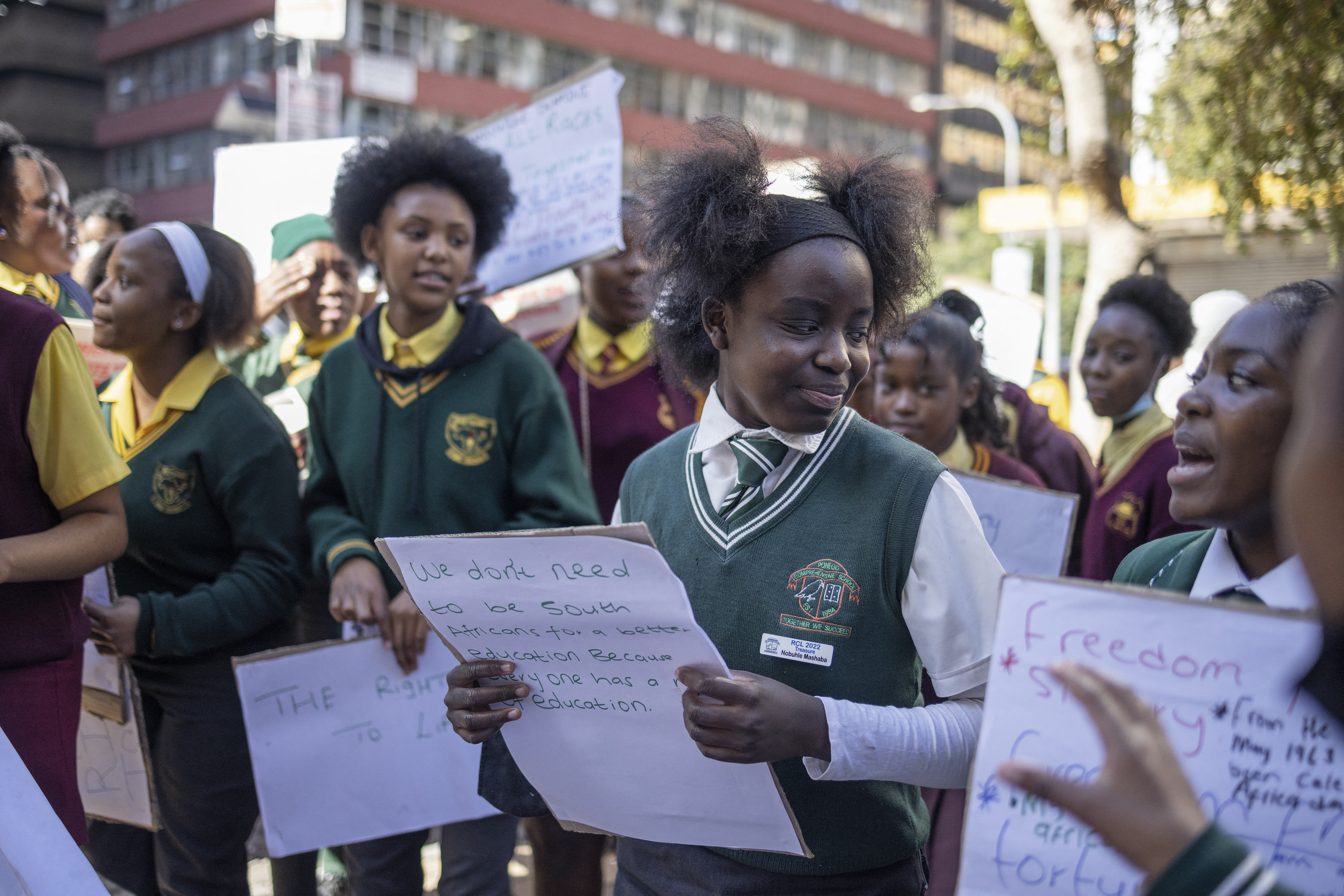
Schoolchildren in South Africa: in most countries on the continent, almost half the population is younger than 25.
AFP
Africa is the future – by 2100, one in three people will live there. As the African Union’s clout grows, Switzerland is stepping up its engagement.


Africa’s demographic surge means the continent will soon account for a major share of the world’s population. According to forecasts, a third of the world’s people will be living on the continent by 2100 – making the continent a sought-after partner in diplomacy, economics and geopolitics.
“Africa […] will play a key role in shaping global developments in the coming decades,” notes the opening line of Switzerland’s new strategy for AfricaExternal link – a sentiment echoed in similar policy papers from other nations.
The surge in diplomatic interest is visible on the ground. In the last decade alone, over 200 new embassies and consulates have opened across the continent – particularly by countries from the Global South seeking closer ties with Africa.
Some of these are in Addis Ababa, the capital of Ethiopia and seat of the African Union (AU). The AU, which includes all African states, represents the continent at the multilateral level. Its aim is economic and political integration, similar to the European Union, with a focus on peace and security. As a result, the AU’s importance is steadily growing.
“The African Union has become a leading force in advancing African interests,” says Dêlidji Eric Degila, professor of international relations at The Graduate Institute of International and Development Studies, Geneva.

Dêlidji Eric Degila, professor of international relations at the Graduate Institute in Geneva.
Courtesy
Like the UN or EU, it faces numerous challenges. But since replacing the Organisation of African Unity in 2002, it is impossible to imagine African diplomacy without it, according to Degila. “Its entry into the G20 in 2023 highlights just how much its role has grown,” he notes.
Ueli Staeger, assistant professor of International Relations at the University of Amsterdam, takes a similar view. “Over the past twenty years, the AU has actively shaped political discourse, built its diplomatic leverage, and still has major untapped potential – which is backed by ambitious goals,” he says.
However, there is plenty of room for improvement. The continent continues to grapple with numerous conflicts that the AU is unable to resolve. Regional integration has stalled, and the Union is hampered by cumbersome bureaucracy and structural flaws.

Ueli Staeger, assistant professor of international relations at the University of Amsterdam.
Courtesy
Degila and Staeger agree that funding is a major problem. “According to my calculations, in some years up to 70% of the AU’s budget came from the European Union,” says Staeger. “This is absurd for an organisation that is committed to the full decolonisation of Africa.”
Many of the Union’s projects rely almost entirely on external funding. Even its symbolic headquarters in Addis Ababa was a gift from China.
“If you are financially dependent on outside partners, you lack autonomy,” says Degila. “It is therefore absolutely essential that African states mobilise more domestic financial resources to ensure the financing of their continent’s organisation.”
Switzerland works to strengthen ties with the African Union
Thanks to its relatively extensive diplomatic network, Switzerland is well connected on a bilateral level with individual African states. It has also long sought to maintain good relations with the AU and holds accreditation with several of its sub-organisations.
“Switzerland takes a smart approach by offering meaningful strategic input with relatively modest effort. One such example is its support for the Oran process, which focuses on continental security and Security Council reform,” says Staeger.
Efforts like these by Switzerland and other countries are also driven by practical considerations. Demographic projections suggest that Africa will become a major force in the global economy, with over 40% of the global labour force expected to be African by 2100.
“The labour force will be in Africa,” says Degila. “For Europe, which is facing a long-term population decline, this represents an opportunity.”
Still, this would require Europe to view migration as more than just a security issue.
“Around 85% of African migration takes place within the continent,” Degila notes, “and most of the remainder migrate legally to other places in the world – often for university study, which raises concerns about brain drain.”
In the long term, regulated migration routes to Europe – with residence and work permits – would be more constructive. But this would also require letting go of the “political and media scare stories of so-called mass migration” to Europe.
As a global financial hub, Switzerland is also seeking closer ties with African financial institutions. It is backing efforts to establish a European office of the African Export-Import Bank (Afreximbank) in Geneva. This multilateral institution, created under the auspices of the African Development Bank, aims to increase Africa’s share of global trade. Establishing such an office in Geneva would bolster the city’s position as a platform for global diplomacy and finance and offer the Swiss financial sector direct access to African markets.
The Swiss government also plans to contribute financially to an increase in the African Development Bank’s guarantee capital. In its official statementExternal link, it frames this move as a gesture of solidarity with Africa – but also acknowledges that, as one of 28 non-African member states, Switzerland is “securing its influence in the Bank.” This is consistent with the Swiss diplomatic approach of maintaining a presence in important international financial institutions.
Swiss reputation at risk
Switzerland enjoys a positive reputation as a partner for African institutions and officials, according to Degila and Staeger. It is seen as a neutral country with a transparent agenda and without a colonial past.
The concept of neutrality, though, is coming under increasing scrutiny. According to both experts, many in Africa believe that Switzerland has abandoned this core principle. Russia claims that Switzerland forfeited its neutrality when it adopted European sanctions – a narrative that has reached a wide audience thanks to Russian propaganda. But Staeger argues that the war in Gaza weighs even more heavily. Switzerland’s silence on the conflict is seen as hypocritical. This, he says, is damaging not only to Switzerland’s credibility, but also to that of the West more broadly, which is accused of having double standards.
There are also fundamentally different interpretations of what neutrality means. “In Africa, neutrality is often equated with non-alignment,” explains Staeger, “so there is a historical basis for this difference in understanding.”
Non-alignment is based on keeping equal distance from both sides – in this case Russia and “the West”. Swiss neutrality, on the other hand, is based on a rule-based model centred on adherence to international law. “Switzerland needs to keep explaining this distinction clearly,” he says.
More

More
Our weekly newsletter on foreign affairs
How Switzerland can maintain its influence
Degila points to the issue of credibility: “Switzerland is becoming more ‘pragmatic’ in its dealings with partner countries in Africa.”
As in all regions of the world, the continent has experienced a wave of backlash against democracy, with setbacks for human rights, the rule of law, and governance. “There have even been a series of coups. Yet criticism from Switzerland has been largely absent,” says Degila.
As a political scientist, Degila understands the realism behind this approach. Africa now has more options in choosing its partners and can turn away from those that are overly critical. But as a citizen of Benin in West Africa, he finds it troubling when Switzerland – a country often seen as a role model for democratic values – fails to take a clear stance.
Diplomatic and political capital, he argues, is built on credibility. When this erodes, so too does a country’s influence. As Degila argues, “Switzerland must find a way to better reconcile its diplomatic pragmatism with its values.”
Edited by Benjamin von Wyl, Adapted from German by David Kelso Kaufher/ds


