


Getting crowded? Yes, according to the right-wing Swiss People’s Party. Voters have their say on June 14.
Keystone / Gaetan Bally
The idea of capping the population at ten million, put forward by the Swiss People’s Party, seems simple. But implementing it would be trickier, especially when it comes to compatibility with international law and rules about asylum and family reunification.
Switzerland is set to reach the mark of ten million inhabitants by around 2040, according to a reference scenarioExternal link from the Federal Statistical Office (FSO). For the Swiss People’s Party, a population beyond this would result in excessive pressure on infrastructure, healthcare, schools, electricity supply and social services in the country. Its immigration initiative, “No to ten million”, which will come to a national vote on June 14, proposes to cap the population at this threshold by 2050.
The proposal seems simple in theory: set a demographic ceiling and act preventively, including by ditching international treaties if necessary. But would the tools set out by the initiative really manage to reduce immigration and avoid exceeding the limit?
A complex equation
The initiative stipulates that if the permanent resident population exceeds 9.5 million before 2050, government and parliament must act to ensure it does not keep rising to exceed ten million. Measures should primarily affect asylum and family reunification, while respecting peremptory normsExternal link of international law.
On average, positive net migration to Switzerland comes to some 70,000 each year, and is by far the main driver of population growth; natural growth, or the difference between births and deaths, is increasingly weak (in 2024 it was around +6,000).
Read our analysis of the challenges posed by immigration-driven population growth in Switzerland and beyond:
More

More
How countries are managing immigration between economic needs and social tensions
In 2025, 31,223 decisions were issued for asylum applications. In addition, some 40,000 people arrive in Switzerland each year to rejoin family members. These numbers may give the impression that a big reduction in net migration is possible. But in reality the room for manoeuvre is limited, with the main areas of action outlined in the initiative being the most difficult to change.
Asylum rules: little room for manoeuvre
Last year, nearly three-quarters of asylum decisions were negative or involved the closure of proceedings, which means the applicants in question must in principle leave the Swiss territory. Only 7,382 applicants out of more than 30,000 actually obtained asylum – receiving a refugee B permit – while 5,005 others were provisionally admitted with an F permit.
Ultimately, this means 12,387 people were authorised to remain, notably because they could not be expelled due to the principle of non-refoulementExternal link, which is protected by peremptory international law. Since the People’s Party initiative guarantees respect for such fundamental rules, it seems difficult to limit the population by targeting the asylum system.
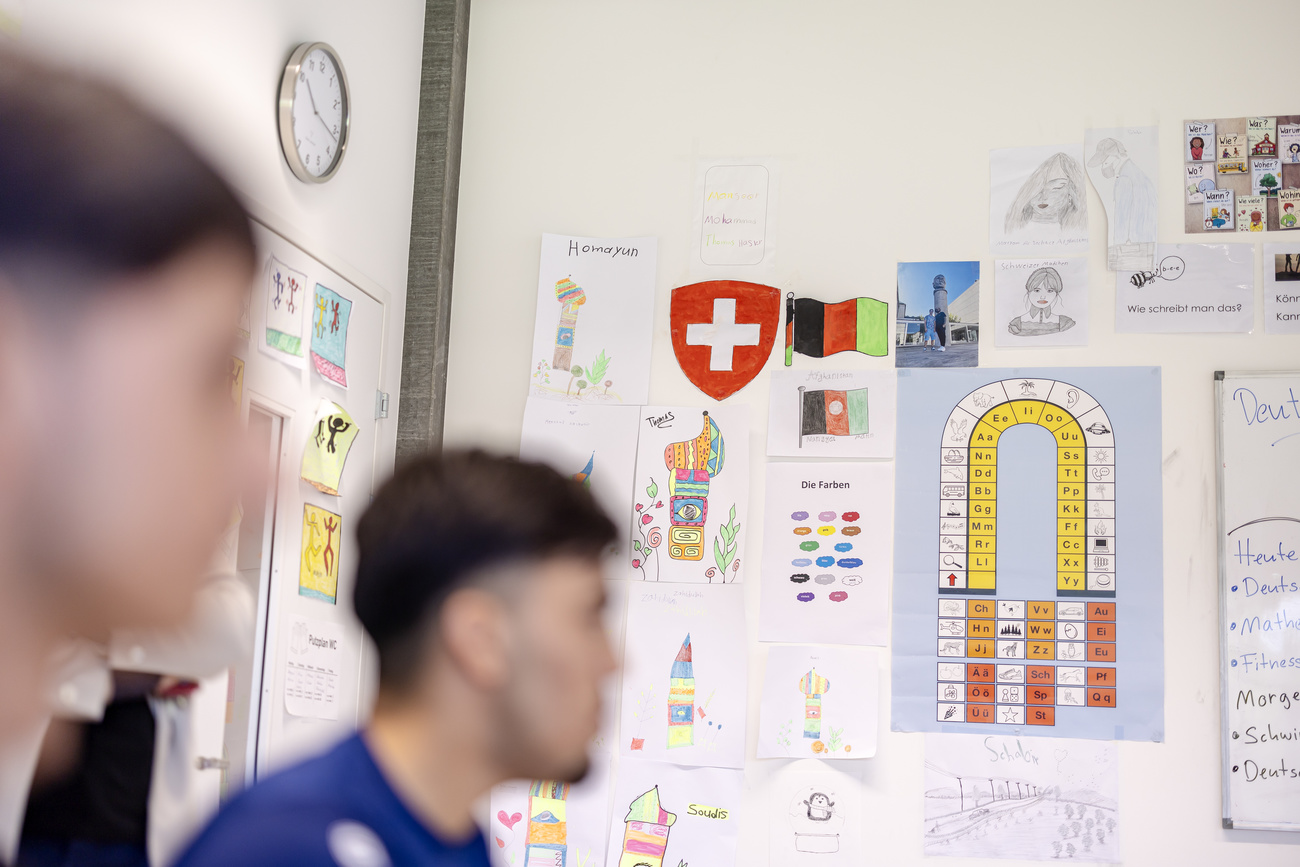
Swiss asylum figures at a glance, illustrated by our colleagues at the Swiss public broadcaster, SRF:
More
More
Asylum in Switzerland: the most important figures at a glance
Clampdown on provisional admissions?
According to the initiative, once the figure of 9.5 million inhabitants is reached, residence conditions for holders of F permits should be tightened, leaving them “no right to stay”.
Asked about the interpretation of this section of the initiative, the parliamentarian Céline Amaudruz, who is also vice-president of the Swiss People’s Party, told RTS that “the aim is to prevent a status designed as provisional or exceptional from becoming in practice an ordinary path to long-term settlement in Switzerland”.
But for Elodie Feijoo, project officer at the information and documentation service of the migration portal asile.ch, the move from provisionally admitted F status to B residence permit is far from automatic. To make it, a holder of an F permit must prove they have become well-integrated; they also have to be financially independent, speak one of the national languages, not be subject to debt enforcement proceedings, have a clean criminal record and have resided in the country for more than five years.
At the end of 2025, 40,000 holders of F permits were in Switzerland, half of whom had been in the country for more than seven years. Also in 2025, just under 3,500 provisionally admitted people moved to a B permit.
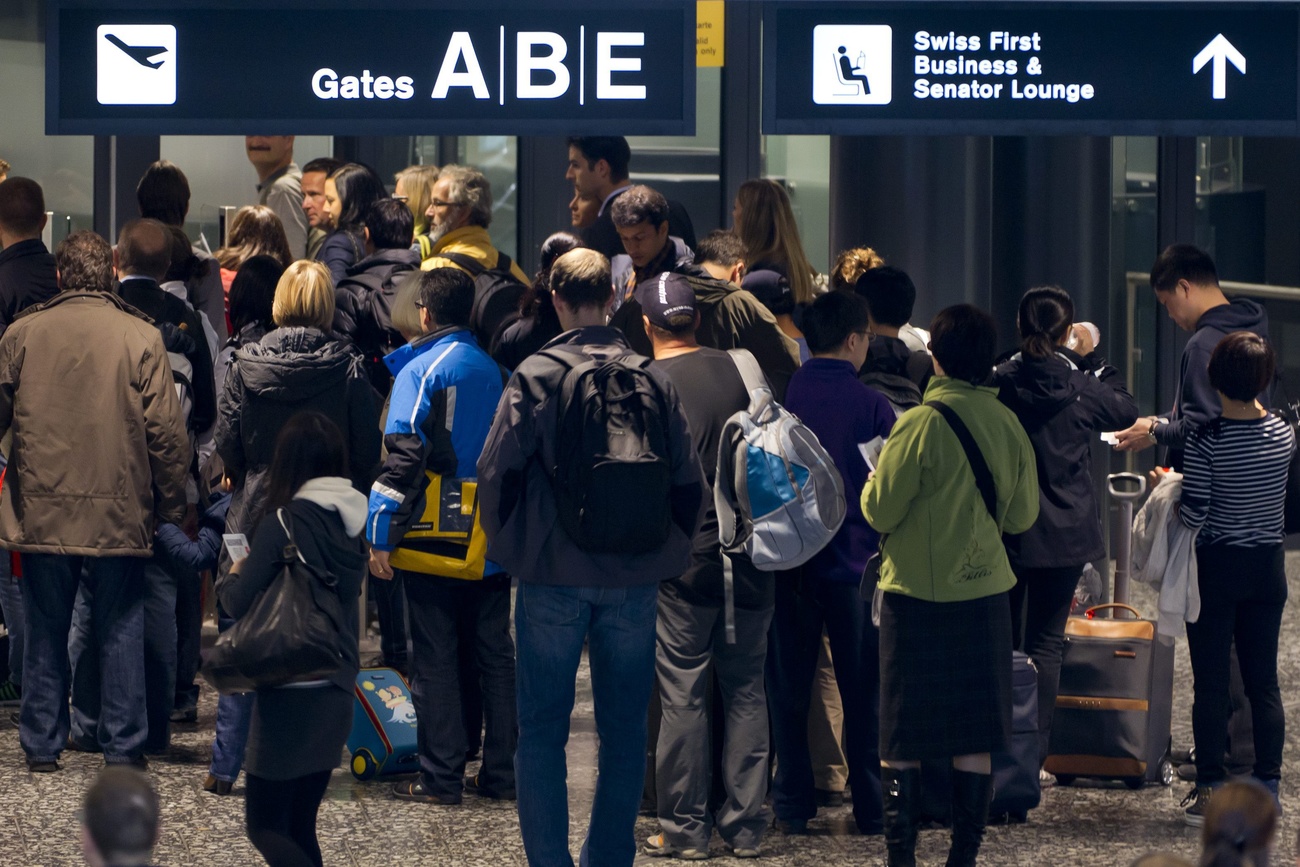
Moving back and forth – read our overview explaining the phenomenon of return migration:
More
More
In Switzerland, migration isn’t just inbound
Family reunification difficult to restrict
The other target of the initiative is family reunification. According to the State Secretariat for Migration (SEM), of the approximately 40,000 people who immigrated to rejoin family members in 2025, around half came under the free movement agreement with the European Union (EU): that is, they were mainly nationals of EU states, coming to join a family member working in Switzerland. The other half was made up of nationals of third countries.
Astrid Epiney, professor of European and Swiss public law at the University of Fribourg, reckons it would be very complicated to lower net migration by clamping down on family reunification.
“The agreement with the EU on free movement provides for a right to family reunification – restricting such reunifications is also in certain cases contrary to the provisions of the European Convention on Human Rights,” she says.
Does international law always trump Swiss law?
When a popular initiative in Switzerland passes the threshold of a majority of voters and cantons, the text is added to the federal constitution. Government and parliament then have the tough task of implementing the text while making sure that all the other parts of the constitution are respected. Other provisions could create tension in relation to the immigration initiative: specifically, it will have to be reconciled with article 5, which outlines the primacy of international law over Swiss law.
One possible solution to this would be the so-called Schubert practice, a case law which was established in the 1970s. This practice allows for – in certain cases – the primacy of federal law over international law.
But the practice has also “clearly eroded over time as the federal court issued decisions protecting human rights and international agreements, such as the agreement on the free movement of persons”, says Cesla Amarelle, professor of public law at the University of Neuchâtel and former cantonal minister for the left-wing Social Democrats in canton Vaud.
Possible alternatives
If asylum and family reunification rules prove difficult to adapt, where is there room for manoeuvre? One option could be to curb immigration of nationals of third countries outside the EU. This type of immigration is already subject to quotas – set each year by the government – and with only qualified workers admitted.
In 2025, the quota for these third countries was 8,500, with 3,500 authorisations also available for UK citizens. However, the limit is not always reached. In 2024, barely 75% of the quota was used for third countries and only some 20% for UK citizens. In total, some 7,000 non-EU people actually obtained a residence permit this way.
If Switzerland stopped admitting these 7,000 nationals, their families, via a knock-on effect, could also no longer join them. This would become an additional lever to reduce immigration – but fewer than 15,000 people annually would actually be concerned.
As such, even by clamping down on nationals from third countries, who are often indispensable to the Swiss economy, it would be difficult to cut net migration in half.
If the People’s Party initiative is accepted in June, government and parliament will thus have to rack their brains to solve the equation of how to make it happen. While setting a demographic ceiling is simple on paper, applying it in reality is much less so.
Meanwhile the initiative foresees a Swiss withdrawal from the Agreement on the Free Movement of Persons if the threshold of ten million is exceeded for two years and no exception or safeguard clause has been negotiated. The Agreement on the Free Movement of Persons was signed between Switzerland and the EU in 1999, and notably makes it easier for citizens of the EU to live and work in Switzerland.
Translated from French using AI/dos
How we translate with AI
We use automatic translation tools, such as DeepL and Google Translate, for some content.
Each translated article is carefully reviewed by a journalist for accuracy. Using translation tools gives us the time for more in-depth articles.
Learn more here about how we work with AI.


