


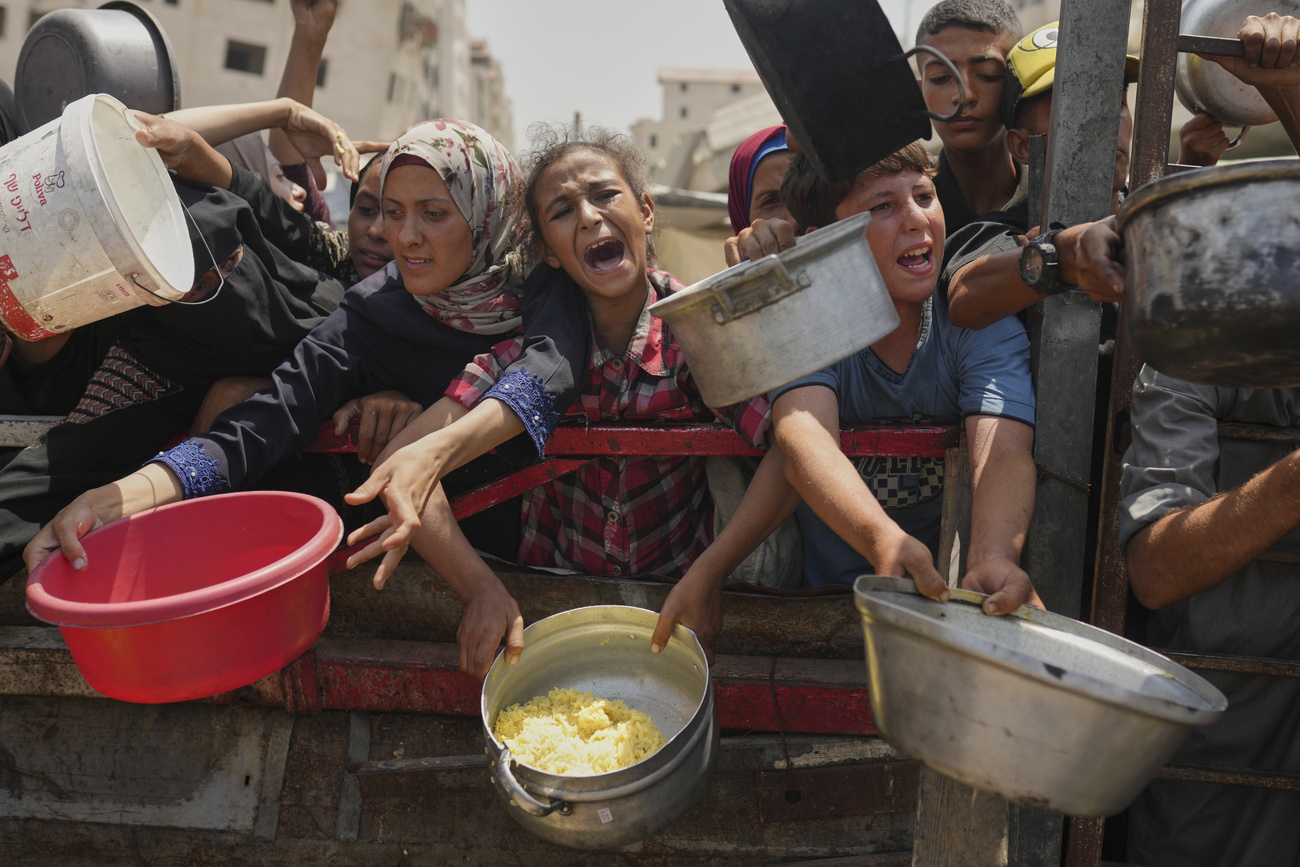
Palestinians struggle to get donated food at a community kitchen in Gaza City, northern Gaza Strip, on August 16.
Copyright 2025 The Associated Press. All Rights Reserved.

Declaring a famine in Gaza is important but won’t bring any short-term relief to the Palestinian population, experts said in reaction to the UN-backed food security body that declared famine in the northern part of the territory on Friday.
Famine has been declared in the northern part of the Gaza Strip, according to the Integrated Food Security Phase Classification (IPC) system, which is used by governments and international aid agencies to identify hunger levels around the world.
“I do think it’s important that the IPC has confirmed that a famine is happening in Gaza, though this does not come as a surprise,” said Anne Saab, professor of international law at the Graduate Institute of International and Development Studies in Geneva.
“The question is to whom does it matter, how does it matter and when does it matter? Will it make a difference to the people dying now? No. IPC confirmation of a famine makes it increasingly difficult for Western governments to deny what is happening, and it gives more leverage to urge Western governments to act. It matters also for accountability.”
Famine affects the administrative district of Gaza, which includes the city of Gaza, the analysis said.
According to the report, the lives of 132,000 children under the age of five are especially at risk due to malnutrition. Of these, 41,000 are considered to be particularly serious cases, twice as many as in the previous assessment in May.
Responding to the report, Israel’s foreign ministry said there was no famine in Gaza.
It accused the IPC of publishing a “tailor-made fabricated report to fit Hamas’s fake campaign”.
More

More
Famine confirmed in Gaza for first time, says UN-backed report
Not a surprise
The report comes after months of repeated warnings by NGOs and UN organisations of dire humanitarian conditions throughout the Gaza Strip. In mid-March Israel imposed a six-week blockade on all food, aid and medical supplies to Gaza, making already catastrophic conditions on the ground even worse.
Under international pressure Israel allowed more aid to enter Gaza at the end of May, which it distributes via the controversial Gaza Humanitarian Foundation (GHF). To date, some 2,000 Palestinians have been killed while accessing food, according to UN figures.
Since June, NGOs and the UN have warned the amount of aid entering Gaza was not nearly enough to avert wide-spread starvation among the population.
Three criteria must be met before a famine can be declared: at least 20% of households are affected by an extreme food shortage, at least 30% of children suffer from acute malnutrition, and at least two adults or four children per 10,000 inhabitants die every day from hunger or due to the combination of malnutrition and disease.
The IPC initiative was founded in 2004. Its members include almost two dozen UN organisations and aid agencies. It is responsible for assessing hunger situations around the world. On the IPC scale, there are five levels of food security in a country or region. The highest – and worst – is level five: “catastrophe/famine”. Below this, the term ‘hunger crisis’ is used. Until now, level four (“emergency”) applied to the entire Gaza.
“It is a famine that we repeatedly warned of, but that the international media has not been allowed in to cover to bear witness,” Tom Fletcher, Under-Secretary-General for Humanitarian Affairs and Emergency Relief Coordinator,said on Friday during a regular press briefing at the United Nations in Geneva.
“It is a famine in 2025. A 21st-century famine watched over by drones and the most advanced military technology in history. It is a famine openly promoted by some Israeli leaders as a weapon of war.”
More
More
Humanitarian community sounds the alarm over famine risks in Gaza
The report comes after Israeli Prime minister Benjamin Netanyahu confirmed the Isreali army would take over Gaza city, a move NGOs said would further increase starvation among the population.
Israel’s defence minister said on Friday Gaza City would be destroyed if Hamas did not agree to disarm and release all hostages.
Israel believes that only 20 of the 50 hostages are still alive after 22 months of war.
“As the occupying power, Israel has unequivocal obligations under international law – including the duty of ensuring food and medical supplies of the population. We cannot allow this situation to continue with impunity,” said António Guterres, Secretary-General of the UN in a statement on Friday.
“No more excuses. The time for action is not tomorrow – it is now. We need an immediate ceasefire, the immediate release of all hostages, and full, unfettered humanitarian access.”
Listen to our podcast on the ICJ case
More

More
Inside Geneva: a look into South Africa’s genocide case against Israel
ICJ ruling pending
Experts questioned by Swissinfo say the report could be part of the case against Israel, accused by South Africa of genocide, pending at the International Court of Justice (ICJ).
“As the report highlights, this is an entirely man-made famine, one deliberately imposed as a weapon of war and ethnic cleansing. Starvation is a war crime, and in the circumstances it most certainly constitutes a crime against humanity and forms part of the unfolding genocide in Gaza,” said Nico Krisch, professor of international law at the Graduate Institute of International and Development Studies in Geneva.
Israel has repeatedly rejected all accusations of genocide.
“Starvation as a weapon of war plays an important role both in the ICC [International Criminal Court] and ICJ cases, and the confirmation of famine adds force to these arguments,” Anne Saab said.
In November 2024 the International Court of Justice issued arrests warrants for Netanyahu and two other senior Israeli officials alleging responsibility for the crimes against humanity and using starvation as a method of warfare.
Edited by Imogen Foulkes/livm/ts


