


Russian forces launched a massive aerial attack overnight on Ukraine on August 21, deploying a combination of drones and missiles against multiple regions of the country, according to the Ukrainian authorities.
The authorities reported civilian casualties and significant damage to residential areas and infrastructure.
The Ukrainian Air Force reported that Russia launched 574 drones and 40 missiles in an overnight attack.
In Lviv, a city in western Ukraine, a Russian missile and drone strike killed one person and injured two others, according to Maksym Kozytskyy, the region’s governor. Dozens of residential buildings were reportedly damaged in the attack.
In Mukachevo, in the Zakarpattya region near Ukraine’s western border, 12 people were injured in a separate missile strike, according to a statement from the city council on Facebook.
In the southern Ukrainian city of Zaporizhzhya, Russian missiles hit residential areas, injuring an 85-year-old woman and damaging several apartment buildings, according to local authorities.
Ukrainian Foreign Minister Andriy Sybiha condemned the strikes in an X post, saying, “Contrary to all efforts to end the war, Russia undertook a massive combined air strike on Ukraine overnight. Hundreds of drones, hypersonic, ballistic, and cruise missiles on civilian and energy infrastructure.”
Sybiha also revealed that one of the missiles hit a major American electronics manufacturing facility in western Ukraine, resulting in serious damage and casualties.
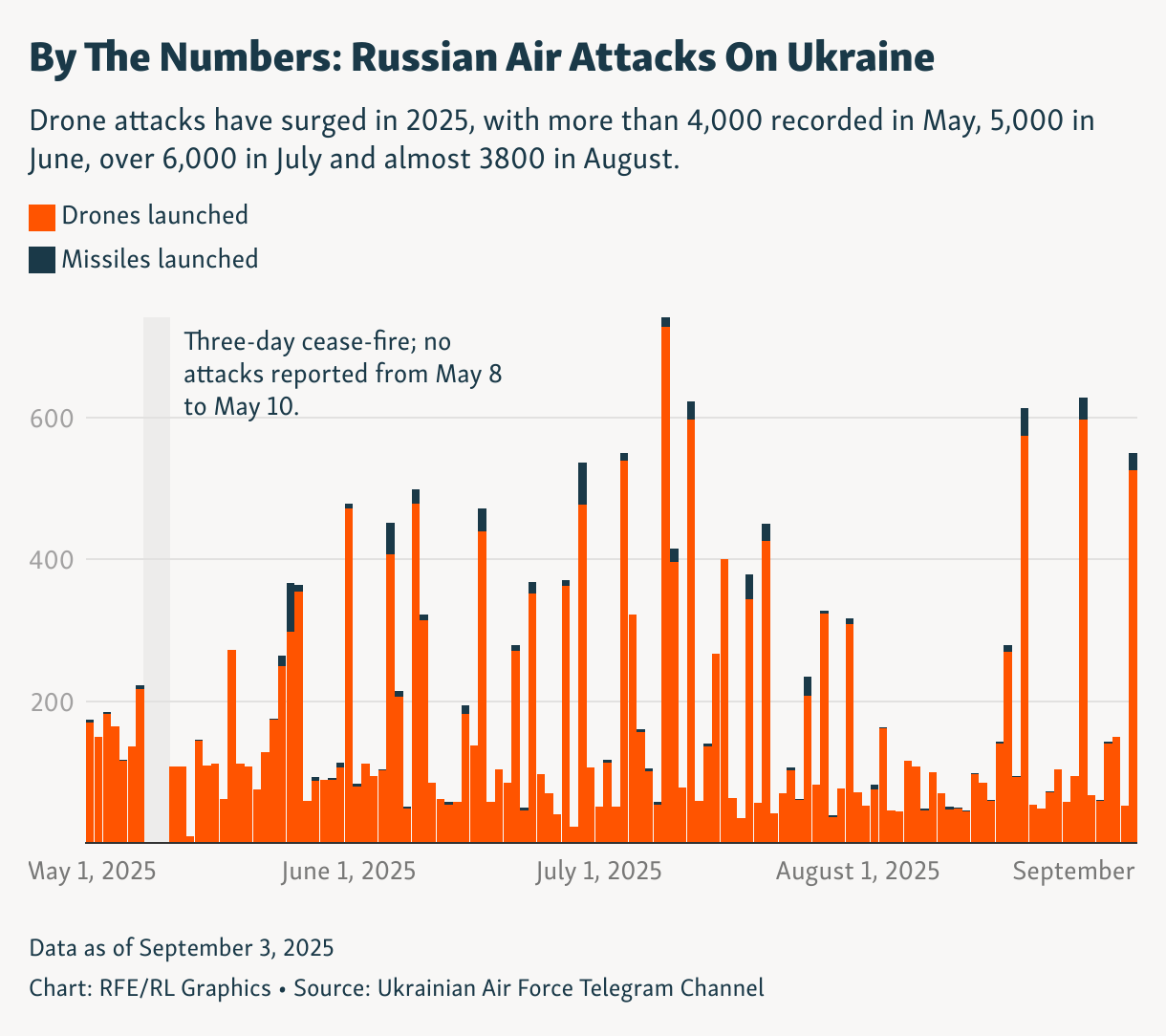
“A fully civilian facility that has nothing to do with defense or the military,” he added, noting that this is not the first time Russian forces have targeted American businesses in Ukraine.
He cited previous strikes on Boeing offices in Kyiv earlier this year.
The latest Russian attacks underscore the growing toll on Ukraine’s civilian population and infrastructure, and come just days after Ukrainian President Volodymyr Zelenskyy met with US Donald Trump and European leaders in Washington to discuss potential security guarantees for Ukraine as it continues to fend off Russia’s full-scale invasion launched in February 2022.
Russia denies deliberately targeting nonmilitary sites, but the strikes routinely destroy homes, hospitals, schools, and energy facilities.
Zelenskyy said that a $90 billion program had been discussed for purchasing US weapons to defend Ukraine.
The outline of a military component of security guarantees for Ukraine is already taking shape, a top Ukrainian official said as the United States reiterated that European countries will have to shoulder most of the burden in providing the guarantees.
Work has begun on setting up the military component of the guarantees, which are being discussed as part of a settlement of the war with Russia, Andriy Yermak, Zelenskyy’s chief of staff, said on X.
“Our teams, above all the military, have already begun active work on the military component of security guarantees,” Yermak wrote on August 20 after a meeting of national security advisers from Western countries and NATO.
On August 20, Russian Foreign Minister Sergei Lavrov said Russia must be involved in the discussions of security guarantees for Ukraine.
“Moscow cannot accept a situation where questions of collective security, especially in the context of the Ukrainian crisis, are decided without Russia,” Lavrov declared. “That is a utopia.”
Could Putin And Zelenskyy Meet?
The Washington talks ended with Trump pledging to get Putin to the negotiating table with Zelenskyy. Trump met with Russian President Vladimir Putin in Alaska on August 15.
The Ukrainian president has repeatedly said he is available for talks but Putin has not. Following the Washington meetings, a Kremlin statement spoke vaguely about higher-level contacts between Moscow and Kyiv — but did not mention the two leaders by name.
“Any contacts involving the most senior leaders need to be prepared with the utmost care,” Russian Foreign Minister Sergei Lavrov said on August 19.
European leaders have voiced skepticism that Putin will come to talks without US pressure to do so. In Washington, German Chancellor Friedrich Merz said, “We don’t know whether the Russian president will have the courage to attend such a summit. Therefore, persuasion is needed.”


