


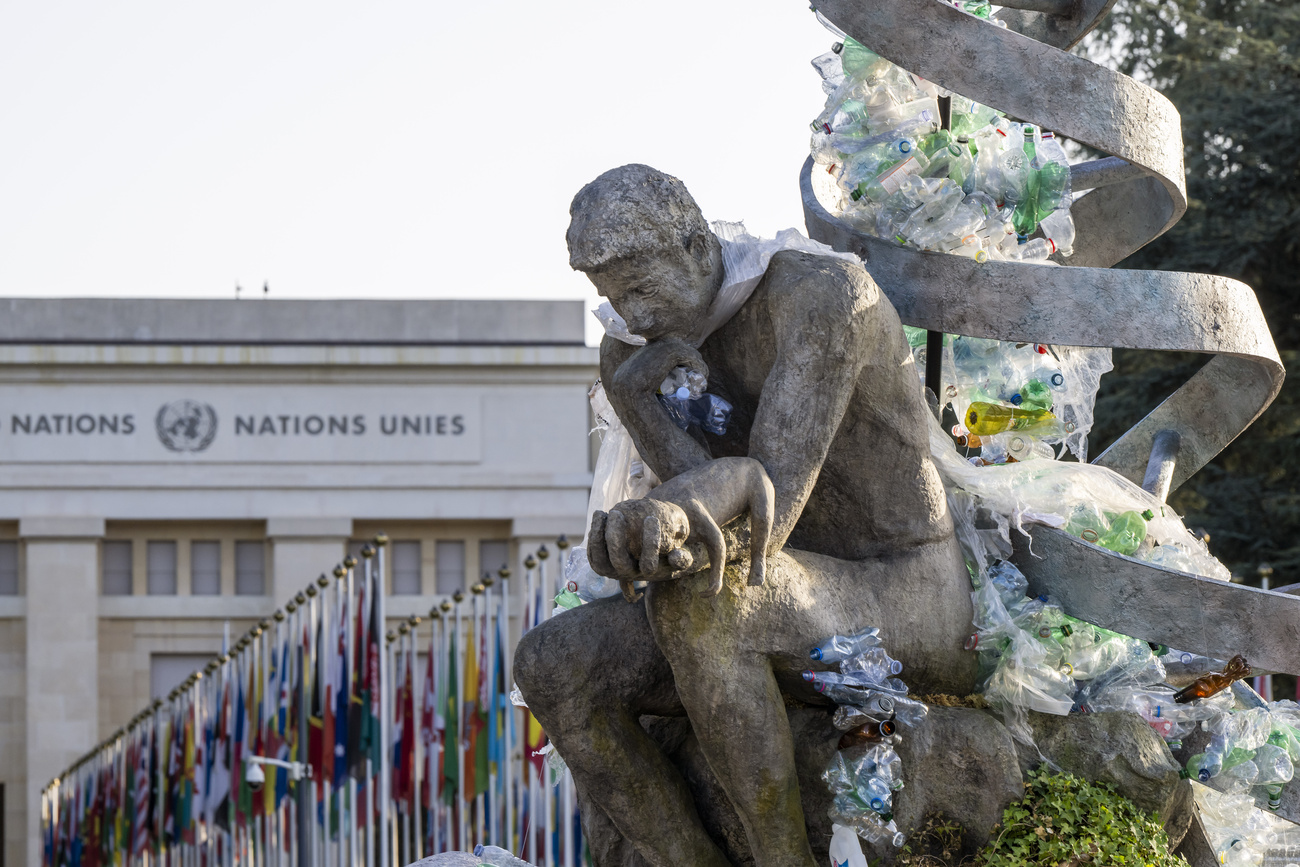
Plastic waste displayed alongside the work “The Thinker’s Burden” by Canadian artist Benjamin Von Wong, created especially for the negotiations on the plastics treaty, in front of the Palais des Nations in Geneva.
Keystone / Martial Trezzini
Negotiations for a binding treaty on plastic pollution broke down in Geneva on Friday. Several experts are pointing the finger at pressure from interest groups and oil- and plastic-producing countries.

The verdict came at dawn on Friday. “We will not have a treaty on plastic pollution here in Geneva,” declared the Norwegian representative during a plenary session.
The negotiations, which had been going on for ten days and were due to end at midnight on August 14, went on until 6am. The heads of the 185 delegations meeting in Geneva were then expected to accept a compromise text, still vague on more than 100 points. Almost all the countries present at the informal session rejected it.
Reducing plastic production was the central stumbling block in the discussions. The aim was to set a global ceiling on production, then gradually reduce it, while limiting the toxic substances used in manufacture. A sensitive issue, which pitted two camps against each other in a tug-of-war that echoed the climate negotiations.
On the one side, an ambitious coalition – to which Switzerland belongs – led by Norway and Rwanda called for a binding target to reduce production by 2040, in line with the UN mandate. This would cover the entire life cycle of plastics, from manufacture to disposal.
Every year, more than 400 million tonnes of plasticExternal link are produced, half of it for single use. Less than 10% is recycled. The rest accumulates in landfill sites, soil and seas, or breaks down into microplastics that contaminate ecosystems and seep into human bloodstream.
Global plastic production has doubled in 20 years and could triple by 2060, according to the OECDExternal link. In response, the UN adopted a resolution in 2022 calling for a binding international treaty covering the entire life cycle of plastics, in particular by curbing their production and improving waste management.
Oil- and plastics-producing countries such as Saudi Arabia, Russia, Iran and China would have sought to limit the treaty to waste management, without restricting production.
Back in December, during what were to be the final negotiations in Busan, South Korea, this bloc of countries opposed any limits on production, resulting in a resounding failure.
“Some countries have not come here to finalise a text but to do exactly the opposite: block any attempt to advance a viable treaty,” said David Azoulay, director of the Environmental Health programme and head of delegation at the Center for International Environmental Law (CIEL).
More

More
In Geneva, global accord in sight on plastics pollution
He described the negotiations in Geneva as a “total failure”. “It is impossible to find common ground between those who want to preserve the status quo and the majority who want a workable treaty that can be strengthened over time.”
Blocking by oil-producing countries and lobbies
But it is also the pressure from lobbies and oil-producing countries that is being singled out. According to an analysis by CIEL, more than 234 lobbyists from the fossil fuel and chemical industriesExternal link were present at the negotiations in Geneva, making up the largest delegation present.
Nineteen of them even joined national delegations, including those from Egypt (6), Kazakhstan (4), China (3) and Iran (3). These included industry giants such as ExxonMobil, Dow and the American Chemistry Council, as well as Coca-Cola and Lego.

Swissinfo
“These lobbyists often exert pressure on member states, use intimidation tactics and seek to reduce the ambition of related processes, thereby standing in the way of an ambitious treaty,” pointed out Ximena Banegas, a specialist in plastics and petrochemicals at CIEL.
What is your opinion? Join the debate:
Towards a new process?
The future of the negotiations is uncertain. Felix Wertli, head of the Swiss delegation contacted by Swissinfo, believes that a pause is necessary. “This is a great disappointment and we must now reflect on the reasons for this failure and determine whether the process should be reviewed. As we have seen, the oil-producing countries strongly opposed the treaty, as did the United States, which did not want international rules.”
For her part, the director of the United Nations Environment Programme, Inger Andersen, says she is confident, despite the fatigue she accumulated during the night’s negotiations. “Despite the disappointment, significant progress has been made. Everyone needs to understand that this work will not stop, because plastic pollution will not stop,” she said.
For David Azoulay of CIEL, any future negotiations will be doomed to failure unless the process changes. “We need a fresh start, not a repeat. The countries in favour of a treaty must withdraw from this flawed process to create an agreement driven by states ready to act, with voting rules that put an end to the tyranny of consensus seen here.”
The presidency has chosen to suspend the negotiations rather than close them, leaving the door open to a new session. The fact remains that the road to a treaty is long and full of pitfalls, in the face of a scourge that continues to grow.
Edited by Pauline Turuban. Translated from French by DeepL/ts
More

More


