


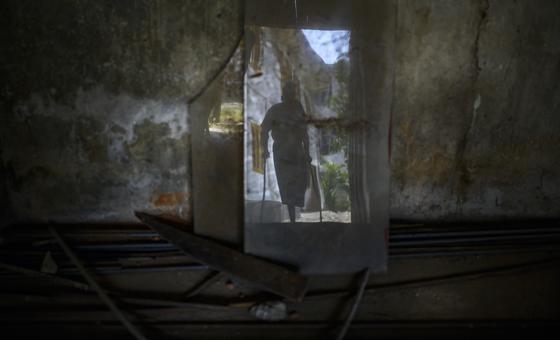
In its annual report released on Tuesday, the Independent Investigative Mechanism for Myanmar (IIMM) said it had made “important progress” documenting crimes and identifying those responsible, including commanders of security forces overseeing detention facilities.
Myanmar descended into civil war following the military coup of February 2021 and the detention of civilian leaders, including President Win Myint and State Counsellor Aung San Suu Kyi. The takeover sparked mass protests, a violent crackdown on dissent and a nationwide armed resistance movement.
‘Significant evidence’
The crimes detailed in Tuesday’s report include burning of sexual body parts, other forms of sexual violence and summary executions of captured combatants or civilians accused of being informers.
“We have uncovered significant evidence, including eyewitness testimony, showing systematic torture in Myanmar detention facilities,” said Nicholas Koumjian, Head of the Mechanism.
“We have made headway in identifying the perpetrators, including the commanders who oversee these facilities and we stand ready to support any jurisdictions willing and able to prosecute these crimes.”
Command responsibility
The report covers the period from 1 July 2024 to 30 June 2025 and draws on more than 1,300 sources, including nearly 600 eyewitness testimonies, photographs, videos, documents, maps and forensic evidence.
It also details intensified investigations into aerial attacks on schools, homes and hospitals – including incidents in the days following the March 2025 earthquake, when rescue operations were still underway.
The UN Human Rights Council-mandated investigators are analysing the composition of the Myanmar Air Force and its chain of command to identify those responsible for such strikes.
New investigations have also been opened into atrocities in Rakhine state, where the military and the ethnic armed group Arakan Army are battling for control, alongside ongoing probes into crimes committed against the Rohingya in 2016 and 2017.
International accountability
Evidence collected by investigators has already supported proceedings before the International Criminal Court (ICC), the International Court of Justice (ICJ) and in Argentina.
It contributed to the ICC Prosecutor’s November 2024 request for an arrest warrant for Min Aung Hlaing, Myanmar’s military chief and to the Argentine Federal Court’s February 2025 warrants against him and 24 others.
“Our report highlights a continued increase in the frequency and brutality of atrocities committed in Myanmar,” Mr. Koumjian said.
“We are working towards the day when the perpetrators will have to answer for their actions in a court of law.”
Spiralling crisis
Fighting between the military, pro-democracy forces and ethnic armed groups has displaced millions and pushed the country into deep political, economic and humanitarian turmoil.
The country also faces the long-running consequences of the 2017 military operations against the Rohingya Muslim minority in Rakhine state.
Those campaigns – described by the then UN High Commissioner for Human Rights Zeid Ra’ad Al Hussein as “a textbook example of ethnic cleansing” – forced hundreds of thousands of Rohingya to flee across the border into Bangladesh, where most remain in crowded refugee camps.
Multiple pressures
Investigators warn their work is being undermined by the UN’s liquidity crisis, which have cut the mechanism’s 2025 budget to just 73 per cent of the approved amount and will require a 20 per cent reduction in regular budget-funded staff in 2026.
To address resource constraints and operational challenges – including lack of direct access to witnesses in Myanmar, security risks and cybersecurity threats – the investigation team has adopted a three-year Strategic Plan, focusing on strengthening operational resilience and enhancing capacity.


