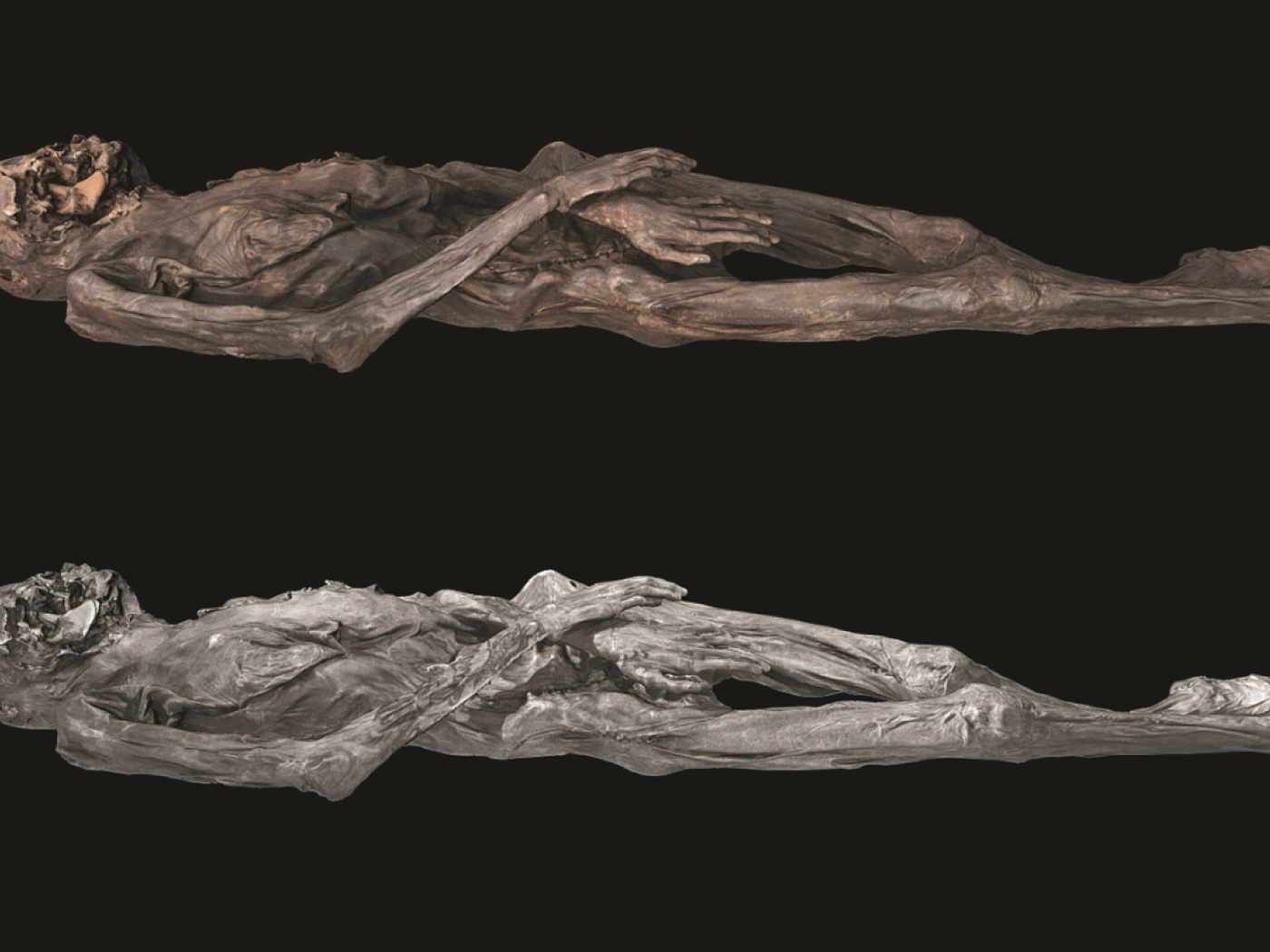
The tattoos of the mummies from the Pazyryk culture provide a better understanding of the way of life of Siberian inhabitants during the Iron Age, says the University of Bern.
Keystone-SDA
Generated with artificial intelligence.
An international research team led by the University of Bern has analysed tattoos on a Siberian glacial mummy that is over 2,000 years old. For this study, the scientists collaborated with a contemporary tattoo artist.
This content was published on
The mummy, a woman in her fifties, comes from the Siberian Pazyryk culture. She was buried in the permafrost of the Altai region, which means that the tattooed skin was exceptionally well preserved.
The tattoos of the mummies from the Pazyryk culture are of crucial importance for the archaeology of Siberia, as they provide a better understanding of the way of life of the region’s inhabitants during the Iron Age, the University of Bern said in a statement on Wednesday.
“The tattoos of the Pazyryk culture have long fascinated archaeologists because of their elaborate and vivid representations,” explains Gino Caspari, a researcher at the University of Bern’s Institute of Archaeological Sciences and the Max Planck Institute for Geoanthropology in Germany.
More
More
Extreme violence uncovered among Siberian nomadic cultures
This content was published on
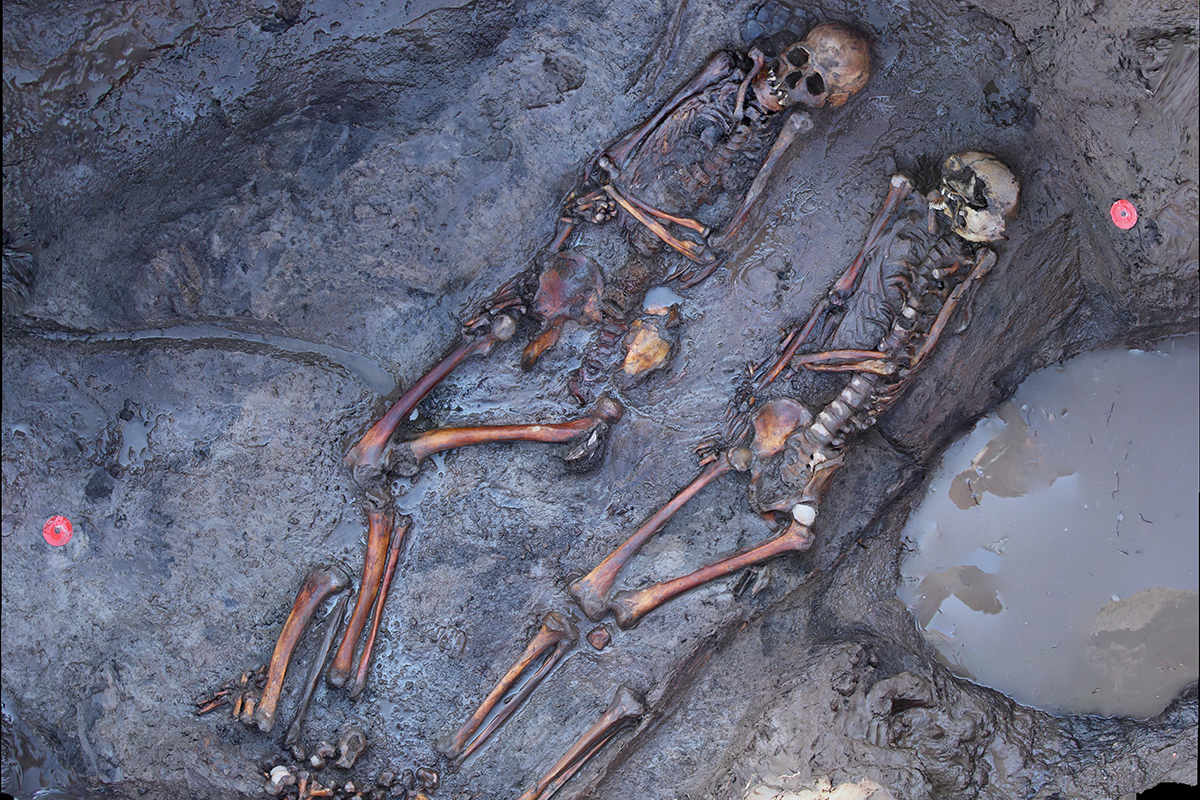
Throat-slitting, scalping and general violence played a major role among Siberian steppe nomads, a gruesome analysis has found.
The mummy had tattoos on her hands and forearms. While the images on the hands are mainly simple motifs, such as a cockerel on the left thumb, the forearms feature some of the most complex Pazyryk tattoos currently known: scenes of animal fighting. In both cases, predators are attacking an elk of some kind.
For a complete analysis of the tattooed skin, the team created a three-dimensional image of the mummy using digital infrared photography with sub-millimetre resolution.
Working with contemporary tattoo artists, the scientists analysed the tattoos in detail, enabling them to identify specific tools and techniques used during the process. They found that a perforation technique using different tools was used.
A complex craft
Analysis showed that the tattoos on the right forearm were finer and more technical than those on the left. This indicates that different tattoo artists were involved, or that the same person tattooed at different stages of their training.
These findings show that tattooing in the Pazyryk culture was not just a means of aesthetic expression, but a specialised craft that required technical skills, an aesthetic sense and training.
“Our study opens up new perspectives on individual scope in the shaping of the prehistoric body,” says Caspari. “Thanks to our study, tattooing appears not just as a symbolic ornament, but as a complex craft that has nothing to envy the art of modern tattooing,” he adds in the statement.
“It was as if we could really meet the people behind the art for the first time, see how they worked, learned and also made mistakes. The images began to come alive,” says the researcher. The study was published in the specialist journal Antiquity.
Translated from French with DeepL/gw
We select the most relevant news for an international audience and use automatic translation tools to translate them into English. A journalist then reviews the translation for clarity and accuracy before publication.
Providing you with automatically translated news gives us the time to write more in-depth articles. The news stories we select have been written and carefully fact-checked by an external editorial team from news agencies such as Bloomberg or Keystone.
If you have any questions about how we work, write to us at english@swissinfo.ch.
More
Swiss president kicks off National Day celebrations on Rütli meadow
This content was published on
Several hundred people gathered on the Rütli in central Switzerland at midday on Friday to celebrate the national Swiss holiday, before Karin Keller-Sutter addressed the crowd.
US sets deadline for Novartis and other pharma firms to lower prices
This content was published on
US President Donald Trump says he has sent letters to Swiss giant Novartis and other pharma firms calling for lower drug prices in the United States – or face retaliation.
Around 25,000m3 of rockfall registered in Swiss village of Brienz
This content was published on
More rock has come loose in the eastern Swiss village of Brienz than initially assumed following rainfall last weekend, said a new situation report published on Friday.
Switzerland testing AI tools to make scarecrows more effective
This content was published on
The Swiss agricultural research centre Agroscope is testing an AI system to more effectively prevent damage to agricultural crops caused by crows and rooks.
UN in Geneva calls for reform of tariffs on plastics
This content was published on
The United Nations is calling for a reform of customs tariffs on plastics, which are lower than those imposed on alternatives, ahead of negotiations for a treaty to limit plastic pollution.
Two robots play hide-and-seek in space with Swiss help
This content was published on
Robots developed separately have worked together at the International Space Station (ISS) for the first time, helped in part by a control centre in Switzerland.
Earth’s magnetic field is older than previously thought: Swiss scientists
This content was published on
Scientists at the Swiss federal technology institute ETH Zurich have shown that the protective magnetic field already existed more than a billion years ago.