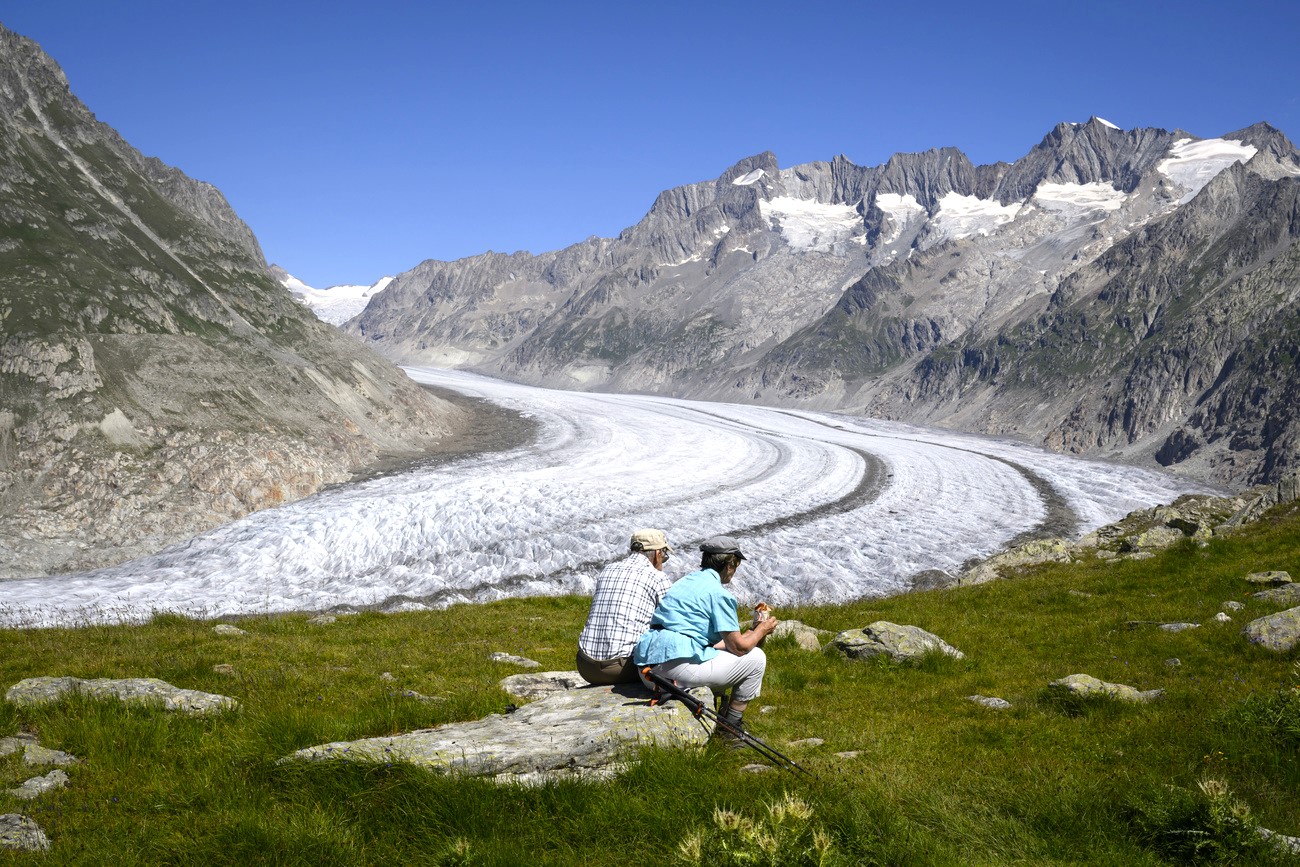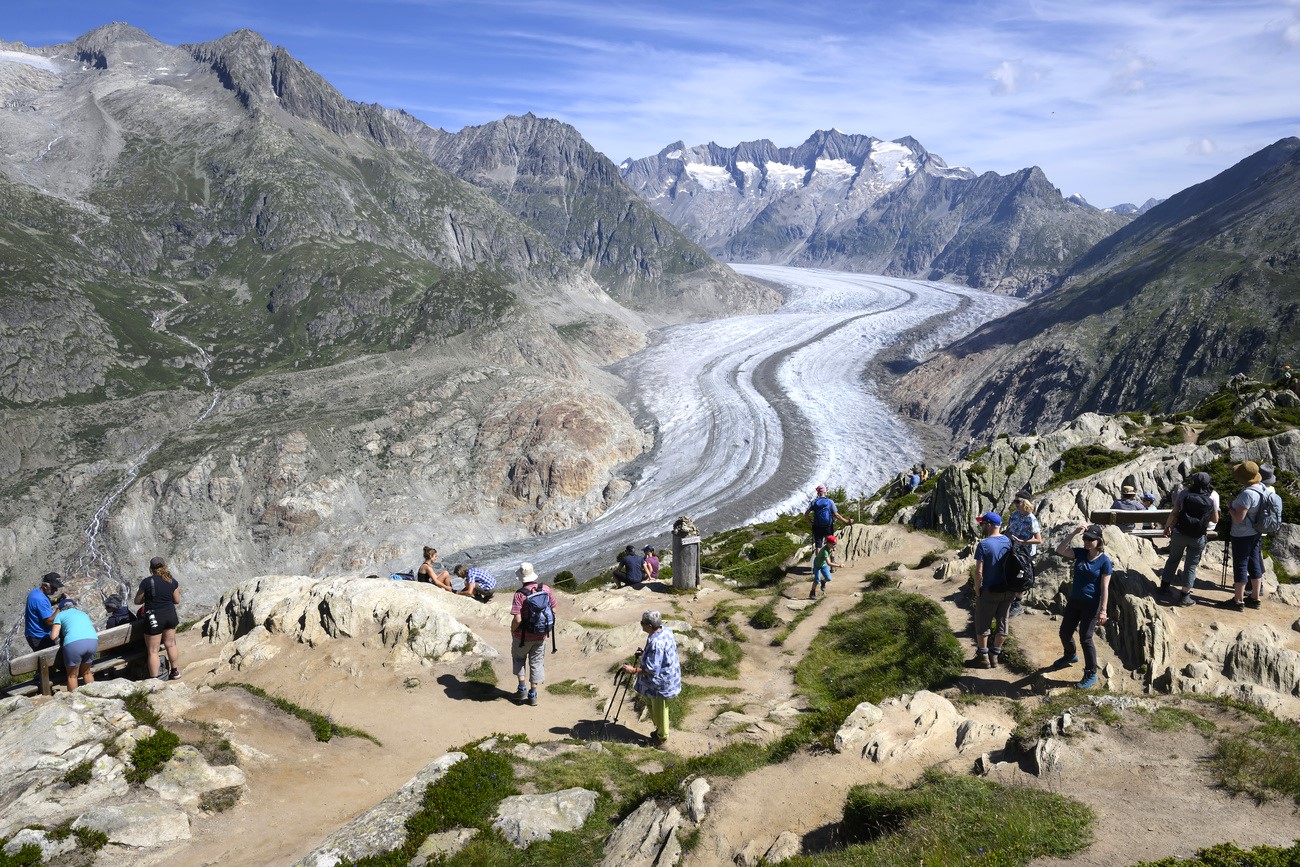
Tourists admire the Aletsch glacier, the longest in Europe.
Keystone / Anthony Anex
Climate change is putting glacier tourism at risk. A vital industry for local communities could disappear. A researcher at the University of Lausanne has come up with solutions to ensure this doesn’t happen.

Every year, glaciers draw millions of people to the Alps in Europe and to other regions of the planet, from North America to New Zealand.
Glacier tourism is a source of income for local communitiesExternal link. Ski resorts, hotels, and mountain guides depend directly or indirectly on the presence of glaciers. Even local infrastructure is built around glaciers.
“The melting of glaciers does not necessarily mean the end of tourism in glacial environments”
Emmanuel Salim, expert in glacier tourism
In Switzerland, glaciers helped to prompt the birth of Alpine tourism and inspired the development of cable cars and ski lifts. The Jungfrau Railway, opened in 1912, was built in part to make the glaciers in the Bernese and Valais Alps more accessible.
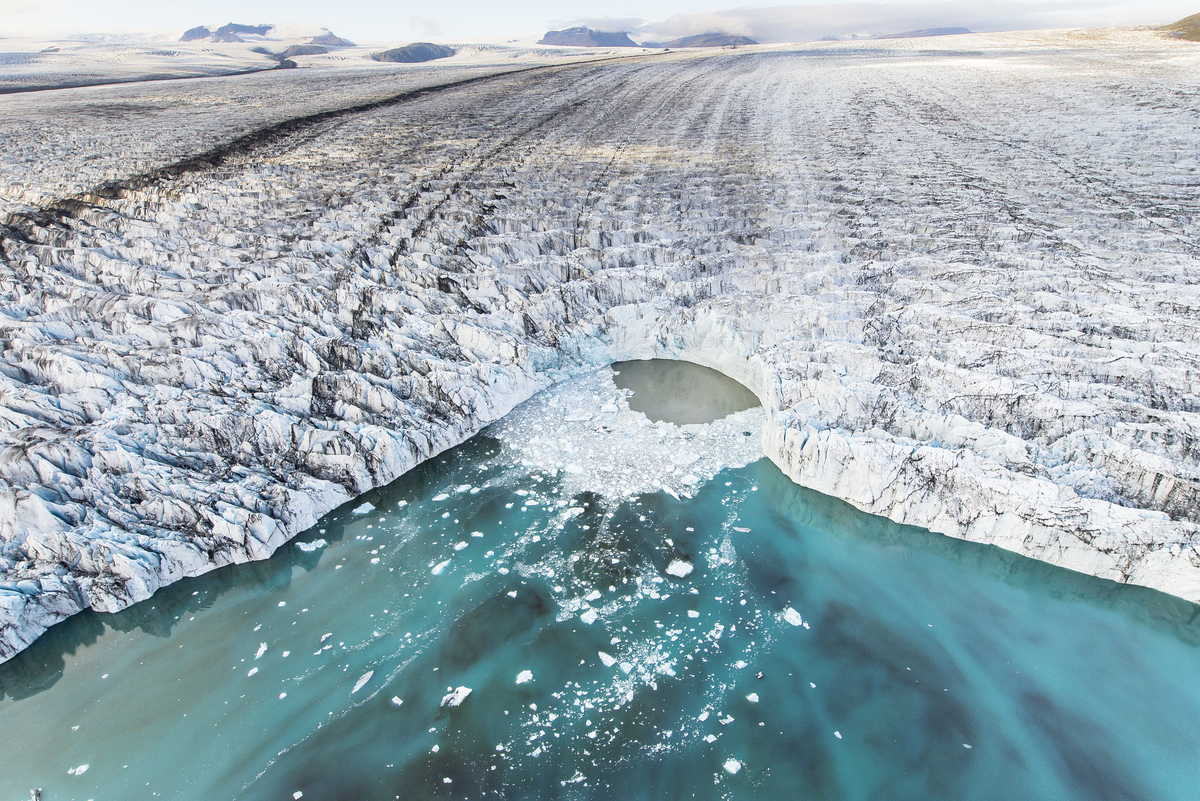
However, glaciers are melting at an accelerating rate due to climate change. Many could disappear almost entirely in the coming decades. This is among the reasons why the United Nations has designated 2025 the International Year of Glacier Preservation.
Glacier retreat is making it more difficult for people to reach high-altitude summits and mountain huts. Melting glaciers and thawing permafrost destabilise the land on which cable cars and other tourist infrastructure lie. Activities such as mountaineering and visiting ice caves, such as on the Rhone Glacier in the Swiss Alps, will no longer be possible everywhere.
Nonetheless, the appeal of visiting glaciers, or what’s left of them, won’t disappear altogether.
>> Permafrost thaw has negative repercussions for Alpine huts, ski lifts and avalanche protection facilities:
More

More
Melting permafrost threatens mountain regions. What can be done?
Based on concrete cases in Switzerland and France, Emmanuel Salim, an associate researcher at the University of Lausanne and the author of a study on the future of glacier tourismExternal link, sees three possible solutions to ensure the survival of the industry: geotourism, dark tourism (visiting sites with a tragic history), and virtual reality.
“The melting of glaciers does not necessarily mean the end of tourism in glacial environments,” Salim tells Swissinfo.
Focus on the scientific value of the glacier

Emmanuel Salim is assistant professor of geography at the University of Toulouse, France, and research associate at the University of Lausanne.
University of Lausanne
Glacier tourism has long focused on the aesthetic appeal of glacial environments, Salim explains. People visit the Alps, Iceland or mountain national parks in the United States to admire, among other things, the natural beauty and majesty of glaciers.
However, glaciers also have a scientific and educational value as witnesses to the impacts of global warming. In this sense, the Aletsch glacier in Switzerland, the largest in continental Europe, is an interesting case, says Salim.
The area around the Aletsch glacier, in canton Valais, is an important destination for skiing and other winter activities. In summer, thousands of people use cable cars to reach the glacier’s scenic viewpoints.
Melting reduces the glacier’s aesthetic beauty but enhances its scientific significance, Salim points out: “The retreat of the Aletsch makes it an ideal place to directly observe the effects of climate change on the landscape. This scenario opens up new opportunities for geotourism development.”
Geotourism at the Aletsch glacier
Geotourism is a form of tourism that focuses on the geological and geomorphological features of a place. It helps visitors to understand Earth’s history and its natural processes. Examples of geotourism in the world include explorations of the Grand Canyon in the US or excursions to Mount Etna in Italy.
Geotourism is also an interesting approach in areas where glaciers are melting, according to Salim. In the Aletsch area, a UNESCO World Heritage site, the environmental association Pro Natura has been offering tours for years to highlight its glaciological and geological features and local biodiversity. Phone apps, brochures and educational trails raise awareness about the effects of rising temperatures.
“Developing geotourism can be an effective strategy to break away from the main resource – the glacier – and ensure tourist interest even when the ice is gone,” Salim says.
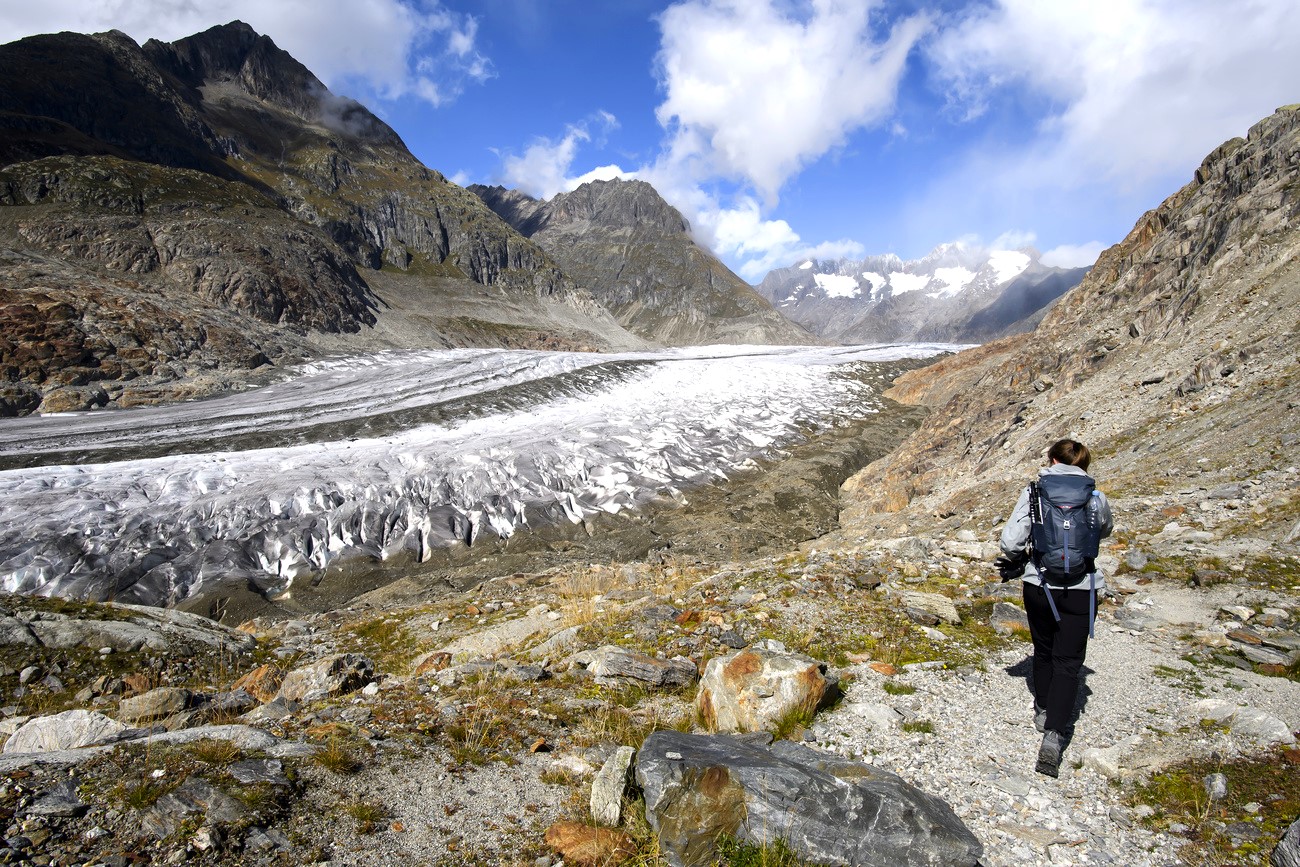
The Aletsch glacier in Switzerland could attract tourists interested in the geological features of this UNESCO World Heritage area.
Keystone / Anthony Anex
Dark tourism at the Mer de Glace
The second approach involves the development of post-glacial tourism. This perspective, Salim argues, could be applied to the Mer de Glace glacier, the most popular glacier in France, with some 450,000 visitors in 2024. In 2050, the glacier may no longer be visible from the observation point at Montenvers, above Chamonix, the Alpine town from which most tourists depart to visit the glacier.
Salim’s surveysExternal link of tourists at Mer de Glace show that a number of visitors are there to see the glacier before it disappears. And many people also express a desire to better understand climate change and its impact on glacier evolution.
“These motivations are often associated with the concept of dark tourism,” Salim explains. This form of tourism involves visiting places linked to natural disasters or tragic events. Among the best-known destinations are the Auschwitz concentration camp in Poland and the Chernobyl nuclear power plant in Ukraine.
In the case of the Mer de Glace and other glacial sites, the transition from “last-chance tourism” to black tourism could allow tour operators to promote a new kind of experience. Previously ice-covered regions could become places to commemorate glaciers – as is already the case with the Okjokull glacier in Iceland and the Pizol glacier in Switzerland – and to think about the consequences of the “climate catastrophe” created by humans.
“With this transition to black tourism, the emphasis is no longer on the glacier itself, but on the impact of human beings on the environment,” Salim says.
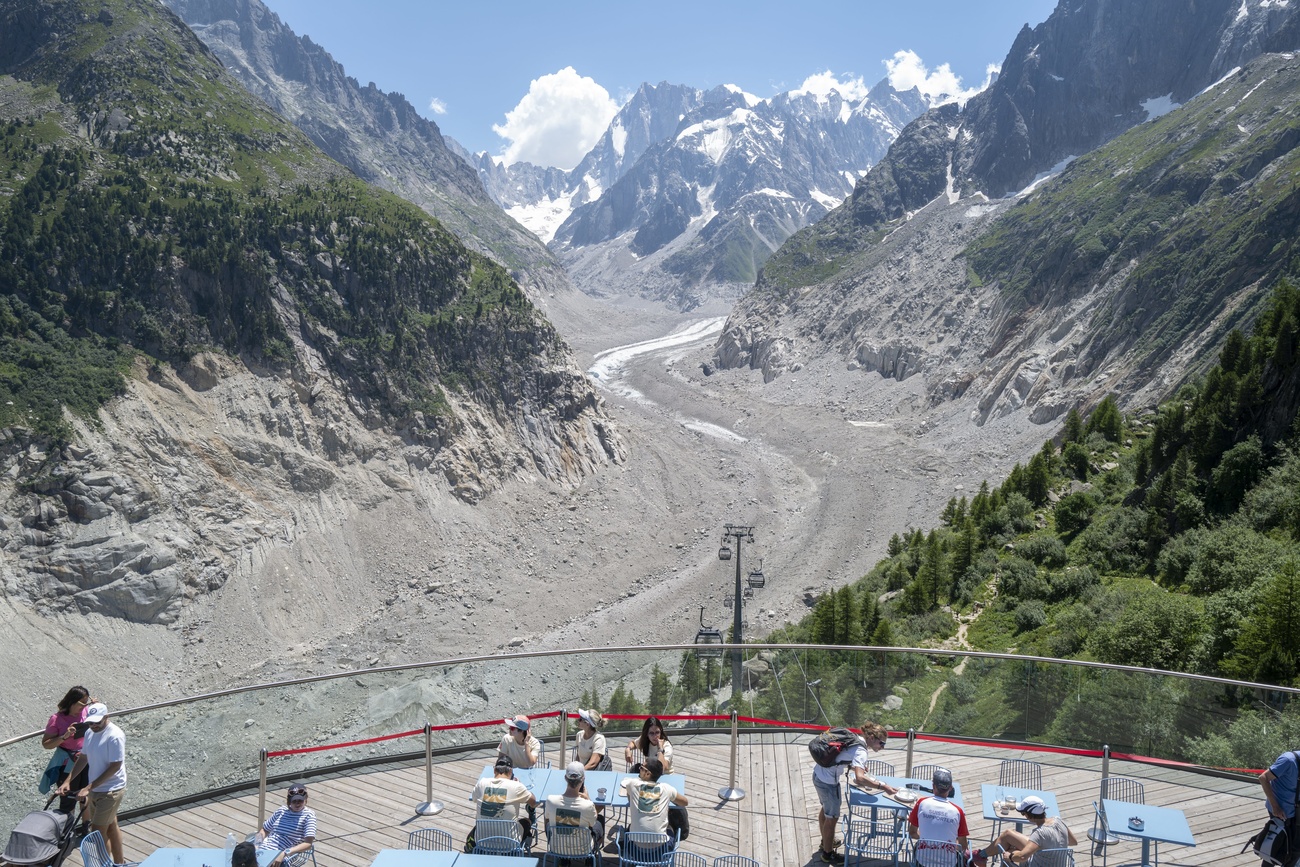
View of the Mer de Glace glacier, France, from the Montenvers viewing platform.
Keystone
Virtual reality on the Morteratsch glacier
Then there is the use of new technologies. Virtual reality makes it possible to reconstruct disappearing glaciers and visualise the future evolution of existing ones. In this scenario, the attraction is no longer the physical glacier, but a virtual representation of it.
Such an experience is already possible for the Morteratsch glacierExternal link in Switzerland. At the visitor centre at the Diavolezza valley cable car station, the public can follow with virtual-reality glasses the history of the glacier and the entire area, beginning in 1875 and ending with predictions for what it will look like in 2100.
Few studies have investigated the use of virtual reality in glacier tourism. However, research on its use for the preservation of archaeological sites in the ArcticExternal link suggests that it could be an effective tool to convey a powerful message, says Salim: “It is definitely an innovative approach.”
>> Experience the Morteratsch glacier with virtual reality:
External Content
Anticipating the disappearance of glaciers
The three strategies are not mutually exclusive. Tour operators can combine them depending on the context and the offer they want to propose. It will be important to take a holistic and anticipative approach to ensure the sustainability of the sector, Salim says.
“This is the only way to maintain activities around the idea of glaciers,” he says, “even when glaciers are no longer the main attraction or they have disappeared.”
Edited by Gabe Bullard/vm/gw