


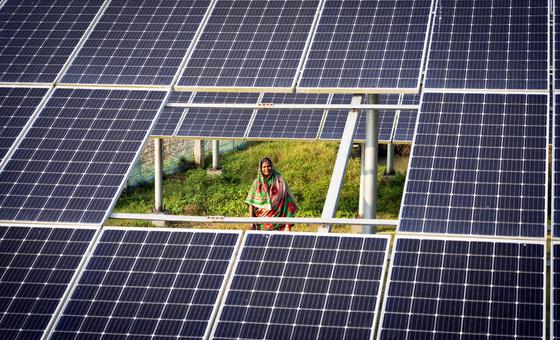
In a special address at UN Headquarters in New York, Mr. Guterres cited surging clean energy investment and plunging solar and wind costs that now outcompete fossil fuels.
“The energy transition is unstoppable, but the transition is not yet fast enough or fair enough,” he said.
The speech, A Moment of Opportunity: Supercharging the Clean Energy Age – a follow‑up to last year’s Moment of Truth – was delivered alongside a new UN technical report drawing on global energy and finance bodies.
“Just follow the money,” Mr. Guterres said, noting that $2 trillion flowed into clean energy last year, $800 billion more than fossil fuels and up almost 70 per cent in a decade.
Key points from the address
- Point of no return – The world has irreversibly shifted towards renewables, with fossil fuels entering their decline
- Clean energy surge – $2 trillion invested in clean energy last year, $800 billion more than fossil fuels
- Cost revolution – Solar now 41 per cent cheaper and offshore wind 53 per cent cheaper than fossil fuel alternatives.
- Global challenge – Calls on G20 nations to align new national climate plans with the 1.5°C target of the Paris Agreement
- Energy security – Renewables ensure “real energy sovereignty”
- Six opportunity areas – Climate plan ambition, modern grids, sustainable demand, just transition, trade reform, and finance for emerging markets.
A shift in possibility
He noted new data from the International Renewable Energy Agency (IRENA) showing solar, once four times costlier, is now 41 per cent cheaper than fossil fuels.
Similarly, offshore wind is 53 per cent cheaper, with more than 90 per cent of new renewables worldwide beating the cheapest new fossil alternative.
“This is not just a shift in power. It is a shift in possibility,” he said.
Renewables nearly match fossil fuels in global installed power capacity, and “almost all the new power capacity built” last year came from renewables, he said, noting that every continent added more clean power than fossil fuels.
Clean energy is unstoppable
Mr. Guterres underscored that a clean energy future “is no longer a promise, it is a fact”. No government, no industry and no special interest can stop it.
“Of course, the fossil fuel lobby will try, and we know the lengths to which they will go. But, I have never been more confident that they will fail because we have passed the point of no return.”
He urged countries to lock ambition into the next round of national climate plans, or NDCs, due within months. Mr. Guterres called on the G20 countries, which are responsible for 80 per cent of emissions, to submit new plans aligned with the 1.5°C limit and present them at a high‑level event in September.
Targets, he added, must “double energy efficiency and triple renewables capacity by 2030” while accelerating “the transition away from fossil fuels”.
Real energy sovereignty
The Secretary-General also highlighted the geopolitical risks of fossil fuel dependence.
“The greatest threat to energy security today is fossil fuels,” he said, citing price shocks after Russia’s invasion of Ukraine.
“There are no price spikes for sunlight, no embargoes on wind. Renewables mean real energy security, real energy sovereignty and real freedom from fossil-fuel volatility.”
Six opportunity areas
Mr. Guterres mapped six “opportunity areas” to speed the transition: ambitious NDCs, modern grids and storage, meeting soaring demand sustainably, a just transition for workers and communities, trade reforms to broaden clean‑tech supply chains, and mobilising finance to emerging markets.
Financing, however, is the choke point. Africa, home to 60 per cent of the world’s best solar resources, received just 2 per cent of global clean energy investment last year, he said.
Only one in five clean energy dollars over the past decade went to emerging and developing economies outside China. Flows must rise more than five-fold by 2030 to keep the 1.5-degree limit alive and deliver universal access.
Mr. Guterres urged reform of global finance, stronger multilateral development banks and debt relief, including debt‑for‑climate swaps.
“The fossil fuel age is flailing and failing. We are in the dawn of a new energy era,” he said in closing.
“That world is within reach, but it won’t happen on its own. Not fast enough. Not fair enough. It is up to us. This is our moment of opportunity.”


