Legal action against Israeli drone purchase
Keystone-SDA
Generated with artificial intelligence.
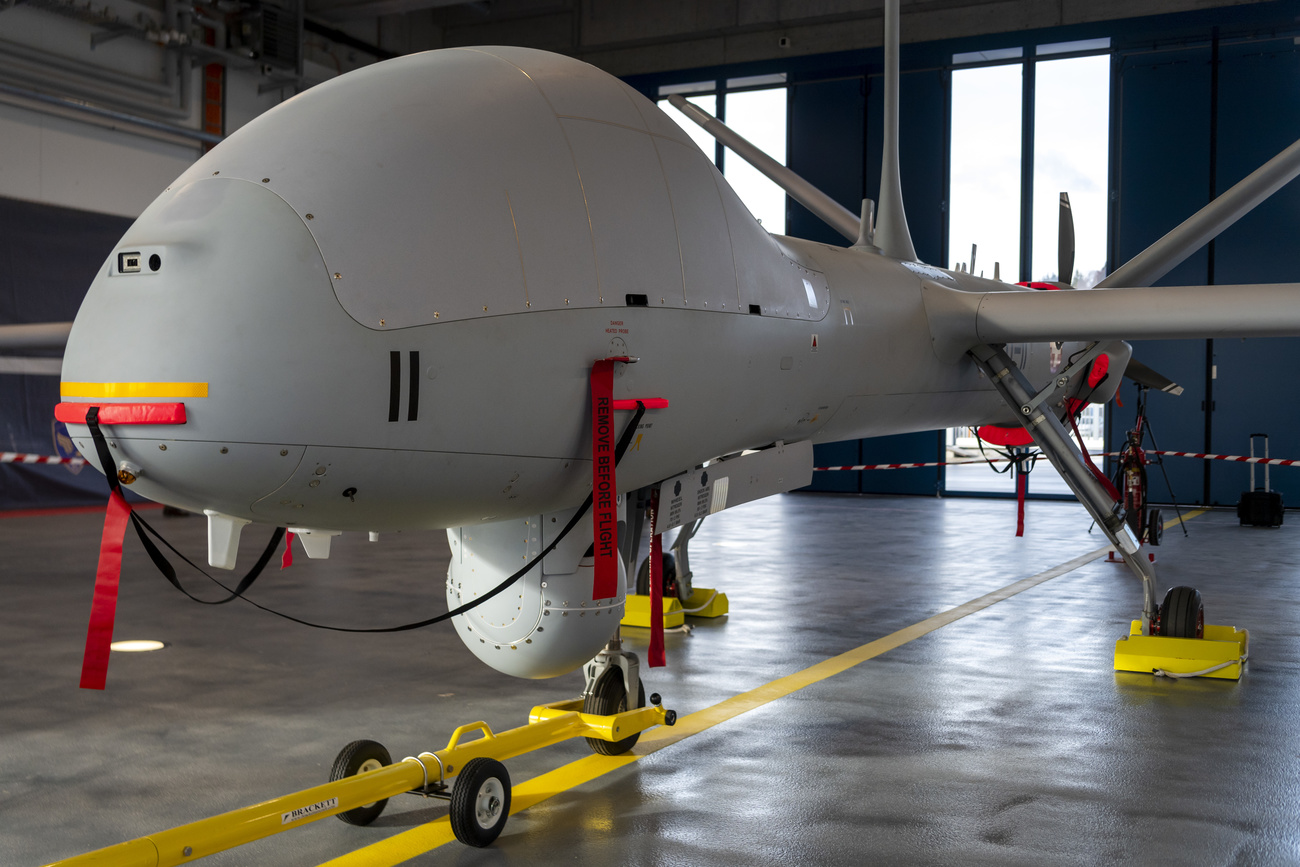
Legal action aims to put an end to the delivery of the six Elbit reconnaissance drones already plagued by delays and setbacks.
This content was published on
The civil case aims to annul the contract signed between the Federal Armaments Office (armasuisse) and the Israeli company Elbit, and was filed simultaneously by a Palestinian couple who fled Gaza in 2024, the Group for a Switzerland without Armed Forces, the Geneva branch of the Swiss Human Rights League, and the Swiss Association of Lawyers for Palestine.
According to lawyer Emma Lidén, quoted in a statement issued today, the application was filed with the cantonal court in Bern, where the federal government is based. The contract, which in fact supports the Israeli army, violates both international and Swiss law, says Lidén.
Originally, the agreement – approved by parliament in 2015 and initially valued at CHF250 million – provided for the delivery of six reconnaissance drones destined for the Swiss Army by the end of 2019. However, as of November 2023, the Israeli company “decided to focus its production capacities on the war effort against Gaza, postponing delivery to the end of 2026”, the statement continues. Meanwhile, the costs of the unmanned (and unarmed) aerial reconnaissance system have risen to CHF298 million.
More
More
Israeli drone headache continues for Swiss army
This content was published on
Swiss army forced to reprogramme Israeli drones to avoid mid-air collisions.
For the plaintiffs, by accepting such a ‘clause’, the federal government “approves and supports the military action of a state that is currently accused of war crimes, crimes against humanity and a possible genocide in Gaza”, the lawsuit states. “As a depositary state of the Geneva Conventions, Switzerland must immediately rescind this illegal and immoral treaty,” it adds.
With this contract, Bern has decided “to do business with a company that supplies weapons used in proven violations of international law”, Lidén stated and claimed that the agreement between Elbit and armasuisse is irreconcilable with the principle of neutrality enshrined in the Constitution.
At the beginning of the month, Urs Loher, head of armament at armasuisse, told Swiss public radio SRF that the delays and setbacks in the delivery of the drones had prompted the defence ministry to re-evaluate the project.
Although Loher himself has long argued that a termination of the contract is out of the question, he said that the ministry has reached a point where it is questioning whether it is worth continuing with the purchase. However, should the project actually be terminated, the armament chief expects that Elbit will certainly submit counter-claims and a lengthy legal dispute will inevitably follow.
More
More
Warfare rewired: drones and civilian risk
This content was published on
Drone warfare is rapidly reshaping modern conflict, raising urgent questions about accountability and compliance with international humanitarian law.
According to armasuisse, therefore, a cost-benefit analysis is underway in order to be able to assess the variants more precisely. If cancellation of the contract is planned, it is particularly important to clarify whether some of the payments already made could be refunded or whether the supplier could even demand additional costs as a result of the investments made.
Adapted from Italian by DeepL/ac
We select the most relevant news for an international audience and use automatic translation tools to translate them into English. A journalist then reviews the translation for clarity and accuracy before publication.
Providing you with automatically translated news gives us the time to write more in-depth articles. The news stories we select have been written and carefully fact-checked by an external editorial team from news agencies such as Bloomberg or Keystone.
If you have any questions about how we work, write to us at english@swissinfo.ch
More
Swiss nuclear plant is off the grid for an indefinite period
This content was published on
The operator must provide evidence of fallback in case of a possible overload in the feedwater pipework system.
Higher direct payments fail to curb scrub encroachment on alpine pastures
This content was published on
The scrub encroachment on Swiss alpine pastures leads to the loss of grassland and damages the typical landscape. It is also responsible for the decline in biodiversity. Despite higher direct payments, the bushes continue to spread.
Swiss population satisfied with life according to survey
This content was published on
In a survey, the population of German-speaking and French-speaking Switzerland expressed general satisfaction with their lives. Respondents were less happy with politics and their personal finances, according to the online comparison service Moneyland.
WHO ‘extremely concerned’ about growing vaccination scepticism
This content was published on
According to the World Health Organisation (WHO), vaccination scepticism and a collapse in funding for vaccination campaigns pose a major threat to the health of the world’s population.
High-net-worth individuals prioritise well-being over material possessions
This content was published on
The priorities of wealthy private individuals have shifted against the backdrop of ongoing geopolitical tensions and trade disputes. While spending on luxury goods is declining, demand for travel and experiences is unabated.
Swiss researchers sequence genome of 1918 Spanish flu virus
This content was published on
Researchers from the Universities of Basel and Zurich (UZH) have sequenced the genome of the Spanish flu virus, thanks to a sample taken from an 18-year-old Swiss boy who died in the city on the Limmat in 1918, when the pandemic spread around the world.