


Prague Correspondent

 BBC
BBCThe Czech capital Prague is one of Europe’s architectural gems: largely untouched by ten centuries of invasion and war, it attracts some 8m tourists a year.
It’s a living tableau of architectural styles; from medieval to Baroque, from industrial to modern. So when a Prague landmark is slated for demolition or reconstruction, it invariably arouses strong passions.
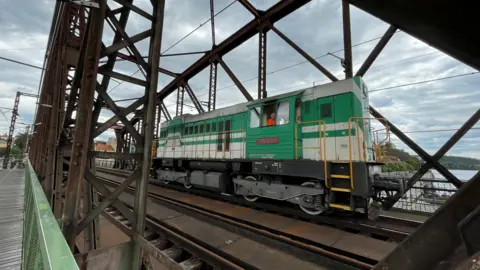
“I think this bridge is absolutely key to Prague,” said architect and bridge engineer, Petr Tej, running his hand over the rust-coated girders of the 123-year-old Vysehrad railway bridge.
“The panorama it forms in conjunction with the Vysehrad fortress behind it is on the same level as the panorama of Charles Bridge with Prague Castle. These two panoramas are – in my view – crucial to Prague, and we need to preserve them,” Tej told the BBC.
Standing on the pedestrian walkway running alongside the rusty steel bridge, we gazed up at the trio of arches that have become an iconic feature of Prague’s southern skyline.

As we talked a train trundled westwards over the river, heading to Prague’s Smichov station, and from there onwards to Karlovy Vary, Pilsen or Germany.
“These bits here are the most impacted by rust,” Petr told me, pointing at a nest of riveted joints and beams.
Petr is part of the Vysehrad Bridge Foundation, an international coalition of experts who’ve restored similar steel bridges around the world – some of them in much worse shape than this one.
They say the Railway Authority’s plan to dismantle this iconic industrial landmark – erected in 1902 during the heyday of the Austro-Hungarian Empire – is entirely unnecessary.
“Previous expert reports said 70% of the steel should be replaced. Our study says it’s only 15%. It’s a huge difference.”
The Foundation’s proposal is simple: repair the bridge in place, keep the trains running, minimising disruption, and save money in the process.
Earlier this year their findings were endorsed by Unesco, which protects much of the historic centre of Prague. They are also backed by over 25,000 residents who have signed a petition demanding the Vysehrad bridge be restored rather than replaced.

A short while later, in the shade of the metal girders, the Director of the Railway Authority’s Construction Preparation Department Pavel Paidar shook his head in disagreement.
“This bridge already handles around three-quarters of Prague’s railway traffic. It could handle more, but because of the corrosion, it can only carry about 60% of its capacity,” Paidar told the BBC.
“With the projected growth in rail travel, that’s going to be a major transport problem. Yes, it’s a protected historical monument, but it’s becoming increasingly clear that it’s simply not possible to reconcile these two things – transport needs and heritage preservation.”
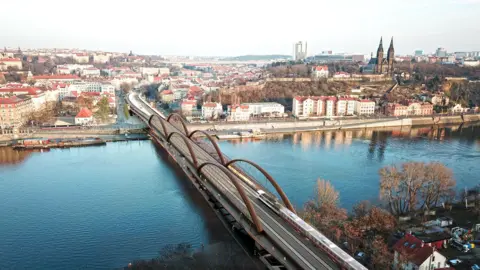
The new bridge would include a third track and, according to visualisations, will be a fair tribute to the original. The whole area will be revitalised, and transport links from Prague’s main station to the west of the country and beyond will be improved.
The old bridge, meanwhile, will be dismantled and moved about 8km (5 miles) south to the district of Modrany, to start a new life as a crossing for pedestrians and cyclists.
 Sprava zeleznic (‘Railway Authority)
That idea too, however, has been criticised by campaigners. The River Vltava at Modrany is about half as wide as in the city centre. An urban railway bridge, they say, will look completely out of place plonked down in the middle of a meadow.
“There’s a mistaken perception that there are two conflicting interests at play here — transport and protecting our cultural heritage,” said Tomas Bistricky, philanthropist and co-founder of the Vysehrad Bridge Foundation, which proposes a second, slender bridge alongside the original to provide the third track.
“But our study shows there’s actually no conflict at all; on the contrary, these two things support each other.”
It’s an age-old dilemma: to tear down in the name of modernity, or to preserve in the name of tradition. It arouses particularly strong emotions in a city which prides itself on its architectural conservation.
Ultimately, and perhaps sooner rather than later, it’s one that will have to be decided not by railway engineers or heritage campaigners, but by the Czech government.


