


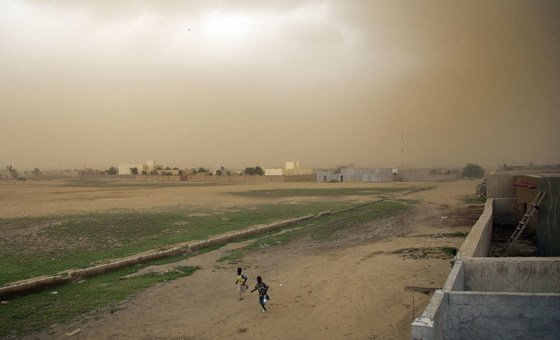
That’s how much sand and dust enters the atmosphere on an annual basis according to the World Meteorological Organization (WMO)’s annual report on the storms which scatter such particles across borders worldwide.
The UN weather agency’s reports warns that while the amount of dust decreased marginally in 2024, the impact on humans and economies is increasing.
WMO estimates that over 330 million people across 150 countries are affected by sand and dust storms, leading to premature deaths and other health consequences in addition to steep economic costs.
More than just a dark sky
“Sand and dust storms do not just mean dirty windows and hazy skies. They harm the health and quality of life of millions of people and cost many millions of dollars,” said Celeste Saulo, the Secretary-General of WMO.
While the movement of sand and dust is a natural weather process, increased land degradation and water mismanagement have, in the past few decades, exacerbated the prevalence and geographic spread.
Dust and sand particles – 80 per cent of which come from North Africa and the Middle East – can be transported thousands of kilometres across borders and oceans.
“What begins in a storm in the Sahara, can darken skies in Europe. What is lifted in Central Asia, can alter air quality in China. The atmosphere does not recognize borders,” said Sara Basart, WMO Scientific Officer, at a briefing in Geneva.
And this is precisely what happened in 2024. Dust and sand from the Western Sahara travelled all the way to Spain’s Canary Islands. And fierce winds and drought in Mongolia brought dust to Beijing and northern China.
Fast-growing challenge
“These extreme weather events are not local anomalies. Sand and dust storms are fast becoming one of the most overlooked yet far-reaching global challenges of our time,” said a senior official on Thursday morning speaking on behalf of Philémon Yang, President of the General Assembly.
The storms can obscure sunlight, altering ecosystems on land and in the ocean. In addition to environmental impacts, these weather occurrences have profound impacts on humans and their economies.
“Once considered seasonal or localised, sand and dust storms have escalated into a persistent and intensifying global hazard,” said Rola Dashti, the co-chair of the UN Coalition on Combating Sand and Dust Storms.
Between 2018-2022, over 3.8 billion people were exposed to dust particles, with the worst-affected regions experiencing dust exposure 87 per cent of the time during that same period.
These particles exacerbate cardiovascular diseases and have other adverse health effects, leading to 7 million premature deaths each year especially among already vulnerable populations.
Mr. Yang referred to this as the “staggering human toll”: from an economic perspective, storms can lead to a 20 per cent reduction in crop production among rural communities, pushing them towards hunger and poverty.
In the Middle East and North Africa alone, economic losses in 2024 as a result of sand and dust storms accounted for 2.5 per cent of the regional GDP.
Can’t go it alone
WMO is calling on the international community to invest more in early warning systems and data tracking.
“No country, no matter how prepared, can face this challenge alone. Sand and dust storms are a trans-boundary threat that demands coordinated, multisectoral and multilateral action,” said Ms. Dashti.
With 2025-2034 declared the Decade on Combating Sand and Dust Storms, Mr. Yang said this should prove a turning point. He urged Member States to move from awareness to action – and fragmentation to coordination.


