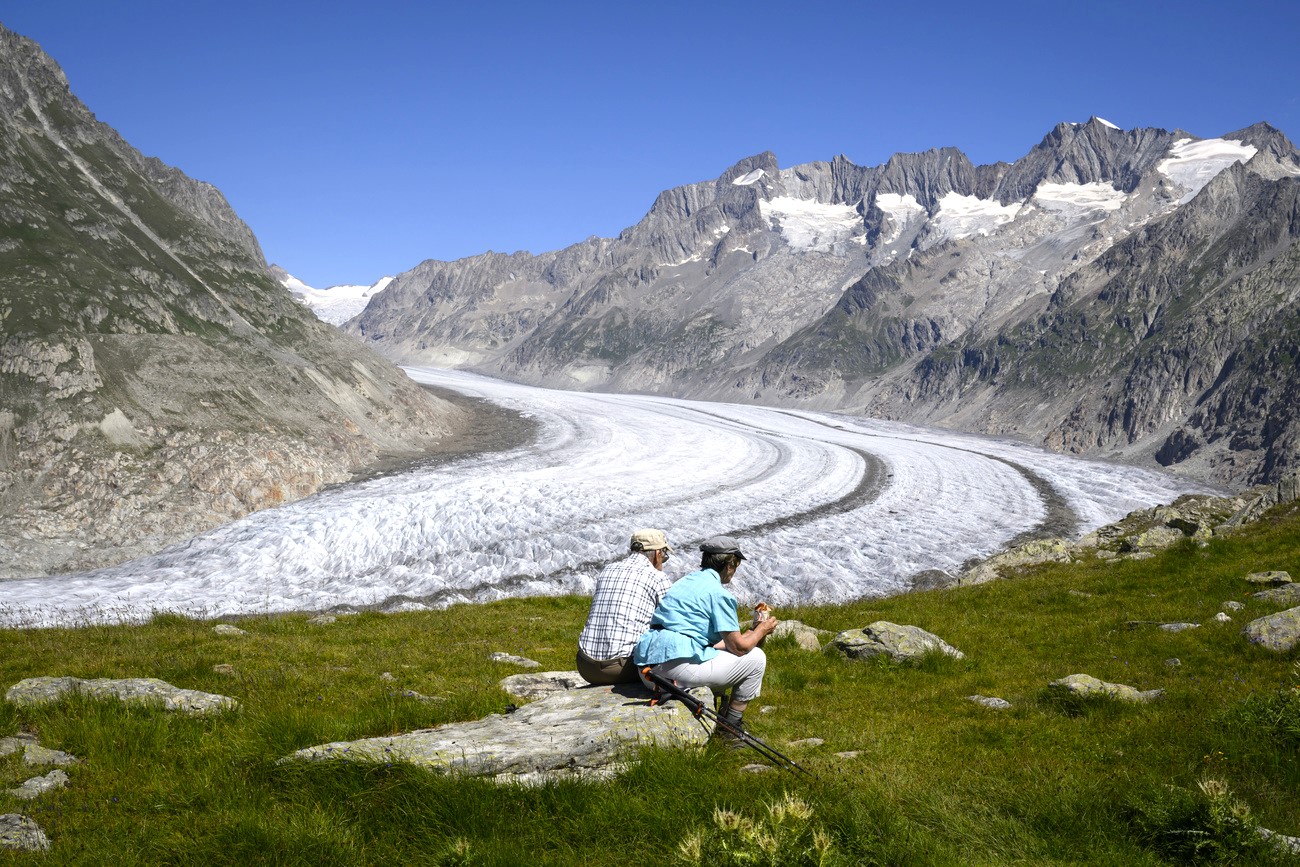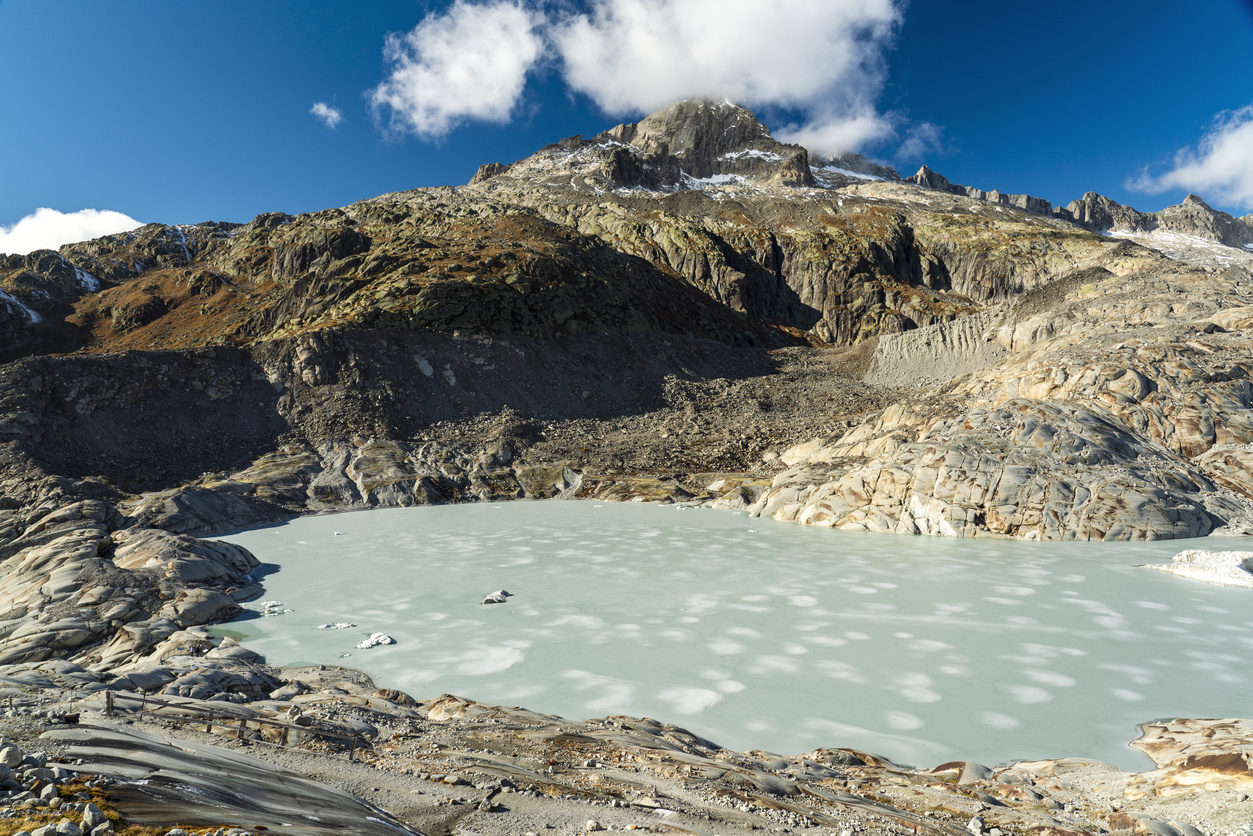
A melted glacier lake in the Swiss Alps.
Westend61 / A. Tamboly
Switzerland is particularly affected by climate change, with average temperatures rising faster than in most other countries. Long-term data shows why that’s the case.


June 2025 was the second-warmest month in SwitzerlandExternal link since temperature measurements began in 1864. Extreme temperatures have also been recorded in other countries, from Europe to the United States. According to early predictions, 2025 is expected to be slightly less warm than last year, the hottest on record. However, there is a strong chance that new records will be set in the coming yearsExternal link, the World Meteorological Organization (WMO) said recently.
The rise in temperatures due to human-caused climate change affects every region of the planet. However, some countries are warming more than others. In Switzerland, climate warming is proceeding twice as fast as the global average, says the Federal Office of Meteorology and Climatology (MeteoSwiss).
Rising temperatures in Switzerland are affecting the population, economic activities and the landscape. Increasingly frequent and intense heat waves pose a serious health risk, especially for the elderly, The heat also jeopardises agricultural harvests. In the mountains, glaciers and permafrost are melting and the risk of natural disasters is on the rise.
>> The thawing of the frozen soil layer known as permafrost will have many consequences for mountain regions:
More

More
Melting permafrost threatens mountain regions. What can be done?
Switzerland is particularly affected by climate change
Warming in Switzerland was especially pronounced between the years 2015 and 2024. This interval ended with the country recording its three warmest years ever (2022, 2023, and 2024). The average temperature in this period was 2.3°C higher than the average from 1951 to 1980.
Switzerland is among the world’s fastest-warming nations, according to United Nations data. Also in this category are the Baltic countries, Russia, Central European countries and Persian Gulf Arab states. Topping the list is a group of ice-covered islands, known as Svalbard, belonging to Norway.
Why is the temperature in Switzerland rising faster than in other countries?
Switzerland is landlocked and cannot benefit from the buffering effect of the oceans, which are able to absorb large amounts of heat. Globally, continents warm more than oceans.
The altitude and morphology of the Alps also play a key role. Snow and ice are melting faster and faster, reducing the land’s ability to reflect sunlight back to space (called the “albedo effect”). Uncovered surfaces, such as soil and rocks released by retreating glaciers, tend to absorb more heat. This accelerates the overall warming of the country.
“The large proportion of mountain regions is among the main factors that explain why Switzerland is warming faster [than other countries],” Aude Untersee, a meteorologist at MeteoSwiss, tells Swissinfo.
>> This video explains how climate change is changing Switzerland:
More


More
The reality of climate change in Switzerland
Temperature rise is most pronounced north of the Alps
Temperatures have risen in all regions of Switzerland. However, since 1864, when the first nationwide measurements were taken, the northern side of the Alps has warmed more than areas to the south.
This is because before 1940, the north of the Alps was characterised by colder and drier winters, Untersee explains. After 1940, these harsh winters became less frequent, and temperature trends north and south of the mountain range were similar.
Regions north of the Alps, which started from colder conditions, thus “caught up” with the south. This has resulted in greater warming in the north (+3°C) than in the south (+2.7°C) over the past 150 years.
Europe is fastest-warming continent
Of the 20 countries and territories most affected by climate change, 15 are in Europe.
The average temperature across Europe in 2024 was 2.4°C higher than the average in the 1951-1980 reference period. The trend in Asia, the Americas and Africa roughly follows the overall global trend, as this graph highlights:
Several factors explain Europe’s record. These include changes in atmospheric circulation, which increase the frequency of heat waves in summer, and the proportion of European territory in the Arctic, the WMO writes in its latest report on the State of Climate in EuropeExternal link.
The Arctic is the fastest-warming region in the worldExternal link. Like in the Alps, melting ice in polar regions exposes darker surfaces that absorb more heat. This creates a vicious cycle that further accelerates warming. Changes in heat and wind distribution can also “trap” warm air in the Arctic region. This is why the Svalbard Islands are the world’s fastest-warming territories.
Paradoxically, some researchers believe that efforts to combat smog may also have contributed to rising temperatures in Europe. Pollutant particles in the atmosphere, or aerosols, block some sunlight and can have a cooling effect on the climate.
In Switzerland, lowland aerosol concentrations have decreased dramatically over the past 60 years, Untersee says. “This has led to a reduction in fog and clouds at low altitudes over the Plateau, resulting in an increase in solar irradiation,” she says.
Temperature records in Switzerland and around the world
It is not only average temperatures that are rising. The highest temperatures reached during the year are also increasing, according to MeteoSwiss, which recently published an assessment of temperature trends since 1971External link. Today, the hottest day of the year averages 3.4°C warmer than 50 years ago.
The highest temperature ever recorded in Switzerland (41.5°C) was measured at the Grono station in the eastern canton of Graubünden in August 2003, according to the MeteoSwiss website. However, the measuring conditions were different from those of today.
Maximiliano Herrera, a Costa Rican climate historian who has been analysing temperature records for more than 35 years, tells Swissinfo that “the 2003 data are not reliable.” The record, he argues, belongs to Geneva, with 39.7 in the summer of 2015.
Whatever the exact figure, the highest value ever recorded in Switzerland is a far cry from the record in Italy – nearly 49°C in Syracuse in 2021 – and especially from the extreme 54.4°C recorded in Death Valley, in the United States, in 2020.
But temperatures in Switzerland will continue to rise faster than elsewhere, and the country will have to adapt to an increasingly different climate than in the past.
>>This short video looks at Switzerland’s top climate-related risks in the coming decades – all heat and drought related.
Edited by Gabe Bullard/vdv/gw