Building density does not necessarily make cities warmer
Keystone-SDA
Generated with artificial intelligence.
High-density building does not necessarily lead to more heat in cities. What matters is how the spaces are organised, says a researcher at the Swiss Federal Institute of Technology Zurich (ETH).
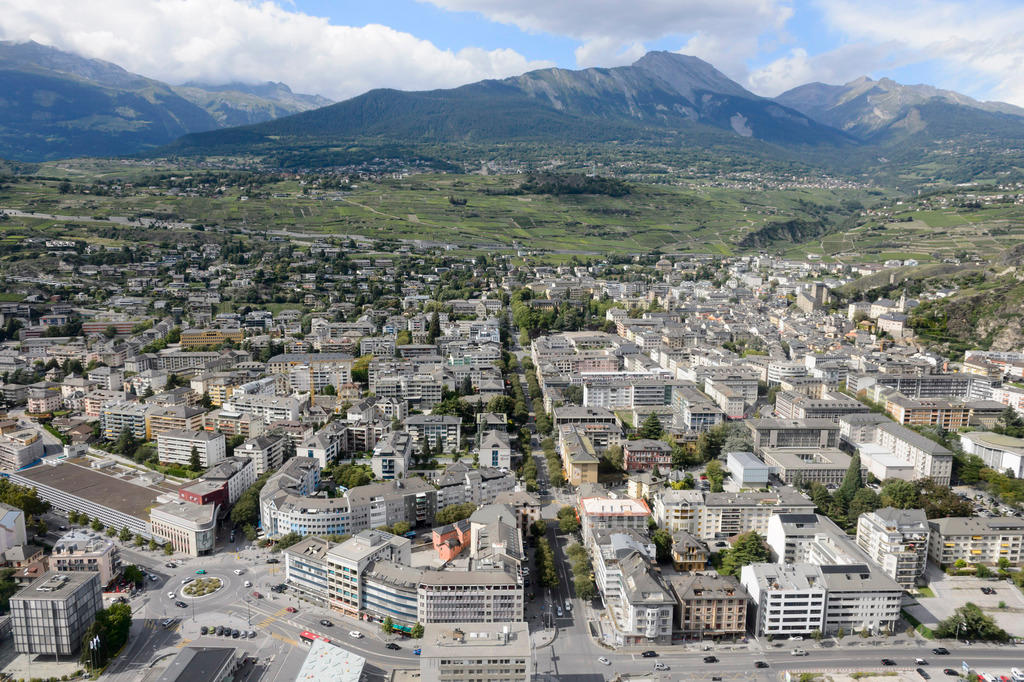
“Densely built-up neighbourhoods with well-placed greenery and lots of trees – as in some areas of Geneva – can be more pleasant than open but less shady and poorly ventilated settlements such as Schönberg in Freiburg,” writes Jan Carmeliet, professor of building physics, in an article published by the university on Thursday.
In the past, densification too often meant more living space at the expense of green space, which reduced thermal comfort and increased the risk of heat stress, Carmeliet says. It is therefore widely believed among urban planners, authorities and researchers that urban densification inevitably leads to higher temperatures.
“I myself conduct research on heat reduction in cities and I think this assumption is wrong,” he adds. “The problem is not density itself, but how we organise it.” In his view, thermal comfort is created through the interaction between the shade provided by buildings and trees, free ventilation and the cooling of vegetation. This interaction requires an integrated approach that takes into account the needs of each neighbourhood, the local climate and the available space and resources.
Densification is necessary to save scarce land. But it must not be at the expense of quality of life. If we build cities that not only offer more living space, but also more shade, air, green space and nature, then densification is not a step backwards, but a sensible key to a climate-resilient future, Carmeliet concludes.
As part of the SWICE project – sponsored by a promotion programme of the Swiss Federal Office of Energy (SFOE) – the heat load of the neighbourhoods of Geneva and Fribourg was analysed and how different greening and densification scenarios affect comfort.
The project comprises six Living Labs, where researchers work together with residents, authorities, property managers and urban planners to develop and test strategies to combat urban heat.
More
More
When a tree is worth more than air conditioning
This content was published on
In Sion, the Swiss city where temperatures have risen the most in recent years, an anti-heat plan has begun transforming how people live.
We select the most relevant news for an international audience and use automatic translation tools to translate them into English. A journalist then reviews the translation for clarity and accuracy before publication.
Providing you with automatically translated news gives us the time to write more in-depth articles. The news stories we select have been written and carefully fact-checked by an external editorial team from news agencies such as Bloomberg or Keystone.
If you have any questions about how we work, write to us at english@swissinfo.ch
More
Euro 2025: Dutch queen cheers on team in Lucerne
This content was published on
Queen Maxima of the Netherlands and her youngest daughter Princess Ariane attended the Netherlands’ women’s European Championship football match against Wales in Switzerland on Saturday.
Man charged with flying drone at women’s Euro 2025
This content was published on
A man flew a drone around the venue on Wednesday evening during the first match of the Women’s EURO 2025 in St. Gallen. The 30-year-old violated the absolute ban on flying during match days. He was reported to the police.
More than 250 Swiss companies sign CO2 reduction initiative
This content was published on
A total of 257 companies from Switzerland have signed up to the Science Based Targets Initiative (SBTi). In doing so, they are committing to CO2 reduction targets that are compatible with the Paris Climate Agreement.
Swiss accident prevention group sees federal targets at risk
This content was published on
The Swiss government’s target for accident figures is at risk, reckons Mario Cavegn, member of the executive board of the Swiss Council for Accident Prevention.
American artist Chaka Khan ‘and friends’ opened the 59th Montreux Jazz Festival on Friday. For over three hours, their show, dedicated to their friend and mentor Quincy Jones, thrilled the audience,