


At the stroke of every hour of the day, tourists look up at the face of the Zytglogge.
Thomas Kern / Swissinfo
A ticking sound has been heard in the middle of Bern’s Old Town for almost 500 years non-stop. It comes from the Zytglogge, a tower boasting one of the very few astronomical clocks in Europe that still works and is fully mechanical.


“Feel the pulsations of the Zytglogge,” says Domenico Bernabei, inviting us to grasp one of the metal bars connected to the gigantic mechanical heart composed of gears, ropes and counterweights. With each tick, you can feel the bar shake.
The Zytglogge, pronounced “tseet-glocker”, is a tower in the centre of the old city of Bern, at the mouth of Kramgasse, the first street around which the Swiss capital grew.
More
More
Why Switzerland hasn’t got a capital city
The building is also the pride of the city, whose historic centre – including the Zytglogge – has been a UNESCO World Heritage Site since 1983. It is probably one of the few buildings on the list that you can pee on: the north wall has a urinal that has been in operation for over 100 years.
This is certainly not the most important quirk associated with the Zytglogge. As the name indicates (Zyt means time, Glogge means clock) the focus is on its clocks, one of which is astronomical.
People who casually pass by and do not know its history and workings may fail to realise how extraordinary the structure is. Even in the gaze of many of the tourists who gather under it at the stroke of the hour, one can sometimes read the disappointment of those who, out of the corner of their eye, only catch a glimpse of the figures’ movements at the last moment.
What makes everything move is a single mechanism that visitors can admire only by appointment. Bernabei is not only one of the city’s guides who accompanies tourists inside the tower, he is also one of the four people in charge of winding up the complicated contraption.
“I don’t know how many people in the world do this job. It’s an honour that Bern bestows on our team,” says Bernabei, who jokes about his Italian surname which contains the name of the city where he was born.
Every day, in turn, the team members turn the crank that lifts the weights that transmit the necessary energy to the machine. Recharging takes place every 27 hours at the most. Unlike other similar works of engineering still in operation, the Zytglogge still works exactly as it did when it was inaugurated in 1530.
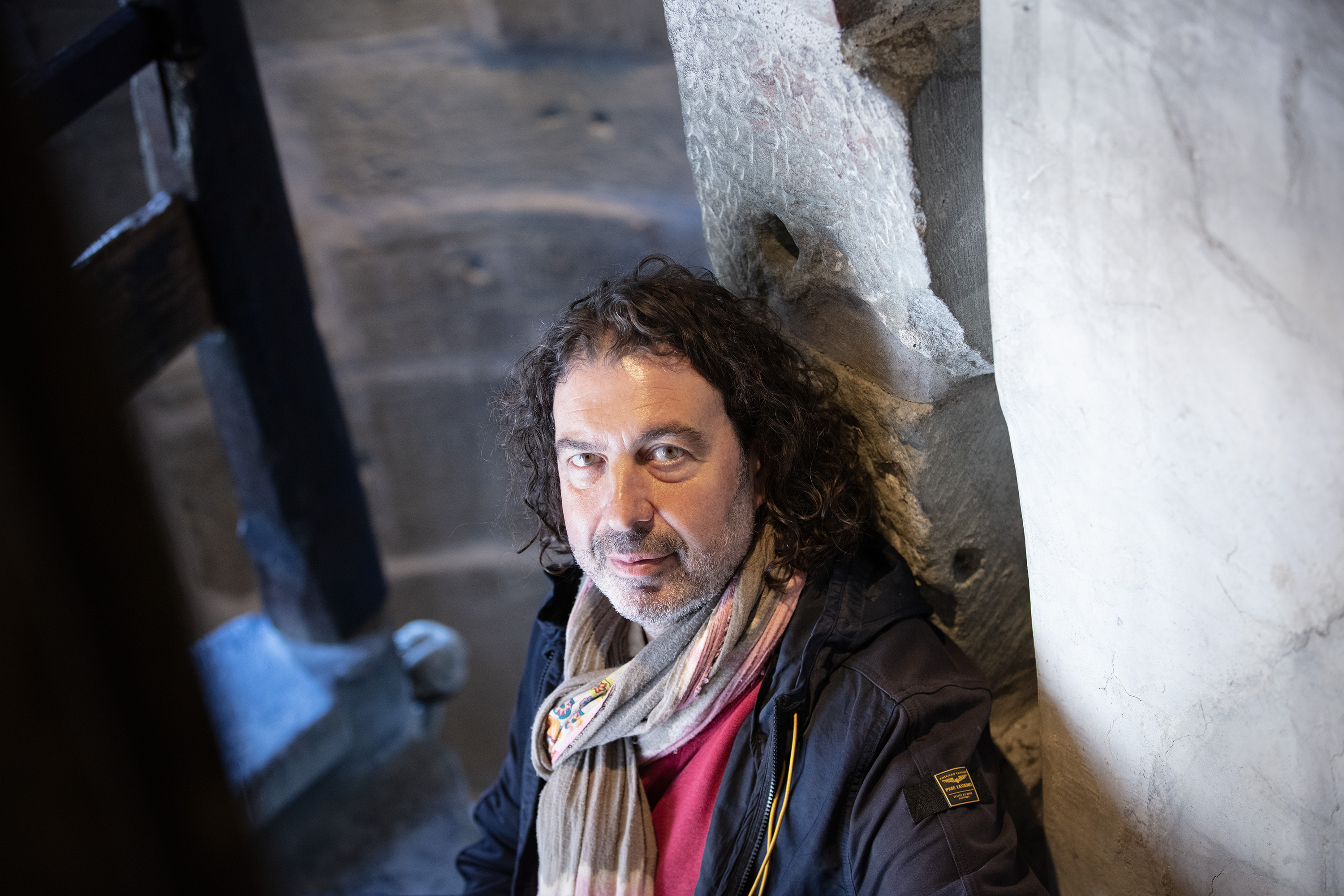
No modern electrical gadgetry to recharge the Zytglogge, just armpower and the dedication of a group of Bernese people. Domenico Bernabei is one of them.
Thomas Kern / Swissinfo
The Nuremberg specialist
At the beginning of the 16th century, Bern was eager to show off its wealth and highlight its detachment from the Catholic Church which, until that period of the Protestant Reformation, pretty much had a monopoly on the timepieces that punctuated the population’s daily life, Bernabei explains. The city therefore decided to commission the construction of a new astronomical clock from… a German (a fact that many Bernese aren’t so keen on).
More

More
Culture stories by SWI swissinfo.ch
The crème de la crème of engineers specialising in the manufacture of such clocks at the time came from Nuremberg. And from there came Kaspar Brunner. For three years he drew, designed, forged, assembled and disassembled his masterpiece several times. He noted meticulously the shape of each individual component, so that in the event of failure, it could easily be remade and replaced.
The result is impressive. That one complicated mechanical heart born from Brunner’s mind moves all these components:
- The large clock at the top of the tower
- The astrolabe on which the time, the moon phases, the date, the day of the week, the sign of the zodiac and the time of sunrise and sunset are indicated
- The arms of the jester, who rings two bells
- The arms and mouth of Chronos who turns the hourglass he holds in his hand and waves his sceptre at each chime
- The rooster that lifts his wings and emits his cry thanks to a bellows that operates a trumpet
- The head of the golden lion to the left of Chronos
- The procession of bears in armour, that rotate as many times as the number of hours (e.g. at 11 o’clock they make 11 complete rotations)
In addition to all this, every quarter of an hour the gears make the large bell ring and move the golden statue of Hans von Tann (generic name in German for the bell-ringer) on the top of the tower. This, however, is a more recent addition, from the 18th century.
The original Zytglogge dates back to the 13th century and was the squat tower that served as the western gateway to the town, but it already had an astronomical clock, more rudimentary than the one that can be seen today.
Returning to the site 100 years later, we would find the building in the centre of the settlement, which had meanwhile expanded westwards. Its function in the 1300s was anything but positive. It was in fact a women’s prison; to be precise the place where women guilty of having sexual relations with members of the clergy served their sentences. The prison, in the upper part of the tower, had no walls to the east and the women were left at the mercy of the elements and the prying eyes of the people.
After the great fire that ravaged Bern in 1405, it was thought that it would be a good idea to turn the building into a watchtower, to detect the beginnings of a fire.
In 1530, the mechanism designed by Kaspar Brunner, which moves the clocks and figures in the carillon, came into operation. It was not until the 18th century, however, that the Zytglogge could be seen in its present form with its spire, whose summit is almost 25 metres high.
As you can imagine, the whole thing is pretty noisy. But even in a country where silence is golden (to the extent that using the washing machine or vacuuming on Sundays is forbidden in many blocks of flats), the Zytglogge is a racket which its neighbours like.
“It rarely happens, but every now and then one of the four of us forgets that he has swapped his usual shift with someone who is on holiday, and the Zytglogge stops,” Bernabei says. “But the great thing is that those who live nearby call us immediately and ask what happened. You can really see that, like the River Aare, it’s a symbol of the city. And it’s something that the people of Bern love.”
And now let’s be carried away for a minute by the ticking mechanical heart of Bern:
More
Edited by Daniele Mariani. Translated from Italian by DeepL/ts


