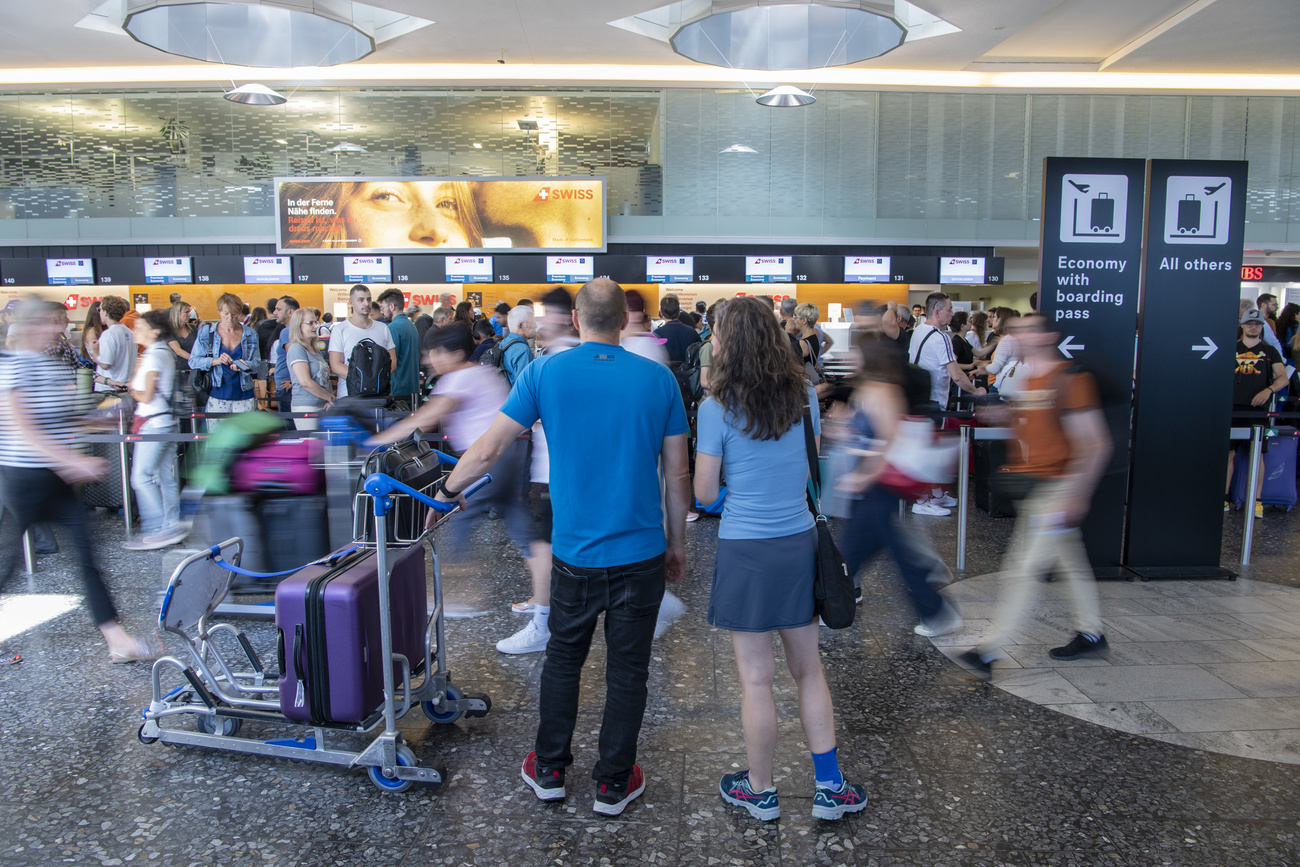
Passengers at the check-in counter at Zurich airport.
Keystone / Ennio Leanza
The number of Swiss nationals travelling and living abroad is increasing resulting in more and more consular protection cases. In an interview with Swissinfo, Yvonne Rohner, head of the Consular Protection Division explains what the most common cases are and clarifies the limits of official support.
Despite the current geopolitical situation, the Swiss haven’t lost their appetite for travel abroad. Every year, they make 12 million foreign trips. In addition, there are 826,700 Swiss nationals with permanent residence abroad and the trend is rising.
Swiss people who love to travel and emigrate mean a lot of work for the foreign ministry. Their helpline received 55,000 requests for assistance in 2024 alone.
More
More
You won’t find any Swiss in these countries
Consular protectionExternal link has become a central service of the Swiss government but within limits. Swiss nationals abroad, whether travelling or residing outside Switzerland, are not legally entitled to support.
Personal responsibility and subsidiarity are enshrined in law. The foreign ministry only gets involved when those affected have done everything reasonable to manage their situation themselves. The Consular Directorate, which is involved in emergency situations together with the respective Swiss representation on the ground, bases its work on the Swiss Abroad ActExternal link.
Swissinfo spoke to Yvonne Rohner, Head of the Consular Protection Department at the Consular Directorate, during a media conference.

Yvonne Rohner, head of the Consular Protection Division.
Keystone / Christian Beutler
Swissinfo: How many employees in Bern take care of consular protection cases in cooperation with the diplomatic missions?
Yvonne Rohner (Y.R): In addition to me, there are four country managers working in Bern who cover the whole world, as well as my deputy, who mainly deals with child abductions.
Swissinfo: Can you give us an insight into an example of a consular protection case that was particularly challenging or worked particularly well?
Y.R: Whenever people are affected, it is very difficult and requires a lot of sensitivity. Child abduction cases, where mothers or fathers have to deal with the pain of separation over a longer period of time, are especially challenging for us. The same applies to deaths of young people.
Last year, we dealt with a case of a young person in Asia who could not be brought back to Switzerland for eight months due to mental health problems that was particularly challenging. We tried intensively with the local authorities, the honorary consul and the assistance in Switzerland to organise a medical repatriation – these are cases that are very time-consuming.
Swissinfo: The foreign ministry only takes action when those affected have tried everything reasonable to overcome their plight themselves in organisational or financial terms. How many cases are we talking about every year?
Y.R: In 2024, the Consular Directorate recorded 1,087 new cases.
Swissinfo: This means an increase of 17% compared to 2023.
Y.R: Switzerland’s demographics show that there are more and more older people. However, they are often still very active and therefore take more trips. However, they suffer medical emergencies abroad more often than younger people. In addition, Swiss nationals who have health problems and are unable to return to Switzerland themselves are repatriated. There is also an increase in travellers or Swiss citizens living abroad who are confronted with mental health problems.
Today’s communication possibilities have also led to an increase in cases. Thanks to global networking, the Swiss are much more likely to worry if they have not heard from their relatives abroad for 24 hours. As a result, we do much more residence research.
More
More
The Swiss Abroad in nine charts
Swissinfo: What are the most common cases that your team faces?
Y.R: Effectively, the number of deaths abroad has increased. This includes both deaths of travellers and older Swiss Abroad who die in their country of residence.
The deaths in the diaspora and the lack of a social network among emigrants mean that the missions abroad are increasingly having to carry out investigations in order to find family members or coordinate funerals.
Swissinfo: Are there geographical hotspots for consular protection cases?
Y.R: Yes, Thailand is one of the hotspots simply because it is a very popular destination for Swiss nationals. In addition, there is an above-average proportion of Swiss senior citizens living in Thailand.
In 2024, 135 cases were opened for Thailand, followed by Spain with 85 cases, Italy with 66 and France with 60 cases.
Swissinfo: Consular protection services are subject to a fee. How much money do Swiss citizens in need pay every year?
Y.R: We don’t have any figures on that. Accounting is handled by the respective foreign missions. The foreign ministry does not charge for up to one hour of work. Also, for example, no fees are charged for assistance in the event of illness or accident, provided that there is full insurance coverage. In such a situation, those affected did not travel negligently.
However, there are long-term assistance cases such as detainees in prisons abroad. Staff visit imprisoned Swiss nationals on the ground, for example and these prison visits will be charged.
Swissinfo: There are limits to consular protection. What are they?
Y.R: When the Swiss representation can and cannot help on the ground is clearly regulated. When providing assistance, the foreign ministry must also respect the sovereignty and legal regime of the host country.
For example, we cannot obtain prison releases, we cannot provide medical care or act as a travel agency if, for example, a flight is cancelled or there is a strike in a country.
Swissinfo: When do you say a clear no?
Y.R: The expectations of the affected persons are sometimes very high. If we can provide support, then of course we are happy to do so, especially in an emergency situation. However, we are always bound by the legal framework..
Edited by Balz Rigendinger. Adapted from German by DeepL/ac