


Targeted tariffs or hot air? Following US President Donald Trump’s pledge to punish Spain with trade measures for not committing to 5 percent defence spending, what does it actually mean for Spain?
US President Donald Trump has publicly threatened to punish Spain with trade measures for not committing to spending 5 percent of its GDP on defence.
Following this week’s Nato summit in the Netherlands, Trump threatened to double tariffs on Spain after Madrid’s refusal to commit to paying 5 percent, promising that “we are going to make them pay twice as much” in order to recoup the difference.
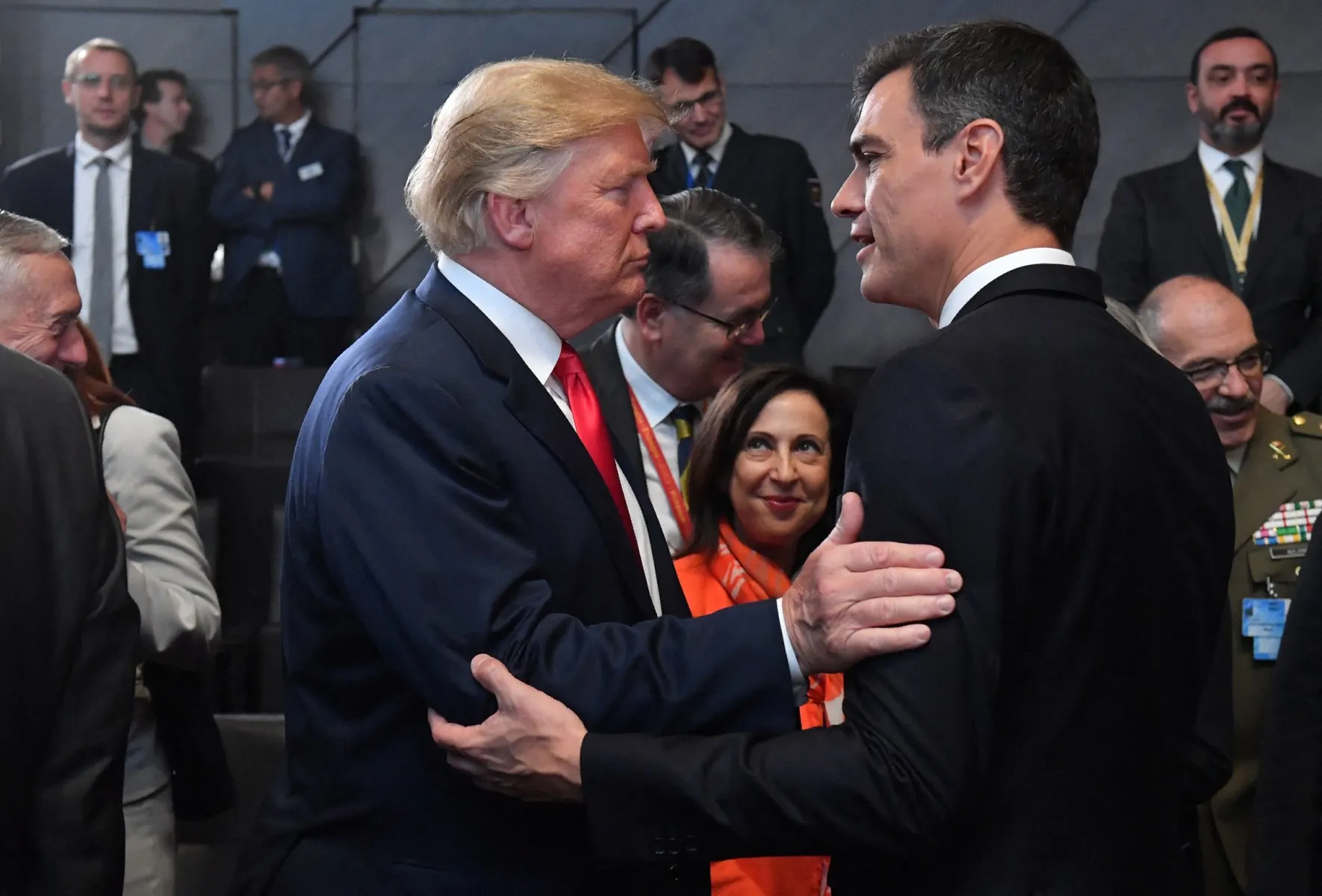
At the summit, Sánchez avoided greeting Trump and in the global leaders’ photo he was conspicuously to the side, appearing isolated.
READ ALSO: Why Spain is against Trump’s 5% Nato spending demands
The outburst is typical of Trump and follows a well-known formula for the US President: threatening tariffs in order to resolve political disputes.
“They’re going to pay double,” Trump said after the summit, referring not to the defence budget commitment, but rather to Spain’s trade bill.
Experts note that, if realised, which is far from certain, the most likely risk would be in sectors that are export-sensitive for Spain, such as agri-food products and pharmaceuticals.
Advertisement
Can Trump actually ‘double’ tariffs on Spain and what impact would it have?
Not in the simple terms Trump puts it, at least. Experts suggest that the US may struggle to actually implement specific tariffs or wider trade measures on Spain without involving other EU member states. In that sense, this may be a war of words rather than an economic showdown.
Sánchez responded to Trump’s threats by rightly reminding him that Spain is a “sovereign” country and that trade policy with any EU member must be agreed with Brussels “on behalf of all member states.”
“Trade negotiations are taking place between the European Commission and the United States,’ Federico Steinberg, senior researcher at the Elcano Royal Institute and Professor at Georgetown University, told El País. That’s why, he added, it is very difficult, if not impossible, to establish trade penalties of any kind that only affect one country.
“If you want to influence Spain, you can impose tariffs on agricultural products such as olive oil or wine,” he said, products which account for a large share of Spanish exports. Last year, for example, Spain exported around €1.2 billion in oils and almost €400 million in wine.
The problem, Steinberg adds, is that the measure would indirectly affect other EU countries such as Italy or France, countries that also export wine and olive oil. In other words: the EU is a trading block and individual countries can’t be singled out for punishment.
Advertisement
Ángel Talavera, chief economist for Europe at Oxford Economics, explained that if penalties were imposed through some special procedure, which is “unlikely,” he notes, it would be specific products with a large share of the Spanish export market in order to apply political pressure, as he did in his first term with olives.
Trump, he adds, “has already shown that he has no qualms about using any mechanism at his disposal to get what he wants.”
READ ALSO: Trump, safety and quality of life – Why so many Americans are moving to Spain
What would it theoretically mean for the Spanish economy?
So say the US did somehow manage to put tariffs on Spain, “the products most exposed would be electrical appliances, machinery and oils,” Talavera says.
Raymond Torres, director of economic analysis at Funcas, agrees that if any punishment-type measures, in whatever form, come to fruition, “they are more likely to be tariffs on specific products, as happened in 2018 with some agri-food products.”
During Trump’s first term, the US imposed special tariffs on olives, and shipments fell significantly during the first two years. In that case, a compensatory effect was achieved because other markets were identified and within a few years the export volume had practically returned to the same levels.
Torres, however, points out to El País that this substitution effect may be more complicated with other products, especially pharmaceuticals, where exports to the US are also very important.
Advertisement
What does it mean for domestic Spanish politics?
Though you might think that Sánchez would want to avoid a clash with the most powerful man in the world, especially one so prone to outbursts and personal vendettas, in reality Trump’s pledges to punish Spain — and the issue of defence spending more widely — may actually strengthen the government.
As The Local has covered extensively this year, Sánchez’s very uncomfortable domestic political context means that the Spanish Prime Minister may actually welcome an international distraction. With his inner-circle engulfed in corruption scandals, Sánchez will likely be grateful for some political oxygen by being abroad and talking about something other than criminal allegations against his government.
READ ALSO: Spain’s PM denies that ruling Socialists are funded by corruption
Crucially, he’s also keen to be seen by his left-wing allies, namely coalition partner Sumar, but also Podemos and Esquerra Republicana de Catalunya, as pushing an anti-Nato stance in order to shore up support and weather the storm of scandals in the face of any potential confidence vote against him.
With the right-wing opposition Popular Party and far-right Vox calling for Sánchez’s resignation, any attempt to topple the Sánchez government in Congress would need support (and votes) from across the spectrum in order to get a majority.
So by publicly challenging Nato and standing up to Trump (however sheepish Sánchez looked at the summit) the Spanish Prime Minister has challenged what the Spanish left would frame as the interventionist military industrial complex. A personal face-off with Trump will give Sánchez extra reward in the eyes of many.
Strangely, Trump could have actually strengthened Sánchez’s standing at home. Whether or not the US can punish the Spanish economy, and in what form, remains to be seen.
READ ALSO: What Trump thinks of Spain (and what Spaniards have said about him)


