


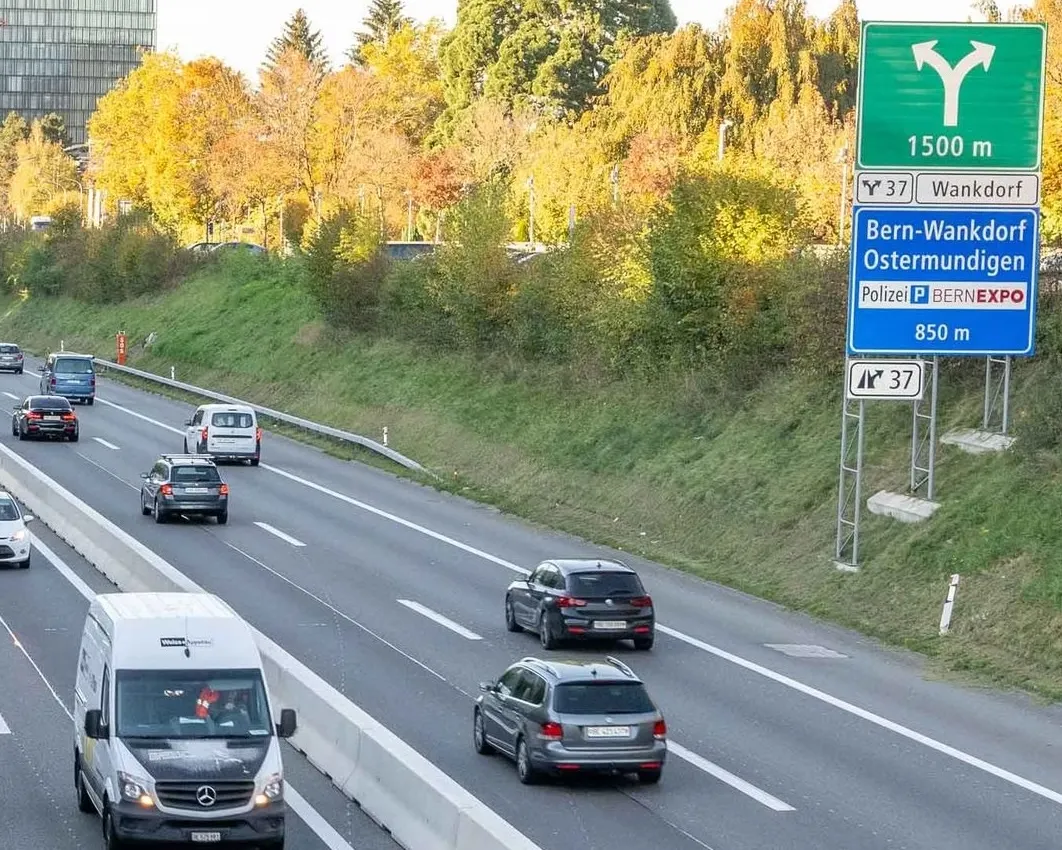
If you ever say to yourself while sitting in your car ‘the traffic is getting increasingly worse,’ you are right: new data confirms that the number of traffic jams in Switzerland has exploded in recent years.
In 2024 alone, motorists travelled a total of 29.8 billion kilometres on Swiss motorways: the vast majority —25 billion kilometres — are attributable to passenger cars. That is 0.6 percent more than during the previous year.
This is what emerges from a new report published by the Federal Roads Office (ASTRA) on June 17th.
And even though they represent only about 3 percent of Switzerland’s entire road network, motorways accounted for more than 40 percent of traffic jams in 2024.
“Nearly 87 percent of these traffic jams were due to traffic congestion, and only about 4 percent to construction sites,” ASTRA pointed out, adding that “regions with heavy commuter traffic were particularly affected.”
These are primarily areas around major urban centres and along major transit routes.
Typically, Zurich and the A1 motorway are notorious for heavy traffic, as is the Gotthard Tunnel road, especially on long weekends and national holidays.
Motorists driving on the A2 motorway, which connects Basel to Chiasso, are also no strangers to bottlenecks.
What plans does ASTRA have to improve the traffic flow?
To address and situation, ASTRA is planning “targeted measures based on network maintenance and traffic management using intelligent systems.”
How exactly will this work?
“Intelligent systems, which allow for speed adjustments and temporary opening of the hard shoulder to traffic, are already being successfully implemented in many locations, for example, between Bern-Wankdorf and Muri since August 2024,” ASTRA said.
“They contribute to better use of available infrastructure, improved road safety, and smoother traffic flow.”
Advertisement
But there is more
There are also plans to relieve congestion in areas where traffic volumes are increasing particularly sharply and where bottlenecks occur repeatedly.
This is already the case since the opening of the third tube in the Gubrist Tunnel, which lies to the northwest of the city of Zürich, and forms a part of the A1 motorway.
The third thoroughfare “has reduced the number of hours of traffic jams in the direction of Bern from around 1,400 in 2023 to around 150 in 2024,” according to ASTRA.
In terms of future plans, the Swiss Federal Institute of Technology (ETH) in Zurich is currently reviewing all planned road and rail development projects on behalf of the Federal Transport Office.
The results, expected in the third quarter of 2025, will serve as a basis for future transport policy decisions.
Advertisement
Will all these measures be sufficient to reduce traffic and congestion on motorways?
Only future will tell, but there is at least one development on the horizon that is likely to increase traffic in Switzerland.
Significantly more trucks that previously transited through Switzerland’s ‘Rolling Motorway’ are expected to be on Swiss roads.
That’s because RAlpin, a company that operated the truck-to-train service since the 1960s and saw up to 80,000 lorries per year switch from road to rail on certain sections of the Swiss Alps — will close in 2026.
As a result of this measure, significantly more trucks are expected to be on Swiss roads.
This will not only generate heavier traffic, but will also result in more pollution in the mountain communities, though the extent of this damage can’t be quantified at this time.
READ ALSO: Switzerland’s ‘Rolling Motorway’ to close


