


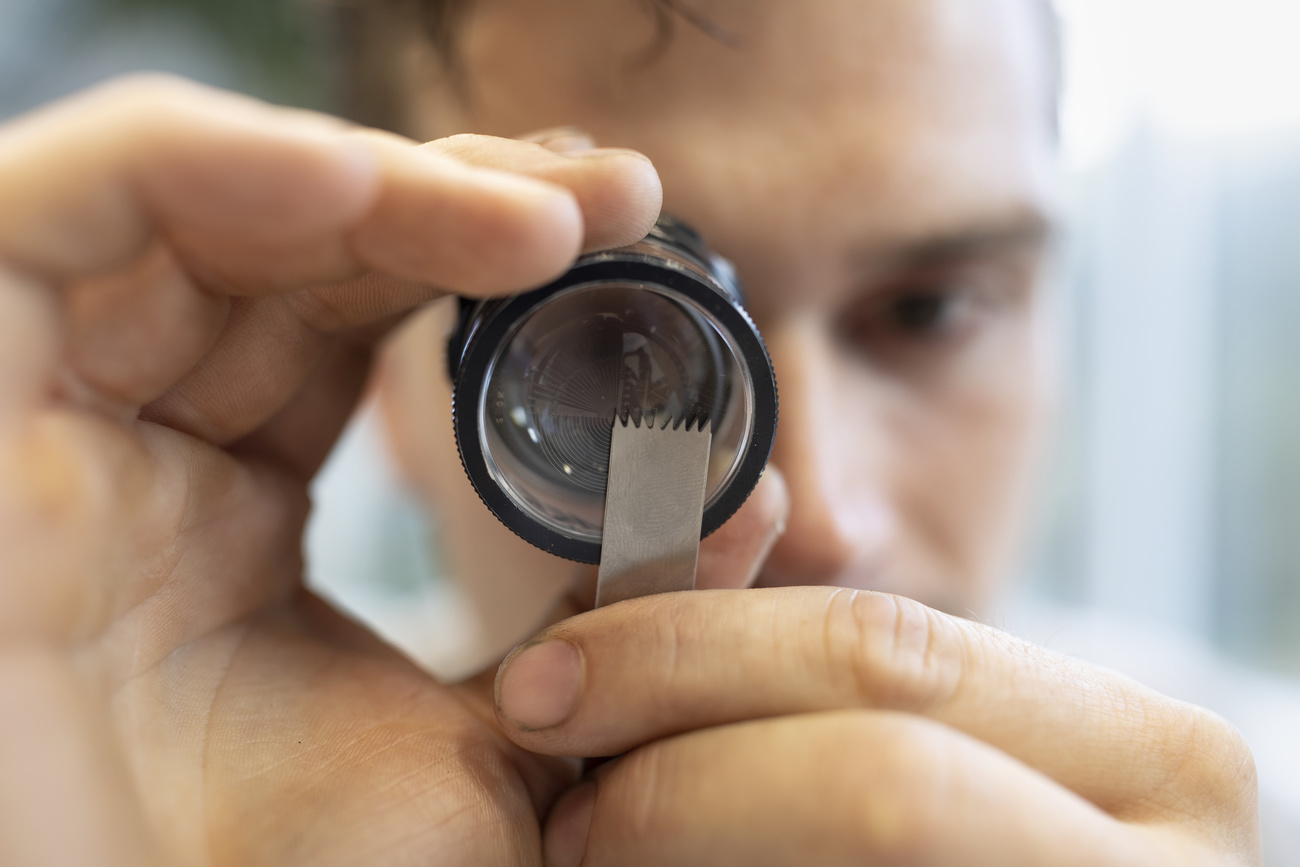
An employee checks an oscillating surgical saw blade at one of the leading manufacturers of products for bone surgery, Gomina, in canton Valais. Switzerland has a high density of medical device companies.
Keystone
Swiss-made insulin pens and orthopaedic implants are being caught in the crosshairs of global trade tensions, but the effects of tariffs on the industry is still unclear.

They might not develop blockbuster drugs or dominate headlines like pharma giants Novartis and Roche, but thousands of little-known medical device companies quietly power global healthcare from Switzerland. From screws for orthopaedic implants to precision tools for surgery, medical devices are used for diagnosis, prevention, monitoring, and treatment.
“Switzerland has a very favourable labour framework that allows companies to really innovate, thanks to universities that systematically rank in the global top ten and the presence of big corporate entities that either have working offices or headquarters in the country,” says Andrea Biasucci, CEO of Confinis, a consulting firm in the field of medical devices. In 2023, 1,400 medical equipment companies were active in Switzerland, a very high density of players in a small country, according to the expert.
But medical device manufacturers in Switzerland are currently unclear on future costs, as they await to hear the extent of tariff hikes on Swiss exports to the US. Switzerland was initially subject to a 31% import tax, announced among a series of retaliatory tariffs presented by US president Donald Trump on April 2 – a rate much higher than the original 20% announced for the European Union block. A week later, the American president backtracked and suspended more consequent reciprocal taxes for Switzerland and the EU, until July 9.
More
More
US tariffs pressure Swiss pharma powerhouse
“It is a frightening moment, because Switzerland is expensive and it’s a small country, so you can’t scale your production as much as competitors. A 31% tariff would basically kill the chances of companies to sell in the US,” said Biasucci.
Tariffs of 10% are currently applied to Swiss and European goods entering the US, and while they are problematic, they are not yet a huge problem, according to the consultant. But with Trump regularly changing his mind, including threatening the EU bloc with 50% tariffs on all goods as recently as last week, the future remains uncertain for the industry.
A ‘highly complex’ supply chain
While the EU remains Switzerland’s biggest market, 23% of the 500,000 medical devices manufactured in the country are exported to North America – mostly the US. In 2024, Switzerland exported CHF2.8 billion ($3.3 billion) worth of medical goods to the US. A 31% tariff would cost manufacturers, buyers or customers more than CHF800 million ($950 million).
“It’s very clear if you have tariffs that it will basically be a hindrance for free trade because somebody has to pick up that tab,” says Daniel Delfosse, vice director at Swiss Medtech, the national industry association representing Switzerland’s medical technology sector.
Additionally, medical devices have highly complex, cross-border value chains, according to the trade association MedTech Europe, which echoes American medical device associations’External link concerns regarding tariffs.
For an ordinary medical infusion pump manufactured in the US, parts ranging from electronics to resins can be sourced from suppliers in over 20 countries, including the US, Mexico, Costa Rica, Germany, China, Hungary, India, and Italy, a recent Financial Times articleExternal link found. In Europe, parts for medical devices are sourced from over 4,000 manufacturers in over 40 countries.
“We can get hit by tariffs not once but multiple times,” Medtech Europe’s director general, Jesús Rueda Rodríguez, told the Washington PostExternal link, highlighting that tariffs would affect manufacturers across the globe.
Medical device giants and competitors in the field of CT scan equipment such as German multinational spinoff Siemens HealthineersExternal link, Dutch manufacturer PhilippsExternal link, and American giant GE HealthCareExternal link, have all cut their 2025 forecast because of tariffs according to announcements made in earnings calls last month.
Injection pens
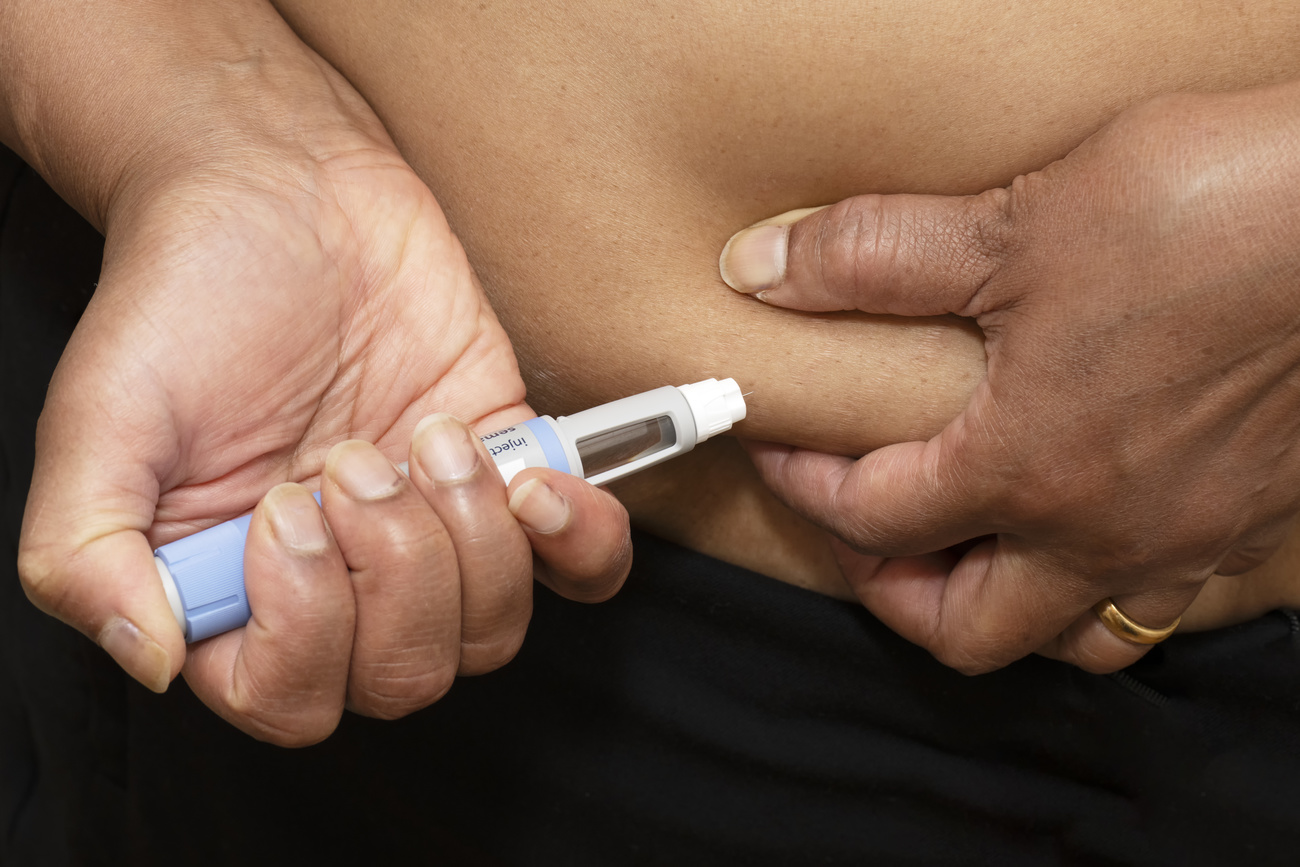
A medical device which has garnered considerable attention over the last year is injection pens, used every day by millions of patients for weight loss, insulin shots and fertility treatments.
Switzerland has positioned itself as a leader in the production of these devices, with 177 of the 612 global manufacturers within its borders – the highest number globally for injection pen parts, according to supply chain risk consultancy, Sphera.
Ypsomed, headquartered in canton Solothurn and one of the leaders in the field of injection pens, says “they are not directly affected by the current developments regarding US import tariffs” because they sell the pens to businesses in Europe and Asia directly from their factories in Switzerland and Germany. Only 10% of the company’s goods are exported directly to customers in the US.
More
More
Swiss regulator and media clash over weight-loss drugs
Ypsomed customers – which include the likes of NovoNordisk, the manufacturer of weight loss and diabetes drugs Ozempic and Wegovy – are the ones responsible for the control of the supply chain, including the filling of pens, according to a spokesperson.
In a first quarter media conference, the Danish group’s executive vice president and chief financial officer Karsten Munk Knudsen, said recently announced tariffs didn’t materially change their 2025 financial outlook, but a “potential expansion” could have a negative impact on the company and its industry. He did not say how the company’s supply chain would be affected.
Production moves and tariff exemptions
Experts consider the best way to avoid erratic tariffs, is to move production to the US, but the move needs to be anticipated, as Ypsomed competitor SHL MedicalExternal link and dental implant producer Straumann have done. With four production sites in North America, we are already benefiting from our broad global production network. “A large part of our solutions sold in the US are already produced in the US,” a Straumann spokesperson said. The company inaugurated its North American headquarters, its first production site outside Switzerland, in 2005 in Massachusetts.
But moving production to the US isn’t feasible for micro or smaller medical device companies, which account for over 90% of the Swiss sector. “If you no longer want to produce in Switzerland but in the United States, you can’t shift that quickly,” says Delfosse, in reference to the US Food and Drug Administration (FDA) approvals necessary to put a device on the market. Clearance takes four to six months, depending on the complexity of the device.
More
More
How Trump’s attack on diversity could derail drug development in Switzerland
While Straumann hasn’t detailed how long it took them to open their US-based plants, other European companies active in medical technologies have taken between a year to three years to move or open production facilities in the US.
“If you already have manufacturing facilities in the US, it’ll be quicker, but most of the SMEs do not have that possibility, so it’s not as easy as saying ‘OK, let’s move production into the US’.”
Other companies are betting on the 1976 Nairobi Protocol to circumvent tariffs. That’s the case of SonovaExternal link, one of the most important manufacturers of hearing aid solutions, that produces its devices in China, Vietnam and Switzerland. The international agreement grants duty-free treatment for devices for disabled people, including audiovisual aids, braille equipment, and specialised medical devices used in educational settings. According to the US Federal RegisterExternal link and the US Customs and Border Protection agencyExternal link, medical equipment continues to be exempt from tariffs.
A complicated shift to implement
“These tariffs are meant to create jobs in the US and discourage production elsewhere, but for a highly skilled market like Switzerland’s precision medical device market, this may be complex to implement,” says Biasucci. Even if they are an essential part of the supply chain, manufacturers unable to limit the impact of tariffs will inevitably have to reduce their margins to keep device prices unchanged, or risk passing the hike onto buyers or patients.
In a bid to soften the US stance, Switzerland said it was opening its market to medical devices that have FDA approval. Only equipment compliant with European regulations are currently sold in Switzerland. This means that devices developed and manufactured in the country to be exported to the US cannot be sold in Switzerland.
“Our number one goal right now is for tariffs to be as low as possible,” says Delfosse from Medtech, which has been campaigning for this policy change.
Edited by Virginie Mangin/ac


