


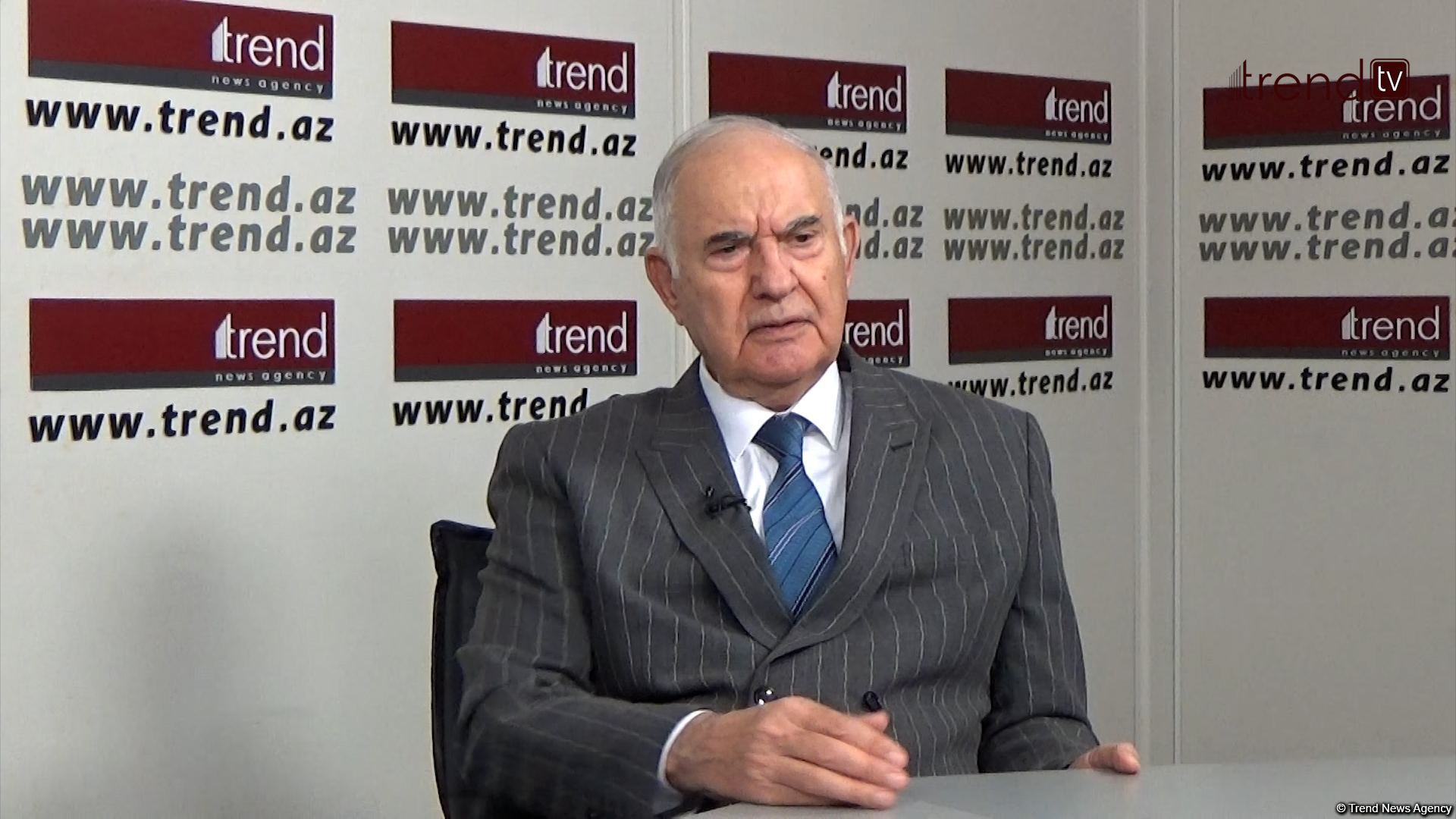
BAKU, Azerbaijan, June 11. Shifting dynamics
in global transport, rising geopolitical tensions, and energy
security concerns have amplified the strategic importance of the
Trans-Caspian International Transport Route (TITR), also known as
the Middle Corridor, political analyst Azer Garayev told Trend.
“This route is not just a rival to northern and southern
corridors—it’s a transformative force across the geoeconomic map.
Its development will undoubtedly spur economic growth in every
country along the corridor.
Connecting China to Europe via Kazakhstan, the Caspian Sea,
Azerbaijan, Georgia, Türkiye, and European markets, the Middle
Corridor offers an integrated multimodal route that blends
maritime, rail, and road networks. The corridor provides a faster
and more secure alternative to the traditional Northern and
Southern transit routes connecting Western China to Europe.
Logistical challenges along the Northern Corridor—particularly
in the aftermath of the Russia-Ukraine conflict—have significantly
elevated the strategic relevance of the Middle Corridor. In this
shifting landscape, Azerbaijan is emerging as the principal driving
force behind the corridor’s development. Beyond its favorable
geographic position, Baku plays a leading role through strong
political commitment, robust economic capabilities, and sustained
investment in transport infrastructure,” he said.
Garayev also highlighted Azerbaijan’s proactive role in regional
logistics, referencing major infrastructures.
“Historically situated at the crossroads of the Silk Road, our
country continues to uphold its strategic importance in the modern
era. In recent years, infrastructure projects spearheaded by
President Ilham Aliyev — including the Baku-Tbilisi-Kars railway,
the Alat International Sea Trade Port, and upgraded rail and
highway networks — have positioned Azerbaijan as the ‘beating
heart’ of the Middle Corridor,” he noted.
Addressing the latest regional developments, Garayev highlighted
the recent inauguration of the “Poti TransTerminal” in Georgia’s
Poti Port, describing it as a significant milestone in the
continued expansion of the Middle Corridor’s logistics
capacity.
“The inauguration was attended by official representatives from
Azerbaijan, Georgia, Kazakhstan, and Uzbekistan. The design,
construction, and oversight of the terminal were carried out by the
Azerbaijani company ZAO INNOPRO. This alone underscores
Azerbaijan’s active role in the development of the corridor and its
contribution to the region in both technological and engineering
spheres. The new terminal in Georgia’s Port of Poti is poised to
become a critical hub for redirecting cargo flows more efficiently
across the Black Sea. He added that Georgia’s role in this process
creates new pathways for Azerbaijan’s westward connectivity.
The successful functioning of the Middle Corridor hinges not
only on physical infrastructure but also on strong political and
economic coordination. In this context, the regional cooperation
framework formed between Azerbaijan, Kazakhstan, Georgia, and
Uzbekistan in recent years has become strategically vital. Since
2022, these countries have established coordination councils and
introduced initiatives such as tariff harmonization, simplified
customs procedures, digitalization, and the implementation of a
‘single window’ system. Azerbaijan acts as both a key initiator and
a principal implementer of these efforts,” he said.
The political analyst also highlighted that over the past 15
years, the Azerbaijani government has made substantial investments
to enhance the Middle Corridor’s transit capacity. The next
strategic phase, he said, is the realization of the Zangezur
Corridor, which will not only strengthen the route further but also
provide a direct link through Armenia to Nakhchivan and on to
Türkiye.
“The Zangezur Corridor is not merely a transportation
initiative, but also a political and economic integration project.
Once operational, it will make the southern branch of the Middle
Corridor more functional and consolidate Azerbaijan’s position as a
regional logistics leader.
Moreover, the deepening of transport and energy cooperation
under the strategic partnership between the European Union (EU) and
Azerbaijan has elevated the importance of the Middle Corridor as a
key route for delivering both energy resources and commercial cargo
to Europe. The European Commission is providing financial and
technical support for the corridor’s digitalization, the deployment
of green technologies, and the development of high-speed logistics
platforms. This also reflects Azerbaijan’s expanding role in
international cooperation frameworks,” he added.
Garayev noted that maintaining the Middle Corridor’s
competitiveness in the future depends on three critical areas:
digitalization, sustainability, and innovation.
“The Middle Corridor is no longer just a transportation route—it
has evolved into a political, economic, and geostrategic platform.
Azerbaijan serves as both the ‘brain’ and the ‘heart’ of this
corridor. The ongoing initiatives and international partnerships
demonstrate that Azerbaijan is becoming a major transport and
logistics hub not only for the region, but for the wider Eurasian
landscape,” he concluded.
Stay up-to-date with more news on Trend News
Agency’s WhatsApp channel


