


A massive glacier in southern Switzerland collapsed on Wednesday, with the debris burying a village and blocking a river, leading to ongoing concerns of flooding in the area. What do we know so far?
On Wednesday the Birch Glacier in Switzerland’s southern Wallis region collapsed, sending tonnes of rock, ice and scree hurtling down the mountain slope and into the valley below.
The barrage largely destroyed the village of Blatten, the highest in the valley, which had been home to 300 people and was evacuated last week due to the impending danger.
How did it all start?
The 3,800-metre-high Kleiner Nestorn, which sat above the now-collapsed glacier, crumbled, depositing around nine million tonnes of debris on the Birch Glacier and a lot of pressure. This led to all of the 300 residents of Blatten being evacuated last week.
How much of the village was destroyed?
Almost 90 percent of the village – including over 130 houses – was buried by debris and ice from the collapsed glacier. According to the Swiss Seismological Service, the debris and ice avalanche registered 3.1 on the Richter scale, usually used for earthquakes. People can generally feel an earthquake when it registers over 3.0 on the scale.
The few houses that weren’t destroyed on Wednesday are now under water as the village has flooded due to a build-up of debris blocking the Lonza River.
Are there any missing people?
A 64-year-old local local, who’d been in the affected area, remained reported missing on Thursday.
A search and rescue operation was launched on Wednesday, with three rescue specialists airlifted to the scene, while a drone with a thermal imaging camera was also used.
“Despite significant efforts, the man has still not been found,” police said on Wednesday.
Advertisement
When can clean-up work begin?
We don’t know yet as the situation remains unstable. Although experts believe that most of the debris came down with the landslide, there are still “significant instabilities” on the Kleiner Nesthorn.
Raphaël Mayoraz, a natural hazards expert for the canton of Wallis, says several hundred thousand cubic metres of rock are affected and there is a risk of mudslides on both sides of the valley.
The threat of further rockfalls also means that the army is currently unable to enter the landslide area. But operational preparations near the site are being ramped up.
The army has also been preparing water pumps, excavators, and other heavy-duty clearance equipment, since Wednesday, while the Air Force is also on standby.
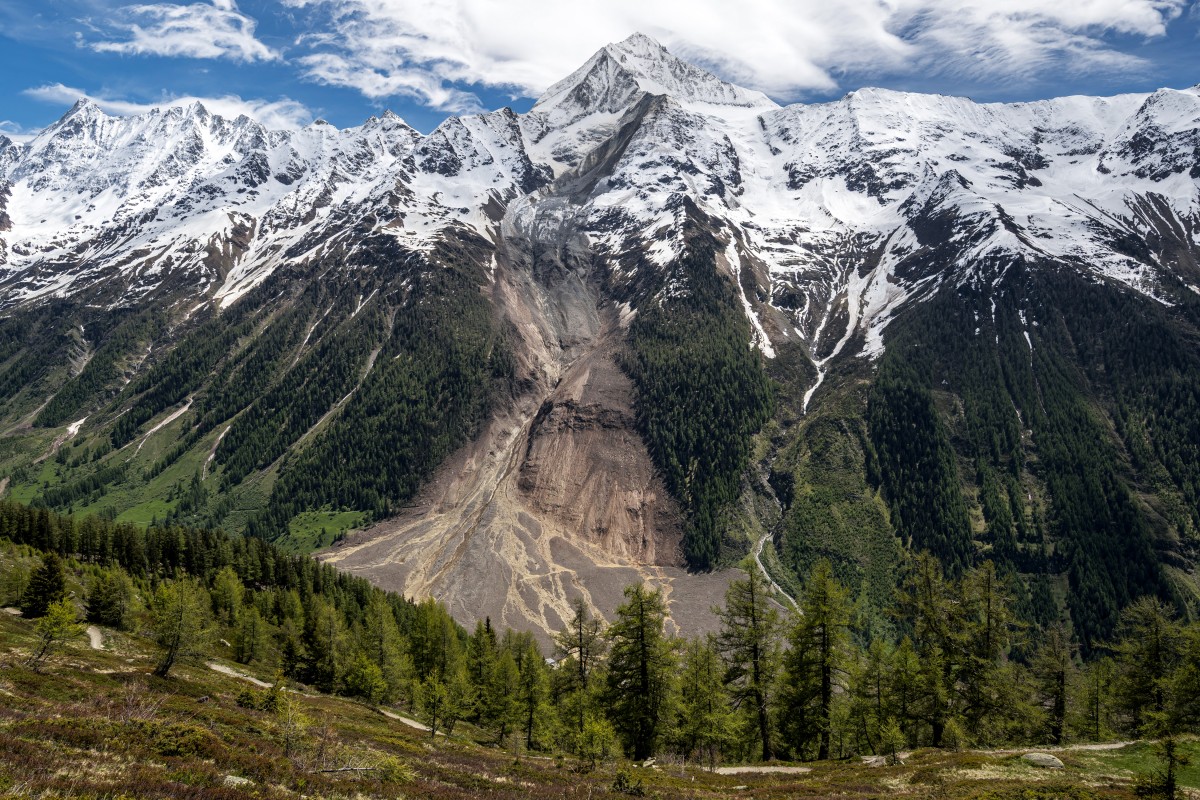
This photograph taken above Wiler shows the Bietschhorn mountain in the Swiss Alps after part of the huge Birch Glacier collapsed the day before and destroyed the small village of Blatten, on May 29, 2025. (Photo by FABRICE COFFRINI / AFP)
What about flooding?
The Lonza River has flooded much of Blatten village. The villages of Wiler and Kippel, which are below Blatten, are also being evacuated due to the flood risk.
Officials are monitoring the situation continuously, but it’s difficult to estimate the water flow as the measuring station in the village was destroyed by the glacier collapse.
READ ALSO: Concerns over flooding after Swiss glacier collapse
“There is a serious risk of an ice jam that could flood the valley below,” Antoine Jacquod, a military security official for the Canton of Wallis, told Keystone-ATS news agency said, referring to the vast mounds of rocks, ice, and earth blocking the Lonza River, which flows to the floor of the Lötschental Valley.
Advertisement
There are also concerns that expected warmer weather will thaw the ice, exacerbating the situation.
How often do events like this occur?
Not that often. Mayoraz said the glacier collapse and mudslide was historically unprecedented.
In 1986, a landslide buried the villages of Lauerz and Goldau in the Swiss canton of Schwyz.
And in August 2017, approximately 3.1 million cubic metres of rock fell from Pizzo Cengalo, a mountain in the Alps in Graubuenden canton, near the Italian border, claiming the lives of eight hikers. Mudslides extended four kilometres.
And in Brienz, in Bern, which saw a landslide in 2023, the situation remains unstable. The village was evacuated before the collapse occurred but residents are still only allowed in their homes during the day due to the ongoing danger.
Advertisement
Are we seeing more of these events in Switzerland?
Yes and no. There hasn’t been an increase in major events (such as this week’s glacier collapse) in the last few decades, but we are seeing more serious events, such as debris flows and rockfalls, since the 1990s, Simon Löw, Professor Emeritus in the Department of Earth Sciences at ETH Zurich, said on Swiss Radio.
Experts believe that the changes we’re seeing in high up mountains can be put down to climate change with the path for the next few years now set, to a certain extent.
“The heat has already set in, and the thawing and melting will inevitably continue,” Jan Beutel, a professor of computer engineering at the University of Innsbruck said in a press release, reported on by Austrian daily Der Standard.
Swiss glaciers, severely impacted by climate change, melted as much in 2022 and 2023 as between 1960 and 1990, losing in total about 10 percent of their volume.


